Sub-Total: $0.00
Crowley Lake – a unique fishing destination
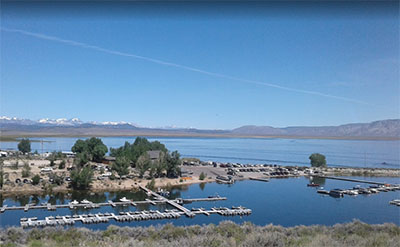
Directions: Hwy. 395. 10 miles east of Mammoth Lakes at an elevation of 6,720 feet. This eastern Sierra reservoir, created in 1941, has 45 miles of shoreline and is located 28 miles north of Bishop, and 15 miles southeast of Mammoth Lakes. | ||
Fish Report: Crowley Lake
| ||
Notes:
The FishThere are four types of Rainbows in the lake: Coleman, Kamloop, Eaglelake, and Hofer, along with Lahontan cutthroat and Brown trout. Crowley once held the state record for Browns at 25 lbs. Now, it is the large Rainbow strains that give Crowley a long and unique fly fishing season. According to Curt Milliron, fishery biologist at DFG’s Bishop Station from a study he did in 1999, “The three strains really complement each other, the Kamloops are a good shallow-water fish, and the shore-anglers get a lot of these early, but they are also running into the tributaries and spawning at the time of the opening weeks of the season. So, as those fish come back and recover, they give a second bump to the fishery in June and July. You’ll notice the Kamloops from their aerial leaps and aggressive runs. The Coleman fish are fall spawners, so they are in deeper water for the opener. They are pelagic fish, so the trollers get into a lot of these fish in the middle of the lake.” The Coleman also do not holdover very well with only a 4% success rate. Milliron also said the Eagle Lake trout spawn in the spring, but noted that even the smaller ones don’t get caught early. “They tend to show up in July. They also have a great capacity to survive for more than one year, and they provide a lot of the larger fish that people catch. They probably survive 10 times better than the Kamloops or Coleman fish. These often show up as 2 1/2-pounders or larger fish the following year”. The Eagle Lake trout have large spots, big shoulders and a small head for a classic “football” shape. The Eagle Lake Trout and the Lahonton Cutthroat are the only trout native to the Eastern Sierra. Hot Creek Hatchery plants 15,000 to 30,000 Lahonton Cutthroats each year in the 6-10″ size. Some now reach 18″ in the lake. During the Fall, many of the larger fish provide a lot of the action. These fish are either the wild fish spawned from Crowley’s tributaries or holdovers from the previous year’s stocking. Two types of Browns are planted within Crowley, the Scottish “Loch Levens” and the Germanic ” Von Behrs”. The Hot Creek Hatchery has planted 50,000 Brown fingerlings in the 6″-10″ size into Crowley Lake since 2008 annually. These are triploid trout so they cannot reproduce but they do grow to a large size quickly. Sacramento Perch were introduced illegally in the early 1960’s and the State Record of 3 lb.s 10 oz was caught at Crowley. About 400,000 Rainbows are planted in the Spring, usually consisting of 100,000 Kamloops, 150,000 Eagle Lake Strain, and 150,000 Coleman Strain. Another 50,000 are planted in the fall near the season end. Many of these will holdover for the following Spring. Unfortunately, the study that Milliron did in 1999 has not been continued and some changes have occurred to Crowley Lake. The catch rate decreased significantly after 2015. A lot of that decrease had to do with the drought years from 2012 to 2016 where the declining shoreline exposed many of the midge larvae areas. CDFW also lost the brood stock reservoir for their Kamloop strain program at Junction Reservoir from the drought. In addition, Lactococcus bacterial infections closed Mojave River Hatchery, Black Rock Hatchery, and Fish Springs Hatchery forcing the euthanization of 3.2 million trout in 2020. The planting of trout in Crowley Lake decreased each year following 2019 (457.494 trout) to 2021 (294,705 trout). Inflation or costs have gone up so that the hatcheries produce fewer fish today due to higher costs. However, 2024 was an exceptional water year and brought lake levels to their maximum levels. The Kamloop program was reinstated at Junction Reservoir and DFWS resumed planting over 450,000 trout in the Fall of 2023 with catch rates now similar to those of better years. In addition to the Kamloop, Coleman, and Eagle Lake strains, a fourth rainbow strain, the Hofer rainbow, has been added due to its ability to withstand Whirling Disease. The Hofman strain comes from Germany where it has been domesticated over a long period of time. The disease resistant genes of this strain are being transferred to other rainbows to assist in combating Whirling disease. TechniquesIndicator MidgingMost of the fly fishing is done by using Chironomid-type midges (ie Zebra midge), with an indicator generally at 8-11 feet depth. Local Guides, Mike Peters and Harry Blackburn developed a successful midging technique that was used widely among anglers at Crowley. They used a 2-3 midge rig using Disco, Zebra, or similar midge in sizes 14-22. These midges are spaced about 6 inches apart and are fished about 6 inches from the bottom. You can use a hemostat attached to the dropper fly to ascertain the proper depth. Adjust your indicator accordingly. Many guides like to use a larva imitation as the dropper with a bead head pupa on the top. When the hatch is fully under way, guides will switch to a bead-head pupa for the dropper and a bead head emerger on top. If only one fly is getting hit, tie on both the same. A strike indicator is set to help ascertain the proper depth control as well as indicating strikes. They applied no movement to the fly as they found that movement generally kept the trout from striking the midge. A split shot about 12″ above the top fly helps to keep tension on the leader. Starting in 2004, many guides were switching from a 3X tapered leader to a straight piece of 3X Fluorocarbon with a 12 inch 4X or 5X Fluorocarbon tippet tied to it. The thinner diameter of the leader allows the midges to sink more rapidly and the fluorocarbon creates a more invisible connection to the fly. Guide Ernie Gulley preferred 36″ of 4X Fluorocarbon between flies. As the lake depth fluctuated dramatically during the drought years of 2012 and 2016, fish were feeding at greater depths than 12 feet. The indicator (Slip Strike) was preferred since it would release upon the strike and allow the rigs to be reeled closer to the angler. This seemed to be work fine but casting the rig proved difficult as the leader lengths increased. In 2024, the problem was compounded with fish now feeding in over 30 feet of water after significant rainfall filled the reservoir. A solution came from the conventional anglers who have used line stoppers to set their bobbin depth with the bobbin free to move along the line from the stopper to the split shot. Upon casting, the bobbin would be near the split shot and the cast was successful. StreamersWith a float tube you have the ability to move around. This gives you an opportunity to troll streamer flies without retrieving. Trolling can be very helpful in exploring Crowley Lake. You can cover a lot of water and keep your fly in the water. Always keep your rod tip down, even in the water, as this will give you a better direct contact of the fly to your stripping hand without any slack. Bugger or leech patterns trailed by a Beaded Nymph like a Prince Nymph can be a killer combination in a trolling/stripping situation at Crowley. At times, particularly during mid-summer, the trout are chasing perch fry and streamer patterns like the Perfection Perch and Punk Perch work well. The type of action you can apply include:
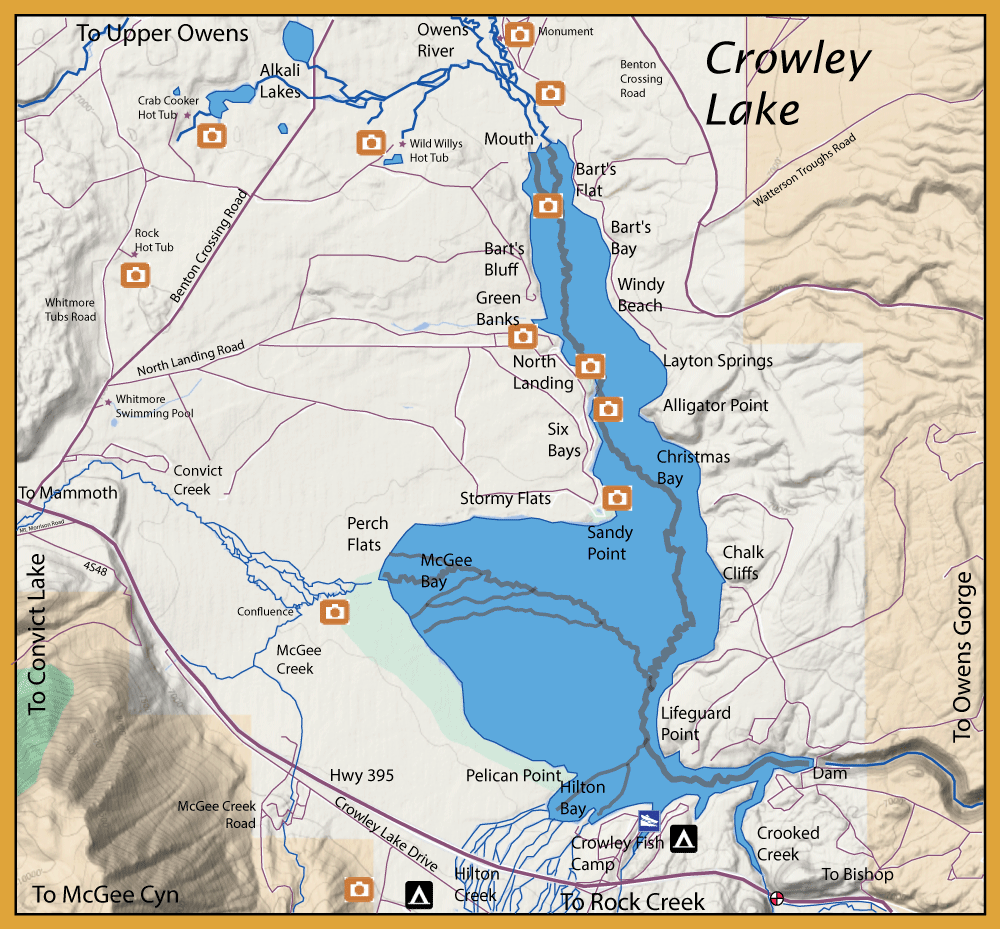
The SeasonThe opening season usually finds fish around the mouth of the Owens River for the Spring Spawning runs. Trout will also congregate around Layton Springs and Sandy Point since the spring will warm up the chilly water early in the season. Sometime in mid-June, the lake will turnover which will make fly fishing difficult. Algea will increase with the warming waters and weedbeds have yet to develop. During this time, McGee Bay is usually the best option since there is oxygenated water near the creek inlet. The trout tend to remain within a thermocline and will seek the areas where the creeks enter the lake as at McGee, Crooked Creek and Hilton Bay. These conditions may persist into July with the additional onset of Daphnia , a microscopic arthropod , causing a shutdown on the trout bite. In June and July, a damsel hatch comes off in which stillwater nymphing with Damsel Nymph patterns can be rewarding. Local Guide, Tom Loe, gives some good tips on damsel nymphing: “The damsel fly hatch is a great time to pull imitations of the nymphs #10-14 with a light to moderate sink tip or floating line. Find a weed line or scum line free floating with the current or wind and stay on the leading edge of this as long as you can. Damselflies lay their eggs on this dead vegetation and feed on spent midges that have accumulated on these unattractive but lucrative fishing areas. The trout will “migrate” with these rafts of dead weed hoping to ambush a damselfly adult or nymph. If you have never experienced a grab on a damselfly now is the time! Fish the nymphs using multiple rapid movements by pulling or stripping the fly line in quickly and aggressively. Allow the fly to stop dead and sink periodically, this is called a pause. The grab comes more times than not after a pause. Try to keep your rod tip at an angle when tugging damsel imitations, you will understand when you break off a time or two after a hard take when the rod can’t absorb the hit by bending!” During July, weed beds form up to 14 feet deep and the fish will reside within the channels of the weedbeds. This can be a great time to fish Crowley. The algea has abated and the water clarity has improved. Perch Fry and Damselfly nymphs will be taking refuge in the weedbeds and working the weedbeds with Buggers, hornbergs, and damselfly nymphs will be productive. Most of the chironomid hatches will be taking place during the morning. Prime areas are Layton Springs, Green Banks, and McGee Bay. The weeds start to die off by late July due to water draw-down and are usually gone by September. When the water temperature drops in August, there can be a regrowth of the Algea again. The fish will usually be found in 10-14 feet of water and your best locations are the oxygenated ones like Leighton Springs and McGee Bay. Chironomid Hatches will be the predominant food source. September can be the best month of the year, despite the die-off of the weedbeds. The Perch Fry are lacking cover and the trout are after them. Use Hornbergs and Buggers with an intermediate line fishing 5-10 feet. McGee is a consistent location, although Green Banks has also had some excellent years. Chironomid hatches will also extend throughout most of the day. Crowley Lake offers a “Double-Haul” Tournament around the third week of September. Try to get your fishing in prior to this date as the 400 contestants create an impact on the fishery that lasts a week or two. The fishery usually recovers from this tournament by early October. Most of the larger fish stage up along Green Banks and Leighton Springs for the Fall spawning up the Owens River. Streamer patterns and Stillwater Nymphs are your best bet. By late October, the City of L.A. starts to lower the water level of the lake and this has a significant effect on the fish. Colder temperatures also reduce the Chironomid hatches. Crowley closes up to fishing on November 15th. The TributariesThe major tributary is the Owens River which enters Crowley Lake at the North Arm. There are a number of access roads to reach this area extending from Benton Bridge crossing down to the lake. The fishing can be quite good throughout the season for both Browns and Rainbows. A boundary marker was established in a section of the river between the bridge crossing and the mouth of the lake for protection of spawners. This boundary marker is no longer used. The Upper Owens between the Benton Bridge crossing to Lake Crowley is now open from the last Saturday of April through July 31st. with no gear restrictions, 5 trout limit and switches to a 2 trout limit (18 inch minimum) using artificial lures only, from Aug 1st to November 15th. Smaller tributaries are Convict Creek, McGee Creek, Hilton Creek, Whiskey Creek, and Crooked Creek. All of these creeks receive a Spring spawning run of Eagle Lake rainbows and a Fall spawning run of Browns and Coleman rainbows. Recently, there have also been Spring runs of Lahonton Cutthroats into the tributaries as well. McGee and Convict Creeks tend to be more popular due to size. On Convict Creek, there is a study area (UC Berkeley) next to Benton Crossing road, that is closed to fishing. Below the study area, Convict Creek is open to fishing from the Saturday preceding Memorial Day through Sept 30th. with a 5 trout limit and no gear restrictions. These regulations apply to the other tributaries as well, with the exception of Crooked Creek. You cannot fish Crooked Creek below the Los Angeles gauging station but above the gauging station, Crooked Creek has a zero limit with barbless artificial lures or flies and is open year round. The Los Angeles gauging station is next to Hwy 395 southbound lane. The lake has a full-service marina. There is also a good unpaved road along it northeast side. A four mile drive on a washboard dirt road access the northern shores via Benton Crossing Road off US 395. Season opens on Crowley the last Saturday in April until Nov 15th. From the Opener to July 31st, there is a 5-trout limit and the waters are open to both lures and bait. Special regulations exist from August 1st until November 15th with limits of two Trout, 18 inches or larger. and you must use artificial flies or lures. | ||
Fishing RegulationsCrowley Lake (Mono Co.). (See individual listings for regulations on tributary waters which include: Convict, Crooked, Hilton, Hot, McGee, and Whiskey creeks and the upper Owens River.): Crowley Lake within 1,800 feet of the outlet dam (this area is marked with a series of buoys). Closed to all fishing all year for safety purposes. Upper Owens River from Benton Bridge crossing to Crowley Lake: Last Saturday in April through July 31st. No restrictions, 5 trout. Whiskey Creek and Hilton Creek downstream from Crowley Lake Drive (old Highway 395).: Saturday preceding Memorial Day through Sept 30th, No restrictions, 5 trout. Summer only to protect Fall, Winter, and Spring spawning Convict Creek and McGee Creek downstream of Hwy 395: Saturday preceding Memorial Day through Sept 30th, No restrictions, 5 trout. Summer only to protect Fall, Winter, and Spring spawning Crooked Creek below the City of Los Angeles gauging station.: Closed to all fishing all year. Crooked Creek above the City of Los Angeles gauging station.: Open to fishing all year. Only artificial flies with barbless hooks may be used. 0 trout. All other creeks and tributaries: Last Saturday in Apr. through Nov. 15. No restrictions. 5 trout per day. 10 trout in possession. | ||

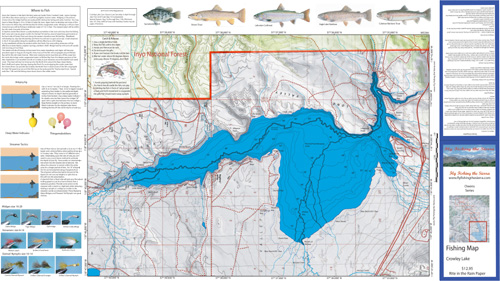
 | Fishing Map AvailableCovers the water of Lake Crowley. Shows lake topography, GPS Long./Lat., camping areas, road access, and below-surface stream channels. Special Features are Suggested Flies, Midging Rigs, Streamer Tactics, Fishing Season and Regulations, Fish Identification, Where to Fish, Catch & Release Procedures, and Stream Etiquette guidelines. | Lake Crowley
| $12.95 pkg |