
Sub-Total: $0.00
Mickey Finn – a classic knockout
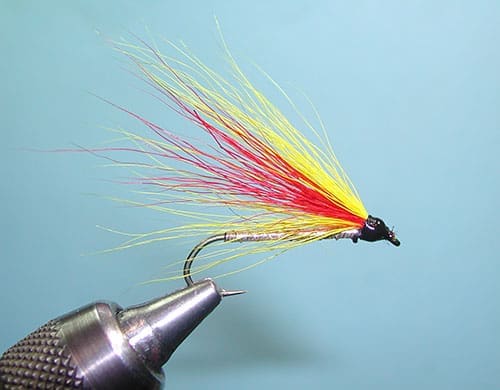
Mickey Finn
Tying Instructions
Tying Instructions: Mickey Finn
1. We are using a Daicchi 2220, a 4X long Streamer hook with a down eye. Place the hook in the vise and secure the thread about one eye length behind the eye.
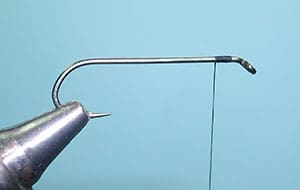
2. Attach a Silver wire to the bottom of the hook shank behind the eye.
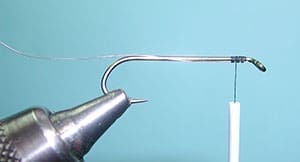
3. Secure the wire with touching thread wraps to the bend of the hook, keeping the wire beneath the shank.
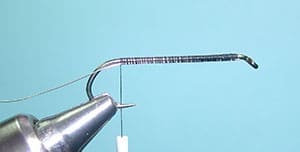
4. Wrap the thread forward to behind the eye, maintain touching thread wraps. Keep the space of one eye length clear.
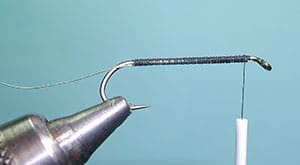
5. Attach a strip of silver tinsel behind the eye. I’m using French Tinsel, Mylar tinsel will also work.
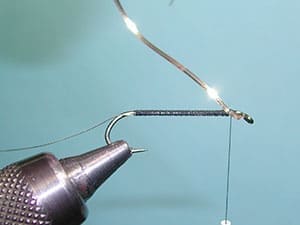
6. Wrap the tinsel back towards the bend of the hook. The wraps should be just touching and do not overlap. You want a smooth finish.
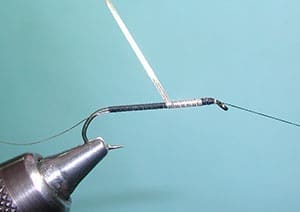
7. At the bend of the hook, reverse you direction and wrap with touching wraps back up to the eye.
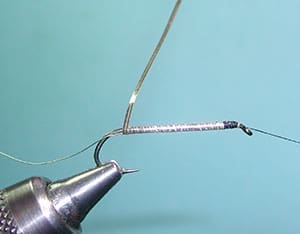
8. Behind the eye, secure the tag end of the tinsel and trim off.
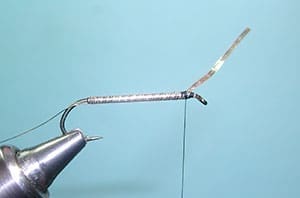
9. Now, counter wrap the Silver wire forward with spirol wraps to the eye. You should have about 9-10 spirol wraps. Secure the tag end of the wire and “helicopter” the tag end off by firm rotations.
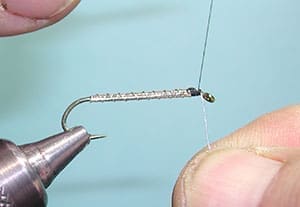
10. Apply some thread wraps over the silver wire tag end and finish about and eye length behind the eye.
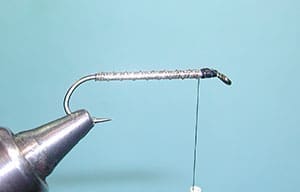
11. Clip some Yellow Bucktail hairs. You need about 15-20 strands. Remove the smaller hairs be preening and adjust the hair tips manually. Don’t bother with a hair stacker, you want the tips close but not even. The clump of hairs should be about a shank plus the hook gap in length.
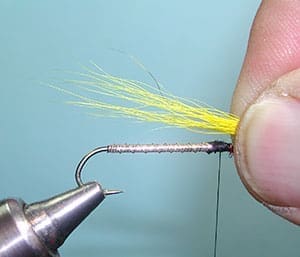
12. You want the hairs to bundle together, so apply a single thread loop around the base of the clump prior to anchoring to the hook shank.
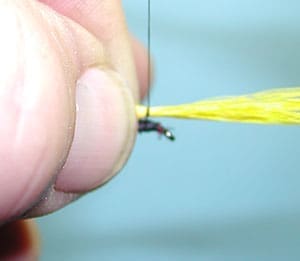
13. Now, anchor the clump of hairs at the base of the wing platform behind the eye with a couple of tight thread wraps. Lift the tag ends of the hair and trim at an angle.
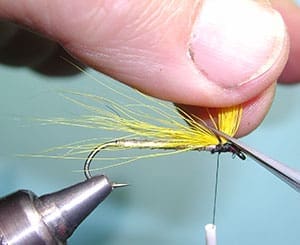
14. Secure the tag ends with some tight thread wraps.
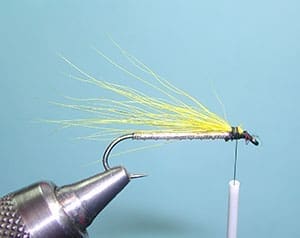
15. Next, clip a clump of red bucktail hairs, about the same number as the bottom yellow clump. Even the tips and measure the clump to be the same length as the lower clump.
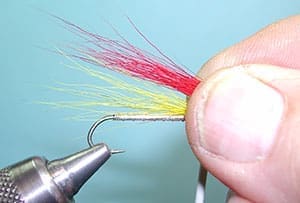
16. Place a thread loop around the base of the clump at the location you want to anchor the clump to the top of the shank.
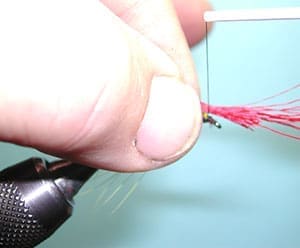
17. Anchor this red clump just front of the previous yellow or base clump with a few tight thread wraps.
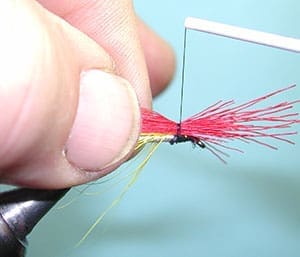
18. Lift the tag ends and trim at an angle cut. Secure the tag ends with some additional thread wraps.
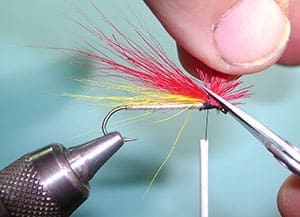
19. Now, clip a clump of yellow bucktail hairs that are about double the number of the previous two clumps. Measure the hairs to equal the previous two clumps.
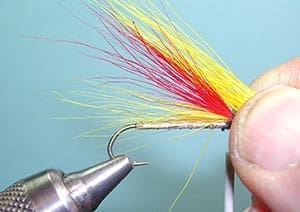
20. Place a thread loop around the base of the fibers and secure the clump just behind the eye. Leave enough room, an eye length for the tapered tag ends.
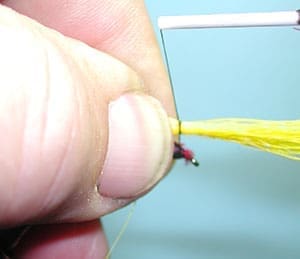
21. Secure the upper clump firmly with a few tight thread wraps.
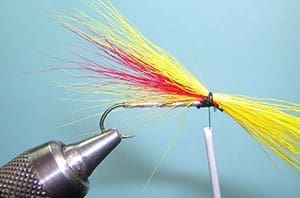
22. Lift up the tag ends and trim at an angle from the hook eye.
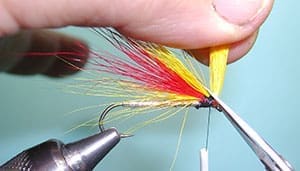
23. Apply thread wraps over the tag ends of the top clump to firmly anchor the hair.
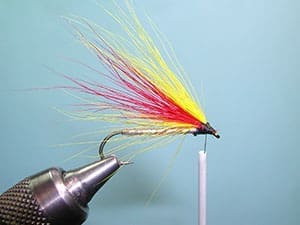
24. Now, apply thread wraps around all three clumps to create a smooth tapered head behind the eye of the hook.
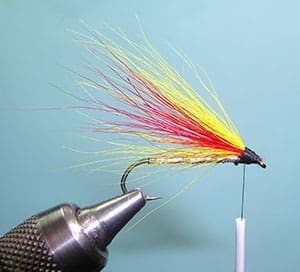
25. Whip Finish.
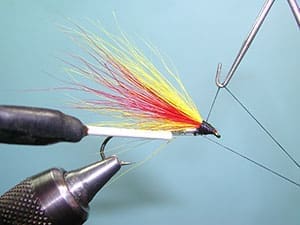
26. Apply a Black Head Finish.
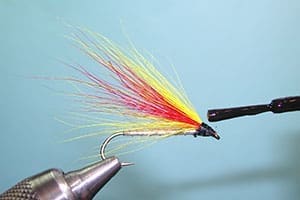
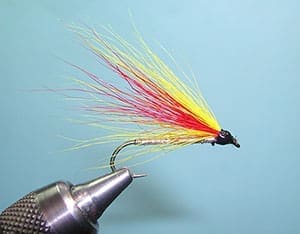
27. The Finished Mickey Finn
| Materials
to Order Material, click the link |
|
|---|---|
| Hook | TMC 5263 #2-10 |
| Thread | Danville 3/0 Monocord, Brown |
| Head | Tungsten Cone, Copper |
| Weight | Leadfree Wire, 0.25 |
| Rib | Copper Wire, Small |
| Body | Medium Chenille, Brown |
| Tail | Marabou, Brown |
| Legs | Medium Round Rubberlegs, Yellow |
| Flash | Krystalflash, Copper |
| Hackle | Grizzly Saddle, Orange and Grizzly Saddle, Yellow |
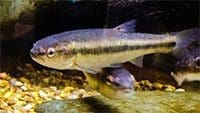
Mickey Finn
Some claim that the Yellow and Red Bucktail fly was developed in the mid 1800’s by a Canadian Fly Tier named, Charles Langevin. However, this has been disputed since the Langevin pattern was described in 1864 as a featherwing pattern not a bucktail. The Canadian Post Office continued to muddy the waters when it released a Mickey Finn Fly postage stamp in 2005 and credited the origination to Charles Langevin. No one really knows the origin but the pattern has been particularly popular when renamed to the “Mickey Finn” in the late-1930’s.
John Alden Knight, a writer and fly tyer from the Catskills, wrote a letter in the late-1930’s to his friend Gregory Clark about this pattern, naming it the “Assassin”. Clark, recalling a notorious saloon keeper named Mickey Finn from 1903, would refer to this streamer as the “Mickey Finn”. The saloon keeper, Mickey Finn, was known to spike his drinks with a drug that would knock out his customers and would proceed to rob them. So, from Clark’s point of view, this yellow and red bucktail would be another knock out streamer, the Mickey Finn. The name caught on and this yellow and red bucktail has kept the name since .
The Mickey Finn provides a good contrast that is particularly useful in murky waters. The colors of Yellow and Red are exceptional within these conditions. There are many variations to this pattern with the use of lead eyes, body materials, and other tweeks. But the underlying basis of a Mickey Finn is the Silver Body with a Red and Yellow wing.
Polar Mickey
Martin Joergensen’s variation using Arctic fox in stead of bucktail to get a fuller and softer wing. However, Martin still prefers the original materials. The bucktail might seem stiff and lifeless when dry, but once wet, it is very mobile and with lots of life and movement. In addition, bucktail is a material that is very hassle free and almost never fouls.
Mickey Jiggy
This is Martin Joergensen’s variation using a conehead and adhesive eyes in the same manner as Bob Popovic’s Jiggy Fly.
Variations
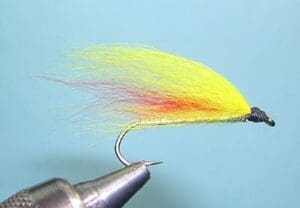
Polar Mickey
| Hook | Daiichi 2220 #6-12 |
| Thread | Uni 6/0, Black |
| Head | Uni 6/0, Black |
| Rib | Silver Wire, Small |
| Body | Flat Tinsel, Silver |
| Wing | Arctic Fox Body Hair, Red and Arctic Fox Body Hair, Yellow |
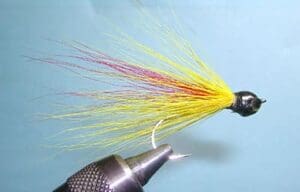
Mickeyjiggy
| Hook | Gamakatsu SP11-3L3h, #1-4 |
| Thread | Danville Monofilament |
| Head | Cross-eyed Cone, Silver |
| Eyes | Adhesive Eyes |
| Body | Flat Tinsel, Silver |
| Rib | Silver Wire, Small |
| Wing | Red Bucktail and Yellow Bucktail |
| Head Finish | Loon Fly Clear Fly Finish, Thick |