Notes:
There are 6 numbered-lakes within the Cottonwood Lake system. The first 5 are within an easy walk of each other from the Cottonwood Trail where the 6th lake is a more strenuous climb to 11,600′. Starting at the trailhead (10,040′), it is a 4.5 mile hike to Cottonwood 1 at 11,008′. The lakes had been off-limits to fishing from 1966 to 1998 while the lakes were used as breeding ponds for Golden Trout by Calif Fish and Game. However, during that 30 year period, Rainbow Trout made their way into the lake system and contaminated the gene pool. Some believe that an accidental aerial drop of rainbows fingerlings may have been the culprit. Others believe that some accidental mixing with Rainbow Trout occurred at the Mt Whitney hatchery and the fingerlings were returned to Cottonwood Lakes. However it occurred, the planting of Golden Trout throughout many of the high elevation lakes during this period were from these contaminated sources, estimated to be 83-88% pure. The contamination nullified the lakes as a source for pure strains of Goldens and pressure was created to open the lakes to fishing. The Dept of Fish and Game was under mandate of the Calif Wild Trout program to open at least one lake and 25 miles of stream each year. These two factors combined opened the lake system to fishing in 1998. Fortunately, pure sources of Volcano Creek Goldens have been identified within the upper reaches of Golden Trout Creek to allow a pure strain hatchery program to continue. Most of the recent effort by DFG is to ensure the genetic integrity of the Golden Trout by protecting their native habitat from intrusions by other species.
Cottonwood Lakes are under special regulations. All lakes and tributaries within the Cottonwood Drainage require artificial lures or flies with a limit of 2 fish. Cottonwood Lakes #1,2,3, and 4 are open from Sept 1 to Nov 30th with a 14″ minimum. The rest of the drainage lakes are open year round, no size restriction. Cottonwood Creek below the lakes is also open year round using artificial lures only and a 2 trout limit.
Records show that Cottonwood Creek was fishless until 1876 when Colonel Sherman Stevens brought 12 Golden Trout from Mulkey Creek and introduced them to Cottonwood Creek. Around 1890, E.H. Edwards and others took 50 Golden Trout from Cottonwood Creek and introduced them to the fishless Cottonwood Lakes. The Goldens that inhabited Cottonwood Lakes were a source for Golden stockings to other areas within the state since 1918.
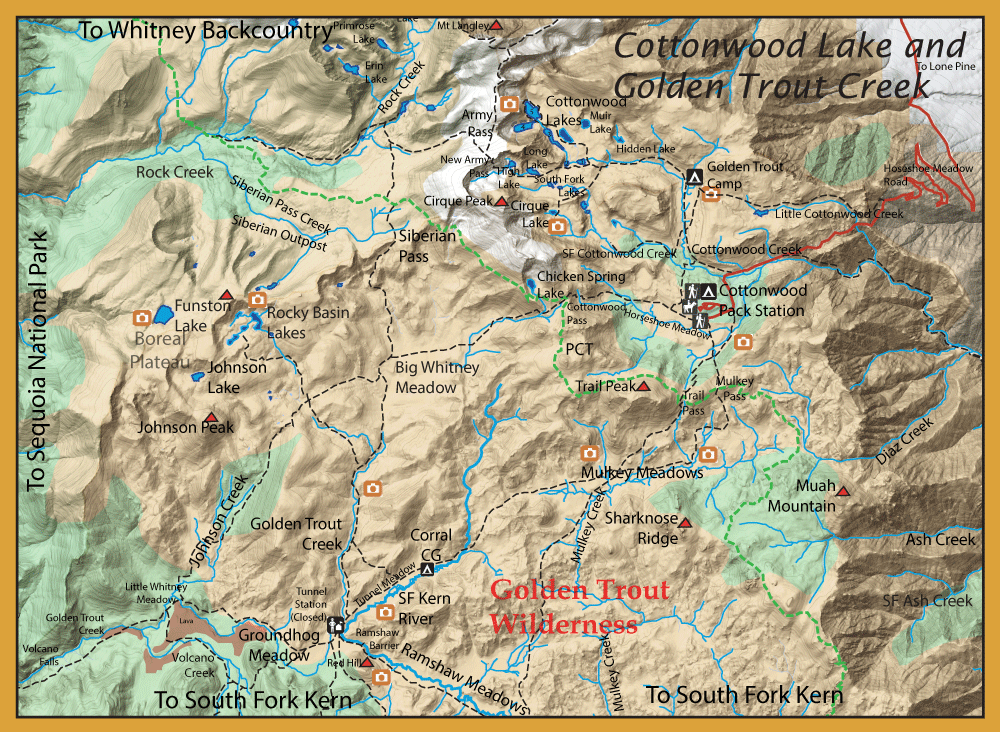
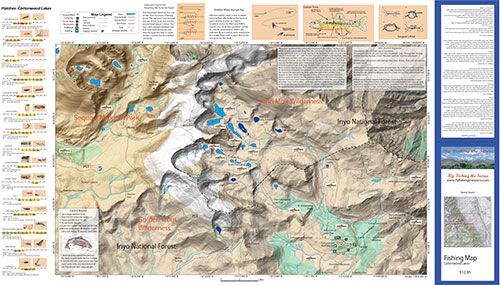
Taking the Cottonwood Lakes Trailhead from Horseshoe Meadow, you can reach the following local lakes and streams: Click map above at Cottonwood Lakes for a detailed map.
Muir Lake: 8 acre lake at an elevation at 11,010. 4.5 miles from trailhead. May consists of Goldens but is now managed as “fishless” by DFG. This lake has been suggested to receive pure strains of Goldens.
Hidden Lake: 6 acre lake at an elevation at 10,850. 4.0 miles from trailhead. May consists of Goldens but is now managed as “fishless” by DFG.
Cottonwood 1: 7 acres at 11,000 feet. 4.3 miles from trailhead. Consists of Golden Hybrids.
Cottonwood 2: 5 acres at 11,030 feet. 4.5 miles from trailhead. Consists of Golden Hybrids.
Cottonwood 3: 25 acres at 11,045 feet. 5 miles from Trailhead. Consists of Golden Hybrids.
Cottonwood 4: 20 acres at 11,150 feet. 6 miles from Trailhead. Consists of Golden Hybrids.
Cottonwood 5: 20 acres at 11,160 feet. 6 miles from trailhead. Consists of Golden Hybrids.
Cottonwood 6: 5 acres at 11,600 feet. 8 miles from trailhead. Fishless.
Cottonwood Creek: Spring Creek with pockets and pools. Designated a Wild Trout Stream by DFG. Between the mouth of Little Cottonwood Creek and South Fork of Cottonwood Creek, Catch & Release only. Consists of Golden Hybrids.
Cottonwood Lakes Trail forks at Cottonwood Lake #1 and continues straight to as the New Army Pass trail.
Upper and Lower South Fork Lake: 4 & 5 acres at 11,640 feet. 4.6 miles from trailhead. Consists of Golden Hybrids.
Long Lake: 7 acres at 11,135 feet. 5.0 miles from trailhead. Consists of Golden Hybrids.
High Lake: 6 acres at 11,500 feet. 5.8 miles from trailhead. Consists of Golden Hybrids.
Cirque Lake: 7.5 acres at 11,060 feet. 5.0 miles from trailhead. May consists of Goldens but is now managed as “fishless” by DFG.
From the Cottonwood Pass Trailhead you can reach:
Golden Trout Creek: Starts at the headwaters of Big Whitney Meadow and Rocky Basin Lakes. About 8 miles from the trailhead over Cottonwood Pass. The creek has about 14 miles of fishable water from just below Rocky Basin Lakes at 10,500 feet to above Volcano Falls next to the Kern River at 7,500. Golden Trout Creek was instrumental in providing the brood stock of most Goldens planted throughout the Sierras. Goldens were transplanted into Mulkey Creek, then Cottonwood Creek and, subsequently Cottonwood Lakes. Brood Hatcheries were established within the Cottonwood Lakes. Unfortunately, pure Genetic strains within Cottonwood Lakes has been lost due to hybridization with non-native Rainbows. Genetic testing has shown that the purity of most of the Goldens within the Golden Trout Creek is 93-96%. However, 100% pure strains were found within Volcano Creek and these populations are being protected from further intrusions. Consists of Volcano Creek Goldens (Oncorhynchus mykiss aguabonita) and Golden-Rainbow Hybrids in the upper elevations.
Rocky Basin Lakes: Series of 4 lakes at an elevation of 10,800 feet. These lakes were planted with Golden Hybrids from the Cottonwood spawning program. Since these fish put Golden Trout Creek at risk in maintaining genetic purity, they have been removed by gill netting in 2001 to 2003. No fish remain at Rocky Basin Lakes. About 10.25 miles from the trailhead over Cottonwood Pass.
Funston Lake: This lake is close to Rocky Basin Lakes but is on the other side of the divide at Boreal Plateau. Fish have not been removed from this lake and it consists of Golden Hybrids, some of them are known to be of large size.
Volcano Creek: About 14.5 miles from the Cottonwood Trailhead. Volcano Creek is a tributary into Golden Trout Creek above Volcano Falls. It is the ancestral home to the Volcano Creek Golden Trout and this particular area has the purist strains. The creek has two forks that extend about 5 miles from 9700 feet to 8300 feet elevation.
Mulkey Creek: About 5 miles from Cottonwood Trailhead over Mulkey Pass. Mulkey consists of about 8 miles of stream. The trail follows the creek through Mulkey Meadows, then you’ll need to follow the creek down to the SF Kern. Golden Trout from Golden Trout Creek were introduced to the headwaters of Mulkey Creek in 1872 by Samuel Mulkey. 13 of these fish were transported to Cottonwood Creek in 1876. Later, some of the Goldens were transplanted from Cottonwood Creek to Cottonwood Lakes which the DFG used as a Golden Trout Brood Stocking program. Consists of Goldens, Brookies, and Browns.
South Fork Kern River: About 11 miles from trailhead over Mulkey Pass. The first fishable waters occur at the top of Ramshaw Meadows, close to the proximity of Golden Trout Creek. It’s interesting to note that these two streams are within 1/4 mile of each other and flow in opposite directions to the Main Kern and South Fork Kern within Tunnel Meadow. A lava flow from the Groundhog Cinder Cone at Tunnel Meadow flowed down Golden Trout Creek about 10,000 years ago and divided the watershed. It kept the flow from Golden Trout Creek westward to the Kern River. The SF Kern was directed eastward to the main river channel. Goldens originally inhabited this area but have been reduced in numbers through competition with Brown Trout and hybridization with stocked Rainbows. Barriers have been erected at Ramshaw Meadows, Templeton Meadows, and upper Monache Meadows (Schaeffer Barrier) to help the Goldens retain habitat. The name, Tunnel, originated since a tunnel was dug between the Golden Trout Creek and SF Kern diverting most of Golden Trout Creek water into the SF Kern for irrigation purposes in 1886 but subsequently collapsed only a few years later.
|
| Fishing RegulationsInyo County, except Cottonwood Lakes and Cottonwood Creek drainage areas: All inland streams, rivers, and canals are open to fishing from the last Sat. in Apr. through Nov. 15, with a five trout daily bag limit, and ten trout possession limit, with no gear restrictions. From Nov. 16 through the Fri. preceding the last Sat. in Apr., a zero trout bag limit applies, and only artificial lures with barbless hooks may be used. In waters where the bag limit for trout is zero, trout must be released unharmed, and should not be removed from the water Cottonwood Lakes 1, 2, 3 and 4 and their tributaries.: Sep. 1 through Nov. 30. Only artificial lures may be used. Minimum size limit: 14 inches total length. 2 trout. All remaining Cottonwood Creek drainage lakes.: All year. Only artificial lures may be used. 2 trout. Cottonwood Creek and all tributaries upstream from the confluence of the main stem Cottonwood Creek and Little Cottonwood Creek, including the unnamed tributaries flowing through Horseshoe Meadow (Inyo Co.): All year. Only artificial lures may be used. 2 trout. Golden Trout Wilderness: All year. Only artificial lures may be used. 2 trout |