
Sub-Total: $0.00
Brook’s Sprout – a puff of white magic attraction

Trico Sprout
Tying Instructions
1. Attach the thread to the 1/3 position of the shank.
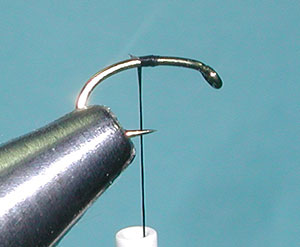
2. Tie in about a dozen Z-lon fibers for a shuck, don’t worry about the length we will trim that later.
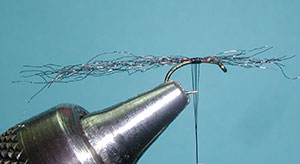
3. Wrap the Z-lon with even thread wraps to the midpoint of the hook curve and trim the butts.
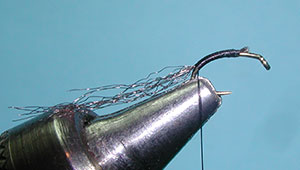
4. Trim the Z-lon shuck so that it is about the same as the hook gap.
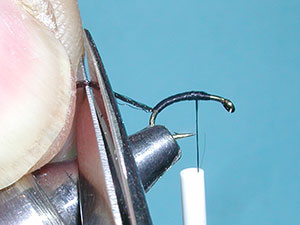
5. Prepare a stripped Ostrich Quill be removing the fibers with an eraser.
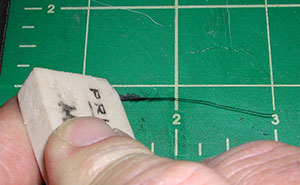
6. Attach the stripped Black Ostrich herl by the tip on top of the hook shank and secure with thread wraps to the shuck tie-in location. Wrap the stripped Black Ostrich herl to the 3/4 position of the shank and secure with a couple of thread wraps. Trim off the tag end.Tie in the 1/16 Round Rainy foam. The height of the foam should be about the hook gap.
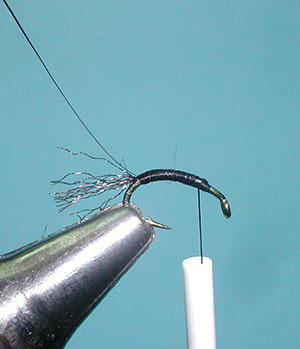
7. Wrap the stripped Black Ostrich herl to the 3/4 position of the shank and secure with a couple of thread wraps. Trim off the tag end.
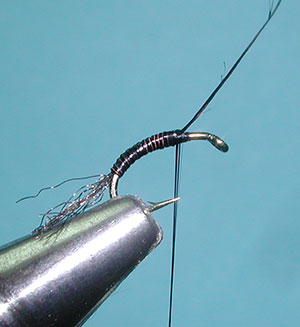
8. Apply a UV flow fly finish to the quill body to protect the quill from breakage.
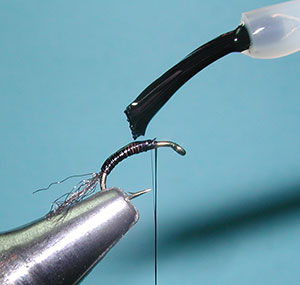
9. Use a UV lamp to harden the coating.
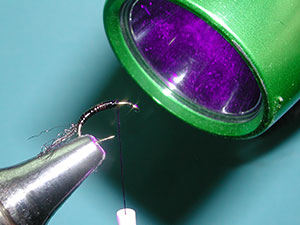
10. Tie in the 1/16 Round foam at the tip of the foam just behind the eye of the hook. Use 4-5 tight wraps.
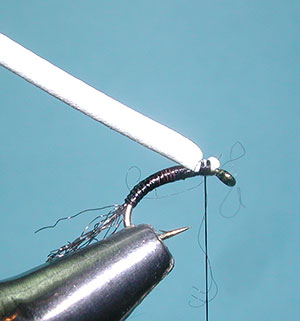
11. Place a few wraps behind the foam post to lift it up. Apply some thread wraps to the base of the post anchoring the thread in front of the post on the hook shank.
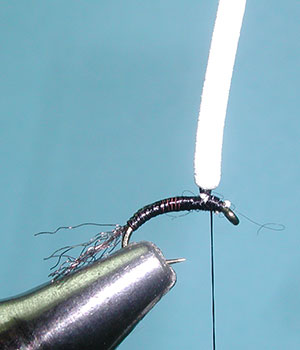
12. Apply some more thread wraps at the base of the foam for a hackle post that is about the same length as the eye of the hook. Bring the thread in front of the post behind the eye.
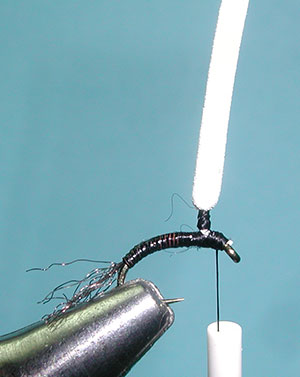
13. Attach a Black Hackle by the butt to the side of the hook shank in front of the foam wingpost. The hackle should be bare along the foam post so that you can secure the hackle butt with thread wraps up the the top of the foam post that was created. No hackle fibers should be trapped while secure the butt end of the hackle. Dub a thorax with the Superfine. Wrap a parachute hackle with 3-4 wraps. Tie down and trim. Apply a few half hitches. The foam post can be trimmed further if desired. Finish the fly with an application of head cement behind the eye.
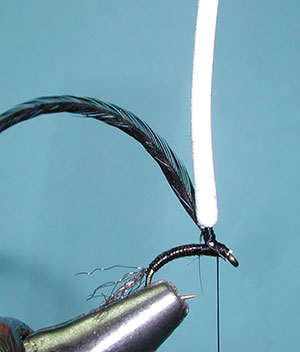
14. Apply Superfine dubbing to the thread, you don’t need much.
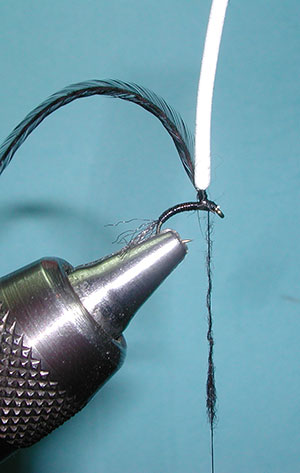
15. Dub a thorax with the Superfine both in front and behind the foam wing post.
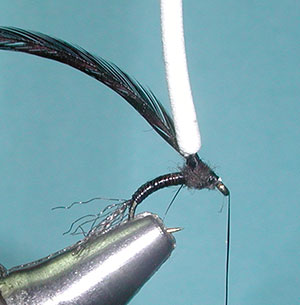
16. Wrap a parachute hackle with 3-4 wraps. Secure the hackle with 3 tight wraps at the base of the foam post between the hackle fibers and the tag end of the hackle.
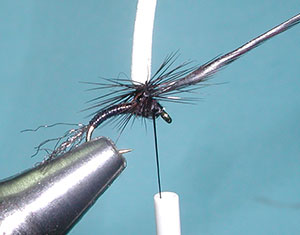
17. Leaving the thread hanging down keeping tension, trim off the tag end of the hackle. Apply a few half hitches. The foam post can be trimmed further if desired. Finish the fly with an application of head cement behind the eye.
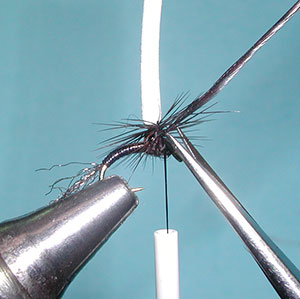
18. Apply a few half hitches.
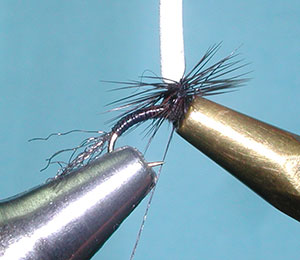
19. The foam post can be trimmed to about the same length as the hook gap.
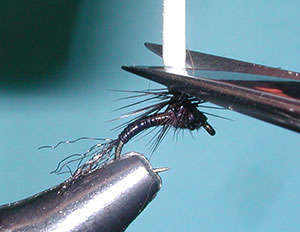
20. Finish the fly with an application of head cement behind the eye.
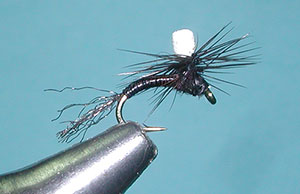
| Materials
to Order Material, click the link |
|
|---|---|
| Hook | Daiichi 1130 #18-22 |
| Thread | Veevus Black 12/0 |
| Body | Black Ostrich Herl, stripped |
| Thorax | Black Superfine |
| Shuck | Black Z-lon |
| Wingpost | 1/16 White Parachute Post |
| Hackle | Black Hackle |

Brook’s Sprout
 The Brook’s Sprout was developed by Bob Brooks while Riverkeeper at Hot Creek Ranch, near Mammoth, CA. Bob managed the ranch from 1989 until the late 90’s for fly fishing guests at the ranch. The portion of Hot Creek within the ranch is about 2.25 miles long and, historically, has had over 10,000 trout within this section. For many years, only dry fly fishing was permitted and this stream section may be one of the only waters within the United States to require only dry fly fishing. Prior to Bob’s involvement with the ranch, most fly fishers fished the ranch waters for the caddis hatch with an Elk Hair caddis pattern. Bob recognized that both mayflies and midges played a major role in the food choice of these trout. So, he created a pattern that could be adapted to the mayflies and midges that were also prevalent within the stream. His Sprout flies have a white foam wing post that allows for excellent visibility since the rest of the fly is under the surface film. Rainy Rider introduced the closed-cell foam cylinders in 1988 and Bob was one of the first tiers to utilize this material for a parachute post. The Brook’s Sprout is a great emerger pattern with an absorbent shuck of Z-lon or Antron. The abdomen is pushed beneath the surface by the weight of the hook utilizing the buoyancy of the hackle and foam. The abdomen needs to be thin and is often constructed with biots, dyed herl, or dubbed thread. The white round foam provides a good visible indicator and provides good floatation around the thorax region. The beauty of the Brook’s Sprout pattern is that it can be tied to very small sizes such as 18-24, fairly easily. Within the smaller sizes, the pattern can mimic an individual midge. This is one of the few patterns capable of representing a single midge. Color patterns can vary to resemble Baetis, Callibaetis, PMD, Trico’s, and Midges.
Variations

Callibaetis Sprout
| Hook | Daiichi 1120 #14-18 |
| Thread | Uni-thread Brown 8/0 |
| Body | Callibaetis Superfine |
| Thorax | Callibaetis Superfine |
| Shuck | Ginger Z-lon |
| Wingpost | 1/16 White Parachute Post |
| Hackle | Grizzly Hackle |
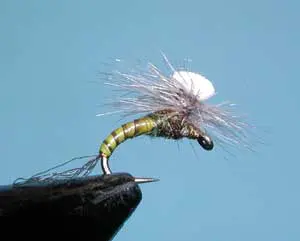
Baetis Sprout
| Hook | Daiichi 1120 #16-26 |
| Thread | Uni-thread Olive 8/0 |
| Body | Olive Turkey Biot |
| Thorax | BWO Superfine Dubbing |
| Shuck | Olive Brown Z-lon |
| Wingpost | 1/16 White Parachute Post |
| Hackle | Light Blue Dun Hackle |

Flavilinea Sprout
| Hook | Daiichi 1120 #14-16 |
| Thread | Uni-thread Olive 8/0 |
| Abdomen | Olive Turkey Biot |
| Thorax | Olive Superfine Dubbing |
| Shuck | Olive Brown Z-lon over Dyed Mallard Flank Woodduck |
| Wingpost | 1/16 White Parachute Post |
| Hackle | Olive Dyed Grizzly Hackle |

PMD Sprout
| Hook | Daiichi 1120 #14-20 |
| Thread | Uni-thread Yellow 8/0 |
| Body | Brown Ostrich Herlstripped |
| Thorax | PMD Superfine Dubbing |
| Shuck | Dark Olive Z-lon |
| Wingpost | 1/16 White Parachute Post |
| Hackle | Light Blue Dun Hackle |