
Sub-Total: $0.00
California Mosquito – a proven timeless treasure
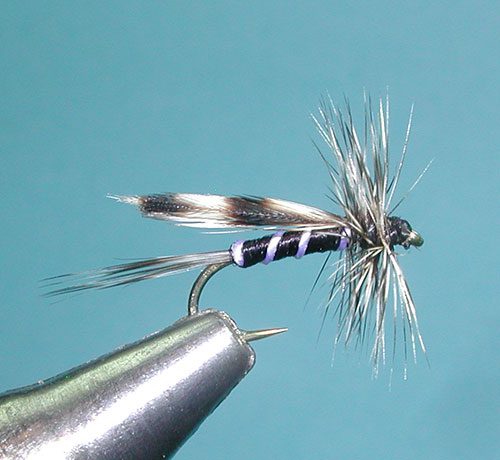
California Mosquito
Tying Instructions
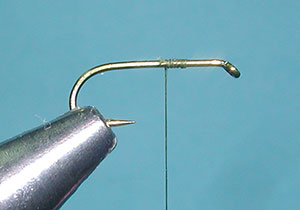
1. Flatten the barb of the hook with your vise and secure the hook at the bottom of the hook bend. Attach the thread at the 1/3 position of the hook shank wrapping a thread foundation to the bend of the hook.
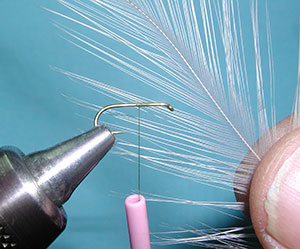
2. Select about 6-8 stiff hackles from a spade hackle. You can procure these hackles from the sides of a cape or purchase a tailing pack with these hackles.
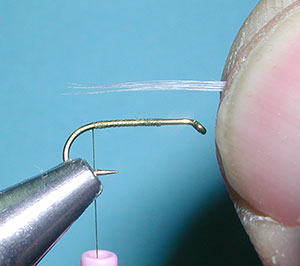
3. The length should be slightly longer than the hook shank. Attach the tailing fibers at the bend of the hook and wrap the tag ends to about the 1/3 position. Clip off the tag ends of the tailing fibers.
4. Select a 1/4 inch section of Turkey T-Base for the wingpost. Note how the T-base has a flat and even tip. You should clip this section with a cut that is parallel to the tips.
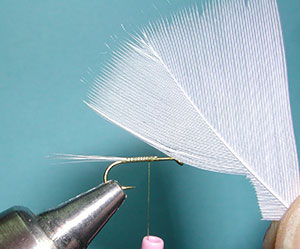
5. Keeping the tips aligned, roll the segment and position the tie-down at the area in front of where you trimmed the tailing butts. The wing post should be the length of the hook shank.
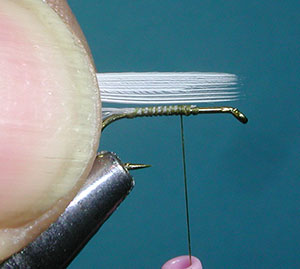
6. A.K. likes to hold the segment at a 45 degree downward angle in front of the shank. With 2 soft thread loops, the bundle will position itself on top of the shank upon tightening the thread.
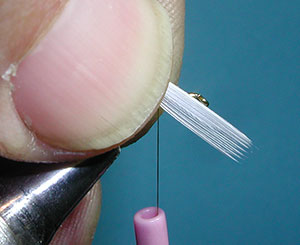
7. Trim the butt ends of the T-Base and wrap to cover the clipped butts.
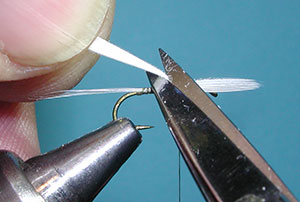
8. Try to wrap an even taper. Lift the wingpost tips and wrap 7-8 turns against the front of the wingpost to hold the wingpost upright.
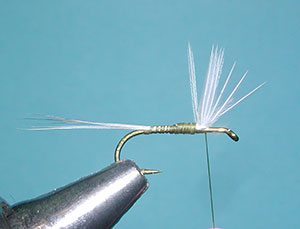
9. Wrap 7-8 times around the base of the wingpost to give support to the hackle. This is easily done with a rotary vise rotating the wingpost towards you.
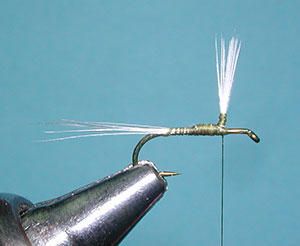
10. Select a hackle stem and clip the guill where the diameter of the quill is about the same as the diameter of the shank.
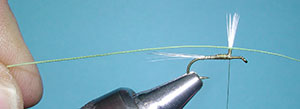
11. This clipped tip is then attached to the side of the hook shank and secured with thread wraps to the tail tie-off position.
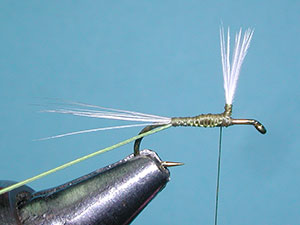
12. Wrap the quill forward. At the wingpost, secure the quill with some tight thread wraps behind the wing post.
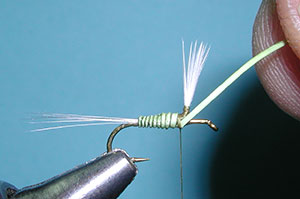
13. Then, bring the quill underneath and tie-off the quill in front of the wingpost.
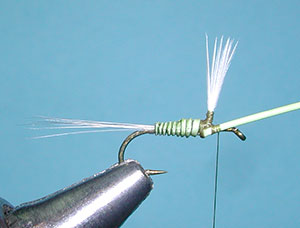
14. Clip the butt and wrap over. Apply some UV Clear Fly Finish, Flow to the quill body.
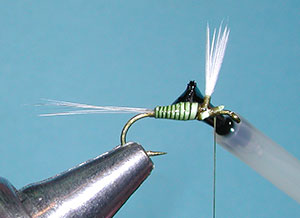
15. Harden the coating with a UV lamp.
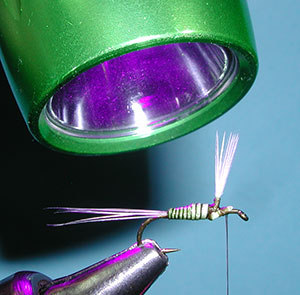
16. Select a stiff Dun Hackle about one size larger than the hook size. Clip three hook-eye lenths of fibers from the stem shiny-side up. This helps keep the fibers from twisting the hackle. Tie the butt end in front of the wingpost nearest you. Also put a couple of wraps around the base of the wingpost to anchor the hackle to the wingpost.
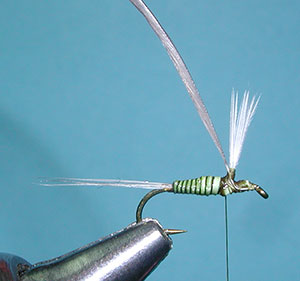
17. Build up a thread thorax and head covering the hackle and quill body butt ends.
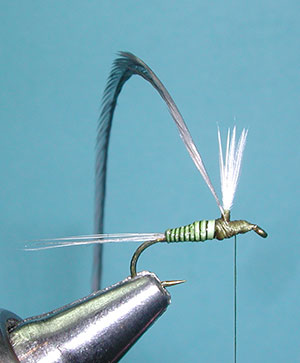
18. Wrap the hackle 4-5 turns around the wingpost proceeding in a downwards direction. Wrap the thread at the base of the wingpost just above the tag end of the hackle 2-3 times to secure the hackle wraps.
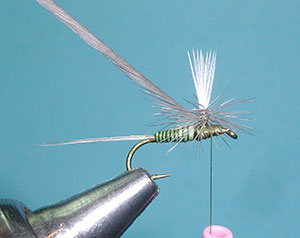
19. Bring the hackle tip over the hook eye and underneath the thread. Bringing the thread over the hackle tip will lock the hackle into place. Wrap the thread around the hackle tip two more times before trimming the tip. Lift the hackles from above the hook eye and wrap to further secure and cover the hackle tip. Apply 2-3 half hitches.
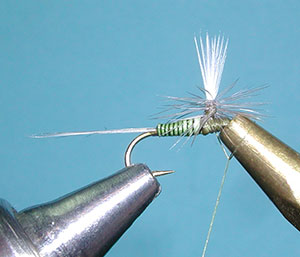
20. Apply some head cement at the head and also at the base of the wingpost. The finished Quill Parachute, BWO.
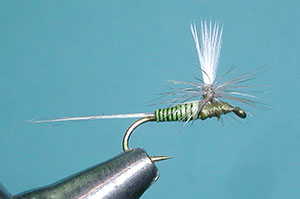
| Materials
to Order Material, click the link |
|
|---|---|
| Hook | TMC 100 #12-20 |
| Thread | Veevus 8/0 Black |
| Body | Uni-Floss Black |
| Ribbing | Uni-Floss White |
| Tail | Grizzly Spade hackle fibers |
| Wing | Grizzly Saddle hackle tips |
| Hackle | Grizzly hackle |
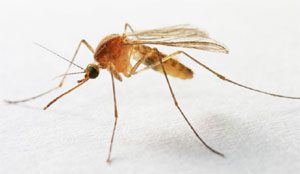
California Mosquito
The California Mosquito pattern goes back to sometime within the 1950’s. During the ’60’s and 70’s, this pattern was one of the most popular dry flies within the Sierra Nevada. The pattern even became a popular graying fly within Alaska. The downwing makes this pattern unique. Mosquitos are known for raising their hind legs in the air when they alight onto the surface film of the water. This brings their body into close proximity to their wings. The pattern is still a producer, particularly within the high elevation lakes and meadow streams.
Often, you will find mosquito clusters beneath overhanging branches and next to brushy shorelines. Cast the California Mosquito upstream of the overhangs and let the current bring the fly into the fish zone. It is important that you choose the size of fly that mimics the actual mosquito. If the pattern is larger than the naturals, the trout will ignore the presentation. At times, fish will be keying on subsurface pupa emergers, especially during the evening. If you find that they are not taking the dry, you can modify this fly into a pupa emerger by trimming the hackle so that the fly lies lower within the surface film.
Ray Bergman
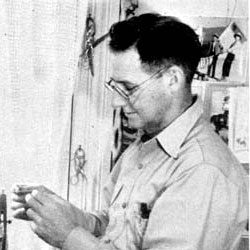
Ray Bergman
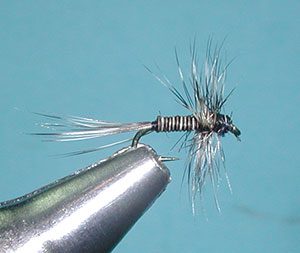
The California Mosquito is a variation of a much older Catskill pattern, theMosquito, with upright split wings. Winnie and Walt Dette tied a similar pattern usingthe “stripped center quill stem from grizzly hackle” in 1928 and Ray Bergman wrote about the Mosquito fly in his 1938 book, “Trout”, with a plate illustration utilizing stripped peacock herl for the body. Obviously, the pattern had a Catskill history with no known originator.
The California Mosquito made it’s debut in the 1950’s and Randall Kaufmann popularized the pattern within his book, “Tying Dry Flies” (1991). This pattern may imitate not only mosquitos but Callibaetis, midges, and gnats.
Variations
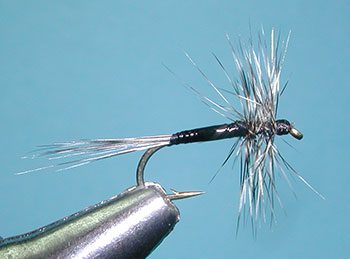
TheRed Tail Mosquitois an important variation of this fly. The red butt has been an attractor on many flies and it’s properties work particularly well on this pattern with the split wing placed to the rear of the hackle wraps in a downwing profile.
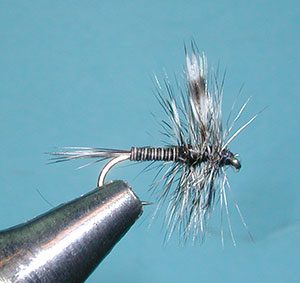
Another variation of the Mosquito is theLake Mary Mosquito, out of Mammoth Lakes, which has no wing but heavily hackled. The body is simply a threaded body coated with a layer of Sally’s Hard as Nails.
TheWingless Mosquito rely only on the hackle to represent wings, perfect for those really small gnats and midges.
Variations
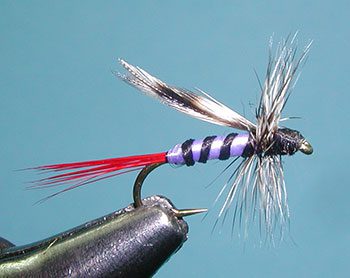
Red Tail Mosquito
| Hook | TMC 100 #12-18 |
| Thread | Veevus 8/0 Black |
| Body | Uni-Floss White |
| Head | Veevus 8/0 Black |
| Ribbing | Black Superfine |
| Tail | Red Spade Hackle Fibers |
| Wing | Grizzly Saddle Hackle Tips |
| Hackle | Grizzly Hackle |
Lake Mary Mosquito
| Hook | TMC 100 #12-18 |
| Thread | Veevus 8/0 Black |
| Body | Veevus 12/0 Black, coated with Loons UV Fly Finish, Flow“] |
| Head | Veevus 8/0 Black |
| Tail | Grizzly Spade hackle fibers |
| Hackle | Grizzly Hackle |
Mosquito
| Hook | TMC 100 #12-20 |
| Thread | Veevus 8/0 Black |
| Body | Stripped Grizzly Hackle quill |
| Head | Veevus 8/0 Black |
| Tail | Grizzly Spade hackle fibers |
| Wing | Grizzly Saddle Hackle Tips |
| Hackle | Grizzly Hackle |
Wingless Mosquito
| Hook | TMC 100, sizes 20-24 |
| Thread | Veevus 12/0 Black |
| Body | Stripped Grizzly Hackle quill |
| Head | Veevus 12/0 Black |
| Tail | Grizzly Spade hackle fibers |
| Hackle | Grizzly Hackle |