
Sub-Total: $0.00
Hairwing Dun – improve results with a few changes
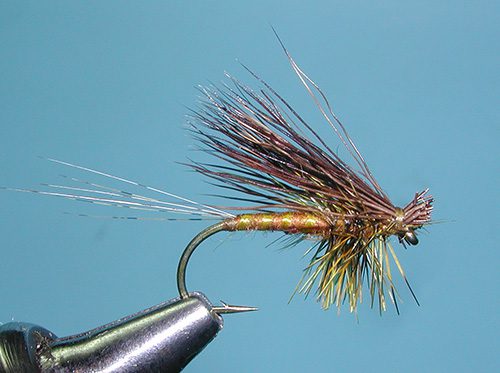
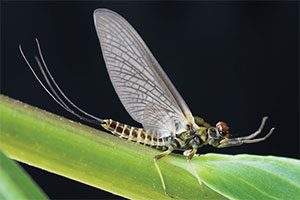
Hairwing Dun, Green Drake
Tying Instructions
1. Attach the thread to the hook shank behind the eye and lay down a thread foundation to the bend of the hook. At the bend, create a small ball of thread.
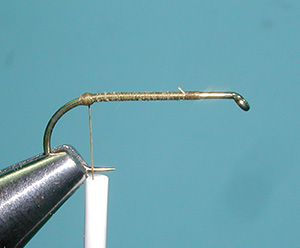
2.Select some tailing material. We are tying a Green Drake pattern so I am choosing the fibers from a Coq de Leon Medio Pardo. An Olive Grizzly spade hackle would also work well.
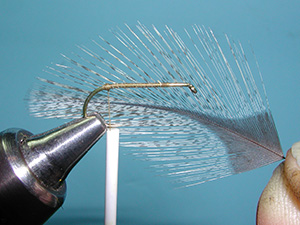
3. Even the tips of the hackle fibers in a stacker and measure the tips to be about one shank length.
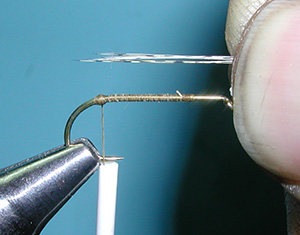
4. Attach the bundle of fibers on top of the hook shank behind the small thread ball you made. With your thumb nail, apply pressure to the top of the ball and the tailing fibers will splay. Apply a couple of thread wraps behind the ball to secure these fibers in place.
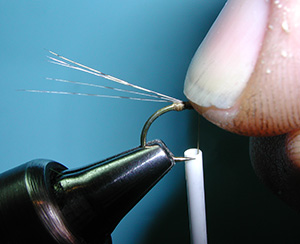
5. Attach a strand of yellow floss to the top of the hook shank and secure with thread wraps to just in front of the tail tie-in.
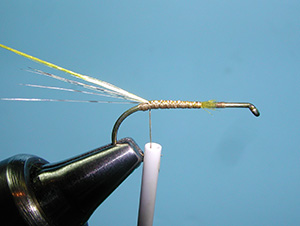
6. Apply Superfine dubbing to the thread. Bring the fibers up the thread until they touch the hook shank and then give one wrap of the dubbed thread behind the thread ball to secure these fibers to the shank.
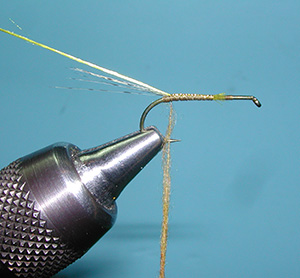
7. Once the fibers are locked onto the shank, you can twist the Superfine around the thread to compact the material and wrap a tight tapered abdomen to just beyond the midpoint of the shank.
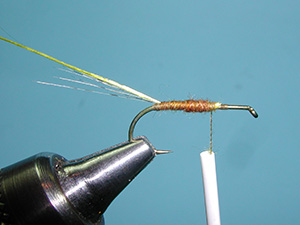
8. Next, wrap the floss around the body with evenly spaced spirol wraps and secure the tag end just beyond the midpoint of the shank.
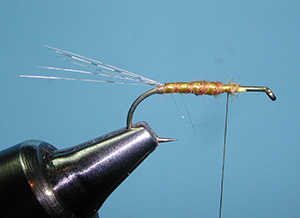
9.Find a sized hackle for the hook and glean the bottom fibers from the hackle stem. Place the clean stem up against the side of the hook shank just in front of the midpoint of the shank. The shiny side of the hackle should face forward. Apply a couple of thread wraps to secure the hackle stem to the shank, also place one thread wrap behind the hackle stem to bring the hackle upright.
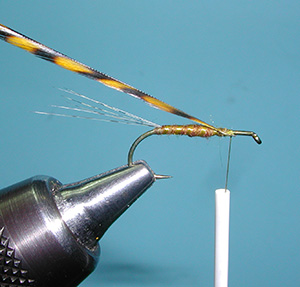
10. With the thread behind the hackle, attach some more Superfine dubbing to the thread. Again, bring those first fibers up against the hook shank and lock the fibers to the shank with a thread wrap behind the hackle.
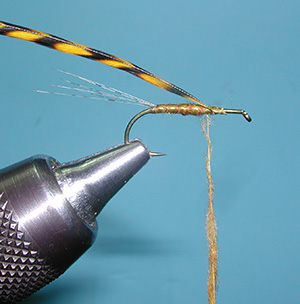
11. Create a dubbed thorax that is about twice the diameter as the abdomen in front of the hackle feather. Stop the thorax about one eye width behind the eye as you will need this space for the wing.
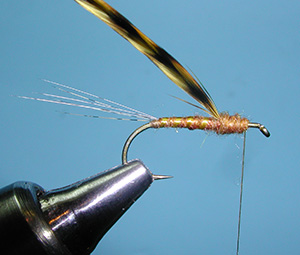
12. Wrap the hackle around the thorax about five times with each wrap just in front of the other as to not trap the hackle fibers from the previous wrap. Secure the tag end of the hackle with a couple of thread wraps. Take care not to trap the fibers of the tag end in doing so. You can bring the tag end over the hook shank to expose the bare quill for thread placement.
13. Clip a small bundle of hair. We are using Moose Body Hair for the wing of thise Green Drake. You could also use Olive dyed Deer Hair or Elk Hair. Remove the underfur with a comb and even the tips within a stacker.
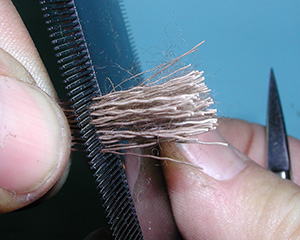
14. Measure the tips to be about one shank length. You do not want the wing to go beyond the tail tie-in position.
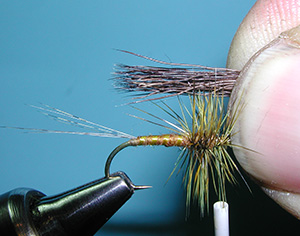
15. Once measured, grab the tips with your left hand and trim off the butts of the hair with a straight cut using your scissors. Then place the exposed butts of the hair bundle just above the eye of the hook.
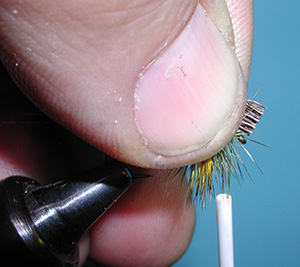
16. Place a couple of pinch wraps between your finger and thumb having the thread slide down to a position behind the eye. Tighten the thread to secure the hair to the top of the hook shank and then place another pinch wrap. Once the spinch wraps have secure the hair in place, apply a couple more tight wraps behind these pinch wraps and then one wrap between the butt fibers and the eye of the hook. This wrap will lock the butts against the pinch wraps.
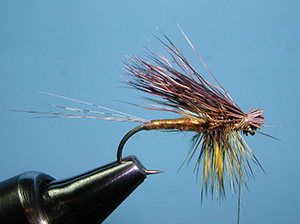
17.Whip finish behind the eye.
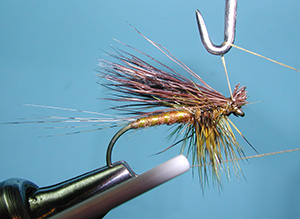
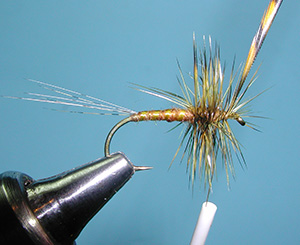
18. Trim the bottom hackle fibers to the length of the hook gap. The finished Green Drake Hairwing Dun.
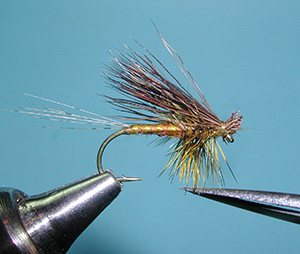
| Materials
to Order Material, click the link |
|
|---|---|
| Hook | Tiemco 100 size #10-12 |
| Thread | Danville Olive 6/0 |
| Body | Brown Olive Superfine Dubbing |
| Thorax | Brown Olive Superfine Dubbing |
| Ribbing | Danville Yellow Floss |
| Tail | Coq de Leon Medium Pardo |
| Wing | Black Moose Body Hair |
| Hackle | Golden Olive dyed Grizzly Hackle size 12 |
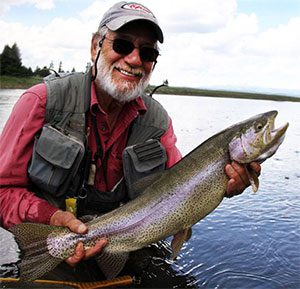
Rene Harrop
Hairwing Dun
Rene Harrop designed the Hairwing Dun during the 1980’s while he fished the Firehole River. Mayflies were hatching and he didn’t have a good imitation. He selected an Elk Hair Caddis, clipped a few fibers, and found that the modifications allowed him to start catching some fish. Rene is a renowned fly designer and taking this experience back to his fly tying desk, he tried some additional modifications from the Elk Hair Caddis.
Rene modified the pattern with split tails, clipping the bottom of the hackle and covering only the thorax portion of the body with the hackle. He shortened the wing and tilted the wing upward. By changing the hook size, dubbing coloration, hackle, and wing material, he could adapt this pattern to a number of mayflies such as the Blue Wing Olive, Brown Drake, Adams, Hendrickson-Quill Gordon, Light Cahill, Pale Morning Dun, and Trico. The Western Green Drake was also in the mix. Currently, Rene tends to tie this pattern using Turkey Biots for the abdomen in a number of colorations, keeping the abdomen thin and sleek with notable segmentation.
Variations
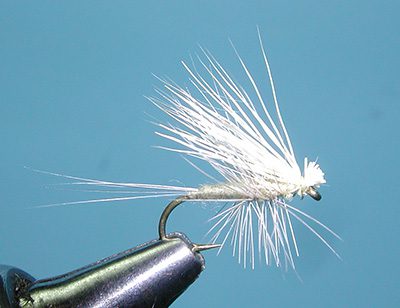
Hairwing Dun, PMD
| Hook | Tiemco 100 size #16-20 |
| Thread | Uni-thread 8/0 Light Cahill |
| Body | Pale Yellow Superfine |
| Thorax | Pale Yellow Superfine |
| Tail | Light Blue Dun Spade Hackle |
| Wing | Bleached Deer |
| Hackle | Light Blue Dun Rooster |
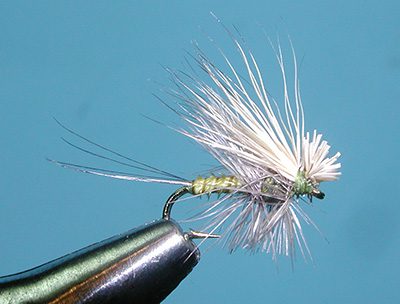
Biot Hairwing Dun, BWO
| Hook | Tiemco 100 size #18-22 |
| Thread | Uni-thread 8/0 Olive |
| Body | BWO Turkey Biot |
| Thorax | BWO Superfine |
| Tail | Coq de Leon Dark Pardo |
| Wing | Natural Dun Deer Hair |
| Hackle | Medium Dun Rooster |
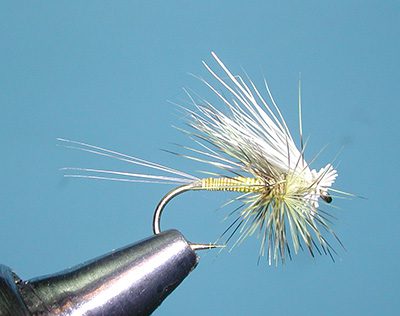
Quill Hairwing Dun, PMD
| Hook | Tiemco 100 size #14-18 |
| Thread | Uni-thread 8/0 Light Cahill |
| Body | PMD Quill Body |
| Thorax | PMD Superfine |
| Tail | Light Ginger Spade Hackle |
| Wing | Bleached Deer Hair |
| Hackle | Pale Yellow Grizzly |
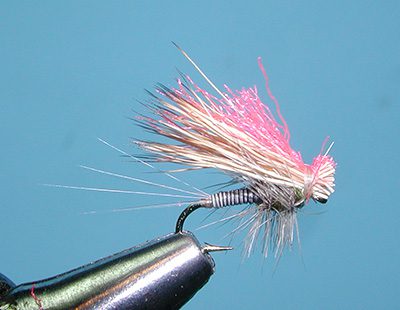
Twilight Hairwing Dun, Winter Baetis
| Hook | Tiemco 100 size #18-20 |
| Thread | Uni-thread 8/0 Tan |
| Body | Blue Quill Body |
| Thorax | BWO Superfine |
| Tail | Medium Blue Dun Spade Hackle |
| Wing | Elk Hair |
| Overwing | Orange Poly Yarn |
| Hackle | Blue Dun Rooster |
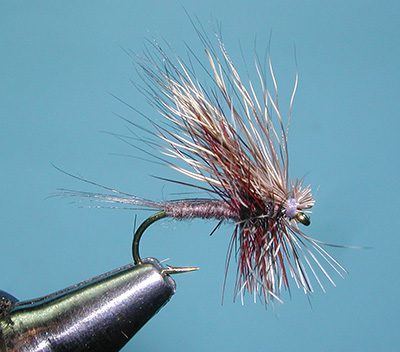
Hairwing Dun, Adams
| Hook | Tiemco 100 size #14-18 |
| Thread | Uni-thread 8/0 Gray |
| Body | Adams Gray Superfine |
| Thorax | Adams Gray Superfine |
| Tail | Dark Pardo Coq de Leon |
| Wing | Natural Dun Deer Hair |
| Hackle | Grizzly and Brown Hackles |