Notes: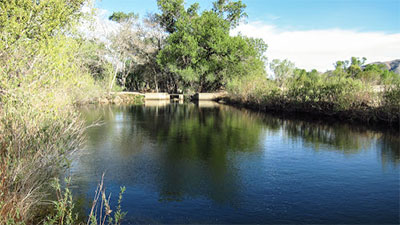
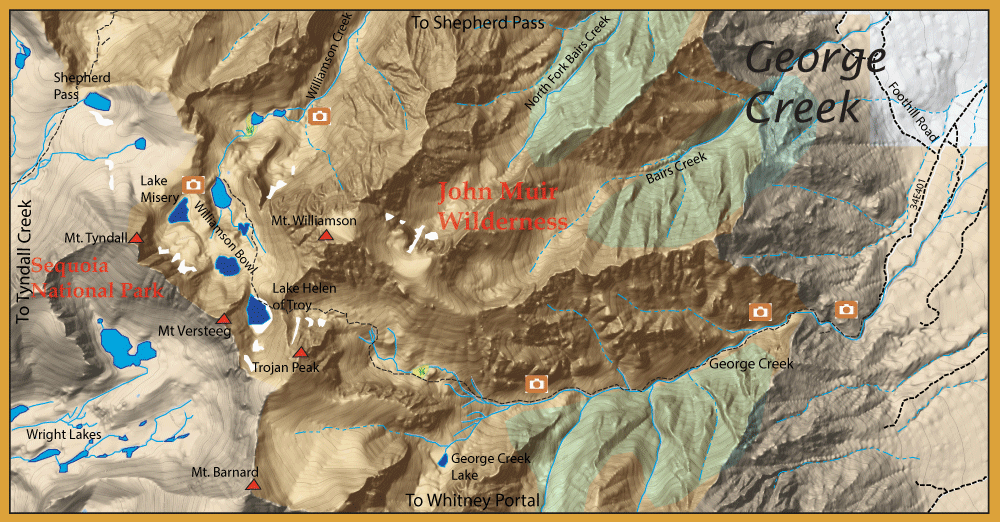
The George Creek trail is a steep, unmaintained cross-country route that climbs more than 6,000 vertical feet into the area near Mt. Williamson, Trojan Peak, and Mt. Barnard. The route is used primarily by climbers attempting to access Mt. Williamson. Trips up Bairs Creek are included in the George Creek – Mt Williamson quota.
George Creek (Sand Trap): In March and April, most of the eastside creeks are flowing heavily due to snow runoff. The sand trap of George Creek is probably the first opportunity to fish and it gets heavily planted. The sand trap is located about 100 yards upstream of the aqueduct. The Sand Trap contains Rainbows, Browns, and Largemouth Bass.
George Creek: Above the sand trap up to the intersection of Foothill Road, George Creek is similar to Goodall and Taboose as a small stream with a lot of riparian cover. Most of this area has small rainbows. The trailhead starts at the end of FR 34E401. It is not a maintained trail and there will be a lot of bushwacking. Many use this route to access the Williamson Lake basin and to climb Mt Williamson (14,380 feet ele). The trail reaches a waterfall within the canyon narrows that restrict any trout from getting past this barrier. Contains Rainbows. Williamson Lakes: The lower three lakes within the Williamson Bowl contain Colorado Cutthroats. This is quite an interesting story as told by Phil Pister retired fishery biologist at the California Department of Fish and Game’s office in Bishop: Pure Colorado Trout Saved by California
By Phil Pister
Outdoor California:January-February 1990
In the early spring of 1953, I was hired as a seasonal aid working out of the California Department of Fish and Game’s Bishop Office and I was “all ears” to learn what I could from the wealth of experience represented by my co-workers.
“Listen especially to Lee Talbot,” counseled state hatchery supervisor Earl Leitritz, “He’s been around longer than we have had fish!”
So listen I did! Leon A. Talbot, then hatchery supervisor for the eastern Sierra, had started his career with the Department of Fish and Game in the Owens Valley following Army service in World War I. Virtually his entire period of service was at Mt. Whitney Hatchery, one of the DFG’s oldest and proudest installations.
One of Talbot’s favorite stories concerned a shipment of 25,000 golden trout eggs to the Colorado Fish Commission, in return for which California received “30,000 black spot eggs – native trout of Colorado.” These eggs (Colorado River cutthroat trout, Salmo clarki pleuriticus) were received at Mt. Whitney Hatchery on July 10, 1931, according to hatchery log entry in the firm hand and cryptic style of hatchery manager George A. (Jim) McCIoud.
“Put the eggs in a part of the hatchery where they won’t get mixed up with anything else,” ordered California Bureau of Fish Culture Chief J. O. Snyder. “When they are ready to plant, find some lakes where nothing else can be planted to hybridize with them.”
One of the most inaccessible and ruggedly beautiful areas of the southern Sierra Nevada is found in the upper Williamson Creek drainage, southeast of 12,000 foot Shepherd Pass, where seven lakes – ranging in elevation from 11,200 to 12,515 feet — are enclosed by a ring of peaks dominated by Mt. Tyndall (14,018 feet) and Mt. Williamson (14,375 feet).
Second in elevation only to Mt. Whitney (14,495 feet), Mt. Williamson stands apart from the main crest of the Sierra Nevada and dominates the entire Owens Valley. The lower Williamson lakes were chosen to receive the plant of Colorado cutthroat.
Early on the brisk, clear morning of October 8, 1931, four saddle horses bearing Mt. Whitney Hatchery employees Talbot and Bud Harper, Independence dentist Doc Baxter and one of Allie Robinson’s packers, left the trailhead at Symmes Creek. They led a string of trout-laden pack mules headed for their first night’s destination at 10,200-foot Anvil Camp, where they “creeked” the fish cans (a hatcheryman’s term for placing the cans in a creek, with screen-covered openings heading into the current to allow fresh water to continually flow into them).
At dawn on the next morning, the crew again loaded the cans onto the mules, and they headed for the 12,600-foot ridge lying beyond Shepherd Pass. From this ridge the fingerling trout would be carried in backpacks down a 840-foot cliff and through a treacherous boulder field to 11,760-foot Williamson Lake No. 3.
According to the Sierra Club’s “Classification of Climbs” this cliff would be placed in Class 3 — requiring the use of hands. In other words, one does not just walk down this cliff, one must use the hands and climb down, in this instance carrying heavy rubber backpacks laden with fingerling trout. Since 30,000 fish were involved, several trips had to be made up and down the cliff while the packer “walked the mules” at the top to keep the water aerated.
Toward the end of the day, Talbot recognized that 30,000 trout would be too many for a lake so typically sterile as most High Sierra waters, so he and Harper made an additional trip to Lake No. 2, which lies another mile, and 560 feet, below Lake No. 3! They then climbed the 1,400 feet back to the top of the ridge only to find that their companions, assuming they had decided to hike down Williamson Creek to the hatchery, had long since left the area, taking horses, food and coats with them.
It was late that evening and edging into the night that Talbot and Harper stumbled, shivering and hungry, to the welcome fire built by their companions at Anvil Camp. This required an additional hike of more than five miles — following a day of climbing up and down a cliff carrying heavy, wet backpacks at elevations approaching 13,000 feet!
In July, 1974, I tape recorded Talbot’s account of the episode. When I marveled at the physical prowess involved, his typically humble response was, “Of course, I was much younger then!”
My first visit to the area later that year confirmed the accuracy of Talbot’s legendary memory. If anything, he had understated the facts. The trout were superb, rivaling California’s golden trout for sheer beauty, and the cliffs we had to climb up and down were steeper and higher than Talbot had remembered. I am certain he had no idea of the accuracy of his prophetic statement when referring to that October day 58 years ago:”Them little fellers may be valuable to someone someday.”
In 1931, no one could foresee that a half-century later, Colorado’s native cutthroat stocks would need a “shot in the arm” from that gene resource so prudently hidden away on the other side of the Great Basin, nearly 700 miles distant.
For more than 20 years, I had been fascinated by this situation — to have such a resource as genetically pure Colorado River cutthroat trout located so nearby — about 45 miles from my home in Bishop and only 12 miles from Mt. Whitney Hatchery — yet locked up in a vault secured by its physical and legal inaccessibility. For in addition to its remote location, it is also located within the Bighorn Sheep Zoological Area of the Inyo National Forest’s John Muir Wilderness!
In 1974, I prepared a short paper, “Prophets of Species Preservation,” and presented it at a meeting of the Desert Fishes Council. In the paper, I used three examples of early foresight that had left us a legacy of genetic purity — Barton Warren Everman (1905) with the California golden trout, Elden H. Vestal (1947) with the Paiute cutthroat trout, and John O. Snyder with the Colorado River cutthroat.
In the audience was Bruce Rosenlund, a U.S. Fish and Wildlife Service biologist now located at Golden, Colorado and affiliated with Rocky Mountain National Park.
The entire matter lay dormant until 1986 when Rosenlund phoned to ask me if the pure population still existed in the Williamson Lakes, and if it would be possible to export about 300 to Colorado. Questions were being raised concerning the genetic purity of some of Colorado’s native stocks.
My response was that it would be difficult, but surely not impossible. We then began to plan a venture which, toward the end, approached the complexity of a military operation.
Although the plan seemed simply to move approximately 300 Colorado River cutthroat trout from California to Colorado, each step was like a maze. Foremost of the technical problems was the difficulty of transporting live fish even under the best of circumstances. Moving 300 fish with the 450 pounds of water and oxygen necessary, across four states and into a remote area within 12 hours would require more planning than most fish stocking operations.
Other obstacles included state boundaries, agency responsibilities, fish disease laws, equipment and funding. As the plans for the operation were analyzed, it became evident that successful completion of the project would require personnel, support, permission and equipment from the California Department of Fish and Game, Colorado Division of Wildlife, Inyo National Forest, the National Park Service, the U.S. Fish and Wildlife Service and volunteers. Funding for items not under agency control was provided by Rocky Mountain National Park and a grant from Exxon Corporation through the Colorado Division of Wildlife. Fish disease certification was provided by California Fish and Game, and fish taxonomy and consultations by Anita Martinez, Colorado Division of Wildlife and Dr. Bob Behnke, Colorado State University.
From January through July 1987, the operation was welded together. The last problem to overcome was the movement of the fish some 700 miles from California to Colorado. The logical solution was to use the California Department of Fish and Game’s Beechcraft King Air, which alternately serves as both a California executive limo and a fish truck. The King Air was capable of moving the fish from Bishop, California to Kremmling, Colorado, in about two and a half hours. With the use of this plane, a plan was developed to capture the fish, helicopter them to Independence, California, truck them to Bishop and then fly them to Kremmling. At Kremmling, a truck from the federal fish hatchery at Leadville would transport the fish to Rocky Mountain National Park where another helicopter would move the fish into the release site, Bench Lake. That lake’s exotic fish population had been removed in preparation for the transplant and the establishment of a new population of Colorado River cutthroats.
The morning of August 17, a 10-man interagency team assembled in Bishop at 5:00 a.m. But, bestlaid plans often go astray. The horses failed to arrive at the trailhead until 10:00 a.m. — three hours late. A bad omen for a project whose last day had to run flawlessly.
Despite the late start, the camp was reached by late afternoon. In the morning we dealt with the next step. Since the Upper Shepherd Pass trail is no longer traversable by packstock, we donned our backpacks, climbed up to 12,000-foot Shepherd Pass and descended down the cliff and through the boulder field into Williamson Lakes.
All trout collecting was done with angling gear – principally fly rods and barbless flies. Good work if you can get it! The crew collected smaller trout because of space limitation. Smaller trout are also generally younger and bear a higher reproductive potential for a longer period of time.
By early afternoon, we had over 300 trout stored in nylon mesh cages for the night. On Wednesday, we descended again to the lower two lakes to sort the fish into milk cans in preparation for their helicopter flight to Independence on the following morning. A total of 246 fish, averaging almost eight inches each, were placed in 11 cans fitted with nylon mesh covers and “creeked’ (as in 1931) overnight in the 43-degree inlet of Lake 2. Rosenlund remained at the lake that evening to tend the fish, prepare the oxygen systems for the next morning’s helicopter flight and accompany the fish back to Colorado. The remainder of the crew ascended their now familiar cliff back to camp and prepared another 50 fish out of Lake 3 for shipment.
That evening, I climbed to the top of a ridge to make a final check by radio. The weather forecast was good, only a few high clouds and no wind. The Beechcraft would be on the ground at Bishop awaiting the Mt. Whitney Hatchery truck that would transfer the fish from the helicopter at Independence for the trip to Bishop Airport.
More hitches developed that night as the all-important helicopter needed to lift the fish from the lakes to Independence was grounded with a bad fuel pump.
The next morning I arose in the predawn chill and switched on the radio, fully expecting a call that the helicopter would not be operating. The first rays of sunlight were just touching the peaks when I heard the sounds of the helicopter laboring its way up the mountain.
In a frenzy of activity, Rosenlund and the fish cans were loaded in the copter, the engine revved up and our precious cargo was launched off the side of Mt. Williamson. In minutes, the helicopter was at the Independence Airstrip, and as planned, the hatchery truck was waiting.
Within an hour the truck arrived at Bishop and the fish and Rosenlund were transferred to the plane. By 9:30 a.m. they were leaving California. The temperature of the water in the fish tanks had been reduced to 34-36 F to reduce oxygen consumption and salt was added to the water to reduce handling stress.
Two and half hours later the King Air was circling Kremmling, and, as planned, the hatchery truck from Leadville was waiting. As the fish were unloaded from the plane to the truck, Rosenlund called Dave Stevens, research biologist at Rocky Mountain National Park, to confirm that the fish would be at the Park within one and a half hours. Stevens said that the helicopter was ready, but the weather was deteriorating and could preclude its use.
Rosenlund was confident, however, that the aging hatchery truck could beat the storm to the Park. Unfortunately, less than 30 minutes from Kremmling, highway work was causing major delays. While the fish truck sat for an hour in a traffic jam, rain began to fall on our parade. The delay prompted thoughts of “creeking” the fish for more nights, increasing the risk to the fish.
When the fish finally arrived at the Park, the weather was actually improving and a crew of three park rangers were flown into Bench Lake. The fish were loaded into a fish tank that could be carried in a sling below the helicopter. The sling was attached and the fish flown to the rangers for release into Bench Lake and Ptarmigan Creek.
By 4:30 that afternoon, the fish were stocked, with a loss of only five, and the park rangers and equipment were back at park headquarters.
Descendants of the Colorado River cutthroats taken from their native waters in 1931 were now back home, representing the second reintroduction within Rocky Mountain National Park since 1979. In the future, eggs will be taken from these fish and used to reestablish other populations within Colorado.
Although Lee Talbot passed away in 1980 and now rests in a cemetery in the shadow of Mt. Williamson, he surely lives on through the legacy that he left us. Lee’s prophecy concerning this 56-year old project had been realized: “Them little fellers may be valuable to someone someday.”
|