
Sub-Total: $0.00
Epoxy Buzzers – best beauty from across the pond
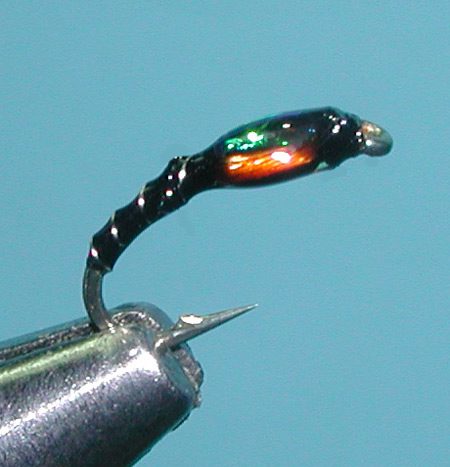
Epoxy Buzzers, Black
Tying Instructions
1. Attach the hook to the vise with the point and barb clear of the vise grips. I am using a Tiemco 2457 curved hook. Other hooks will work as well. The Daiichi 1120 and 1130 have a wide gap. You might select a heavier wire as well for larger fish. Another good hook is the Tiemco 2499sp-bl, this is a barbless and wide gap hook with a heavy wire.
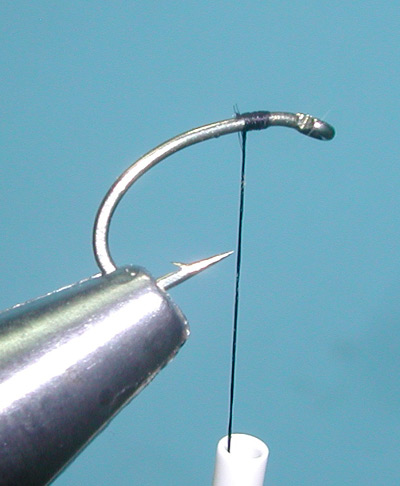
2. Attach a ribbing wire to the bottom of the hook shank just behind the eye. Secure the ribbing along the bottom of the shank to the bend of the hook. Copper and Silver colors are the most common. Ultrawire comes in a number of wizes. The small size is generally used but you might want to use the X-small size for buzzers in the 18-20 size. A larger wire size will create an enhanced segmentation look to the pattern once the epoxy is applied.
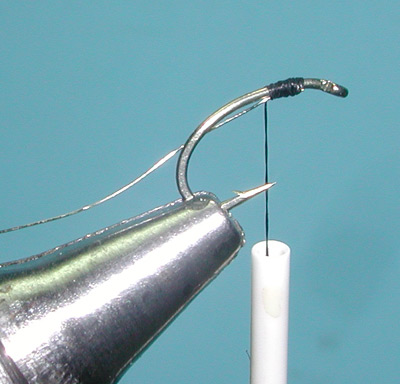
3. Wrap a thread foundation. Keep the thread wraps close together with even wraps building a solid and smooth foundation. The thread foundation should end near the thorax location behind the eye. Be careful to not nick the thread on the point of the hook as small fibers will extend from the body.
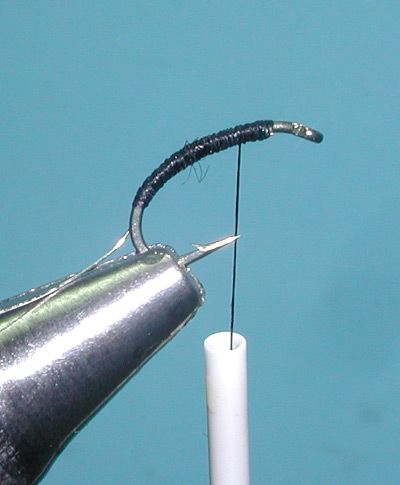
4. Wrap the ribbing wire forward with evenly spaced wraps. Secure the tag end of the ribbing near the thorax region with thread wraps.
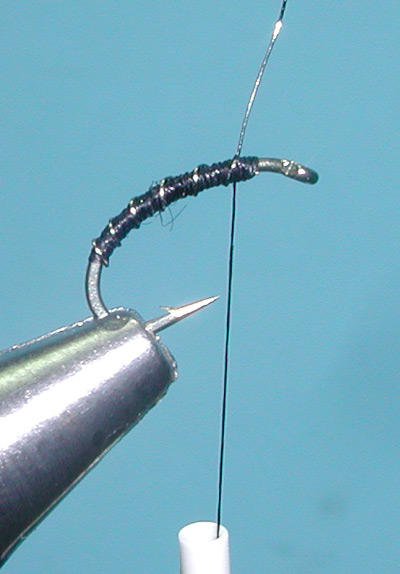
5. Attach 2 strands of Pearl Krystalflash within the thorax region for a wingcase. Buzzers tend to have an elongated thorax section that is about one third the body length.
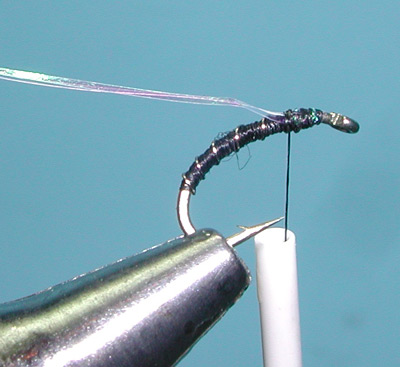
6. Attach a strand of Burnt Orange Lifeflex for wingpads to the bottom of the hook shank near the back of the thorax region. Use Figure 8 wraps to secure the material. You can use other material as well for the wingpads such as floss, biots, flashabou, etc. Buzzers typically have an orange colored wingpad but other colors are used as well.
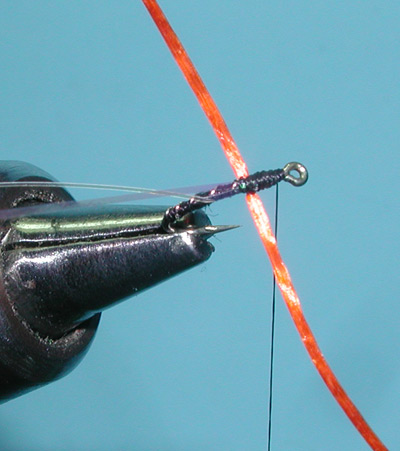
7. Sweep the Lifeflex strand back and build a thread thorax that is about twice the diameter as the body and about one third the length of the body. The thorax should have a elongated taper on each side.
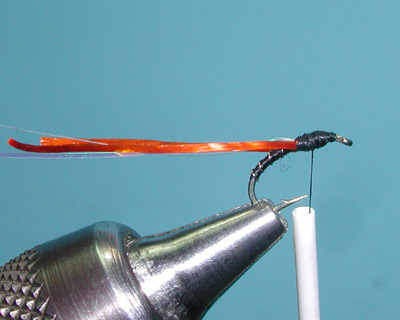
8. Bring the two Pearl Krystalflash strands over the thread thorax and secure with a couple of thread wraps behind the eye. Note the I am securing these strands about one eye length behind the eye as you need some room to create a head and to hide the tag ends of the strands.
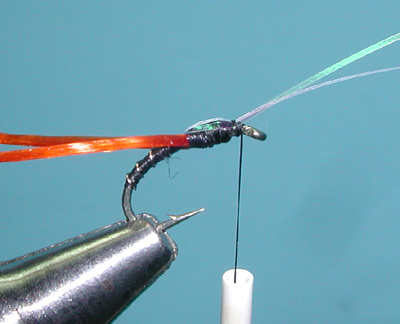
9. Next, bring the two sections of the Lifeflex forward on each side of the thorax and secure these strands with a few thread wraps. Lifeflex is stretchable and I stretch this somewhat to keep the strands tightly against the thread thorax sides.
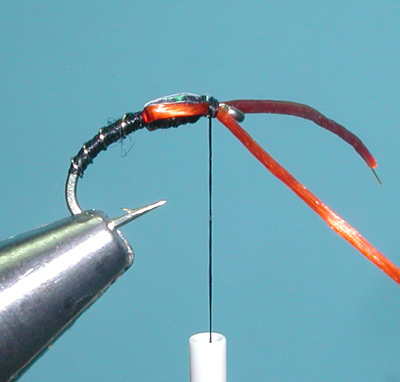
10. Place a couple of thread wraps in front of the tag ends of the strands and trim off the tag ends. The exposed end sections of the strands will be hidden with thread wraps in the creation of the head.
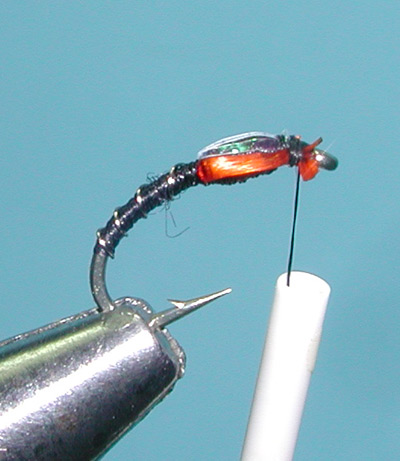
11. Create a thread head which is about the same diameter as the thorax and whip finish. Try to not crowd the eye of the hook.
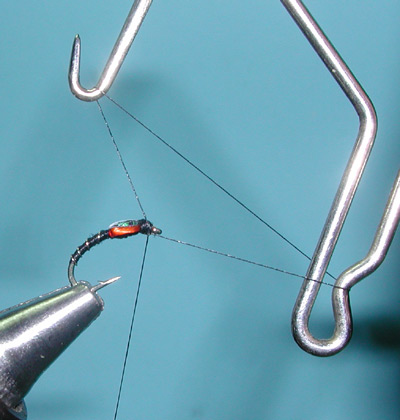
12. Turn the pattern upside down with the vise and apply a thin layer of epoxy to the fly. Try to keep any of the epoxy from coating the eye of the hook. If you do, clean the eye with a bobkin. I am using Loon’s UV Clear Fly Finish, Thin. Applying the finish upside down helps to keep the epoxy from being excessive on the body.
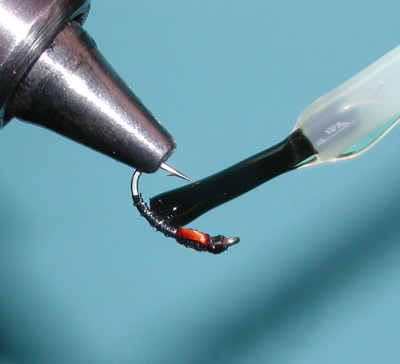
13. Use a UV light source to cure the epoxy. It only takes about 30 seconds.
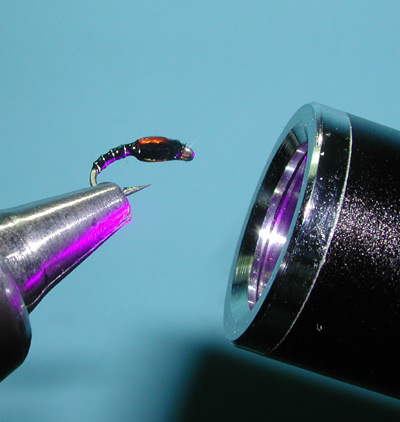
14. The finished pattern. Note how the Pearl Krystalflash wingcase glows under the epoxy. The wingpads also disappear into the thorax section for a lifelike appearance. The ribbing is also a smoother profile of segmentation.
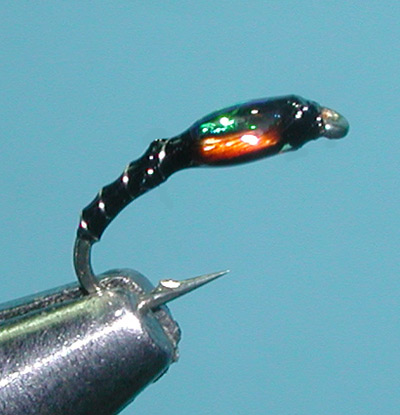
| Materials
to Order Material, click the link |
|
|---|---|
| Hook | TMC 2457 #14-20 |
| Thread | Uni-thread 8/0 Black |
| Head | Uni-thread 8/0 Black |
| Body | Uni-thread 8/0 Black |
| Thorax | Uni-thread 8/0 Black |
| Wingcase | Pearl Krystalflash |
| Wingpads | Life Flex, Orange |
| Ribbing | Small Silver Wire |
| Coating | UV Clear Fly Finish, Thin |

Ron Oldroyd
Epoxy Buzzers
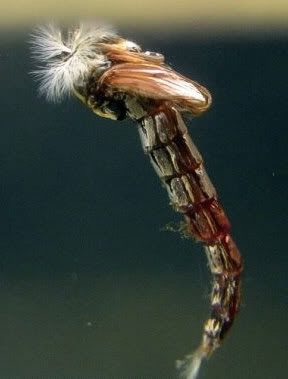
Buzzers is an English term for midges. They represent Chironomids that are a significant food source for many fish, particularly within stillwaters. TheTDCpattern was one of the first emerging midge patterns designed on our West Coast in the 1950’s and theZebra midgefollowed soon as a thread body pupa and larvae pattern.
Buzzers, an English pattern
Buzzer patterns were developed within England starting in the 1920’s with the Blagdon Buzzer created by Dr. H A Bell. The Epoxy Buzzers were also developed in Great Britain, eventually coming to our West Coast as well. Bob Wyatt (Trout Hunting: The Pursuit of Happiness, 2004) indicates that Ron Oldroyd in England may have come up with the pattern using a thread body with a Pearl Mylar ribbing and a Pearl Mylar thorax. Unfortunately, Ron passed away in 2021, a longtime member of the Rutland Water Fly Fishers. Keeping the pattern slender with the minimal amount of material, Ron covered the body with Epoxy to protect the material and also provide a realistic glassy body.
Epoxy to UV Fly Finish
Epoxy takes some time to harden and has associated fumes that must allow some time to cure. If the coating was to be slim, an acrylic coating such as Sally’s Hard as Nails would often be substituted. Today, there are UV cured products that produce the same effects as Epoxy and are much easier to apply as well as curing within minutes. With these new finishes, Epoxy Buzzers have become much more popular and are used often within our Sierran waters. The thin profile allows the pattern to work well as a multiple fly nymph rig due to the excellent sinking rate.
Use as a dropper
It is also a good choice for a dropper from a dry fly. Within stillwater applications, trout might shy away from traditional beadhead patterns but will readily take an Epoxy Buzzer. Epoxy Buzzers are often composed of a thread or floss body with a ribbing. The thorax is usually thread with orange colored cheeks and a small thread head. Some patterns tie a tuft of antron just in front of the head for gills. The entire body is covered with UV Fly Finish with a small build-up of Fly Finish around the thorax for a smooth and sleek profile.
Variations
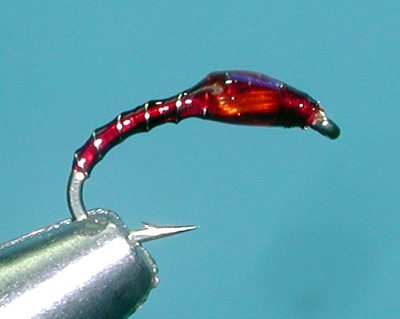
Epoxy Buzzer, Wine
| Hook | TMC 2457 #14-20 |
| Thread | Uni-thread Wine 8/0 |
| Head | Uni-thread Wine 8/0 |
| Body | Uni-thread Wine 8/0 |
| Thorax | Uni-thread Wine 8/0 |
| Wingcase | Pearl Krystalflash |
| Wingpads | Life Flex, Orange |
| Ribbing | Small Silver Wire |
| Coating | UV Clear Fly Finish, Thin |
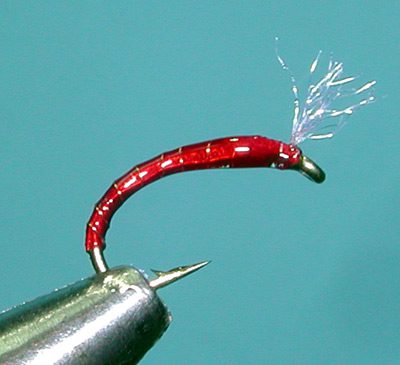
Epoxy Buzzer, Red
| Hook | Daiichi 1130 #14-20 |
| Thread | Uni-thread 8/0 Red |
| Head | Uni-thread 8/0 Red |
| Body | Uni-thread 8/0 Red |
| Thorax | Uni-thread 8/0 Red |
| Gills | White Antron |
| Ribbing | Small Copper Wire |
| Coating | UV Clear Fly Finish, Thin |
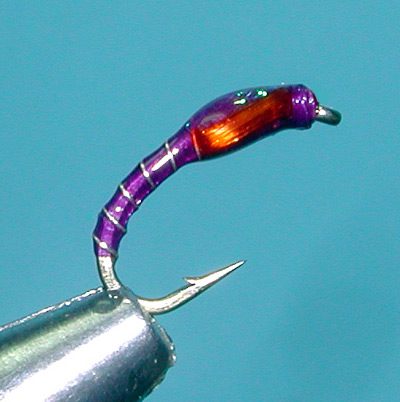
Epoxy Buzzer, Purple
| Hook | TMC 2457 #14-20 |
| Thread | Uni-thread 8/0 Purple |
| Head | Uni-thread 8/0 Purple |
| Body | Uni-thread 8/0 Purple |
| Thorax | Uni-thread 8/0 Purple |
| Wingcase | Pearl Krystalflash |
| Wingpads | Life Flex, Orange |
| Ribbing | Small Silver Wire |
| Coating | UV Clear Fly Finish, Thin |
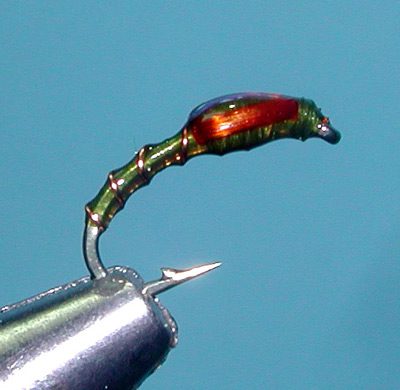
Epoxy Buzzer, Olive
| Hook | TMC 2457 #14-20 |
| Thread | Uni-thread 8/0 Olive |
| Head | Uni-thread 8/0 Olive |
| Body | Uni-thread 8/0 Olive |
| Thorax | Uni-thread 8/0 Olive |
| Wingcase | Pearl Krystalflash |
| Wingpads | Life Flex, Orange |
| Ribbing | Small Copper Wire |
| Coating | UV Clear Fly Finish, Thin |
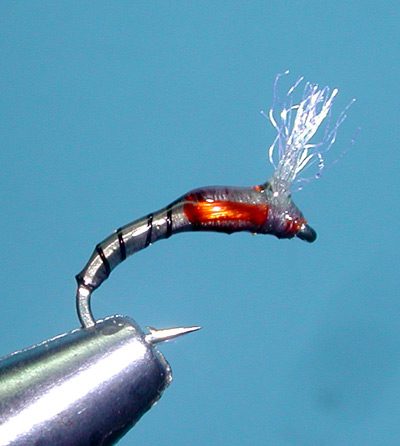
Epoxy Buzzer, Gray
| Hook | TMC 2457 #14-20 |
| Thread | Uni-thread 8/0 Gray |
| Head | Uni-thread 8/0 Gray |
| Body | Uni-thread 8/0 Gray |
| Thorax | Uni-thread 8/0 Gray |
| Gills | White Antron |
| Wingpads | Life Flex, Orange |
| Ribbing | Small Silver Wire |
| Coating | UV Clear Fly Finish, Thin |
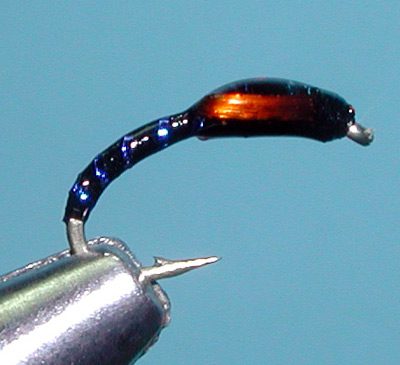
Epoxy Buzzer, Black/Blue
| Hook | TMC 2457 #14-20 |
| Thread | Uni-thread 8/0 Black |
| Head | Uni-thread 8/0 Black |
| Body | Uni-thread 8/0 Black |
| Thorax | Uni-thread 8/0 Black |
| Wingpads | Life Flex, Orange |
| Ribbing | Royal Blue Krystalflash |
| Coating | UV Clear Fly Finish, Thin |