
Sub-Total: $0.00
Squirmy Wormy – close to being a live worm
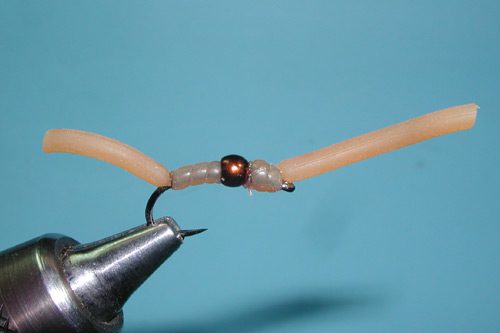
Squirmy Wormy
Tying Instructions
1. Slip a bead onto the hook.
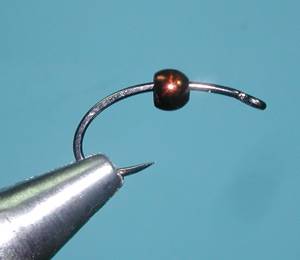
2. Attach the thread to the midpoint of the shank and lay a thread foundation halfway along the curvature.
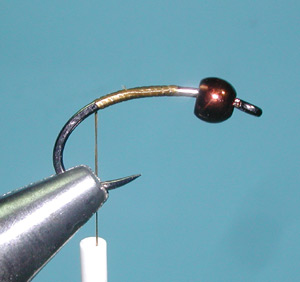
3. Attach the Squirmito material to the shank facing you and apply two loose thread wraps that will not cut the material.
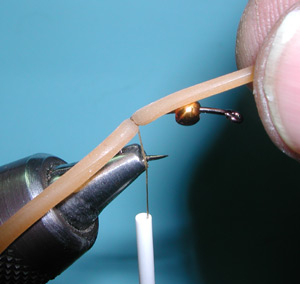
4. Bring the thread in front of the Squirmito material with two tight wraps just in front of the material and wrap back up to the midpoint of the shank.
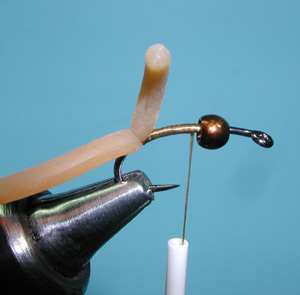
5. Next, stretch the Squirmito material and spirol wrap up to the midpoint of the shank. Secure the material with two loose wraps as to not cut the material and place two tight wraps just in front.
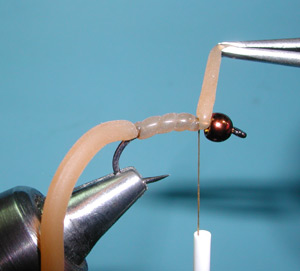
6. Snip off the tag end and secure with 5-6 additional thread wraps, then apply a whip finish and snip the thread.
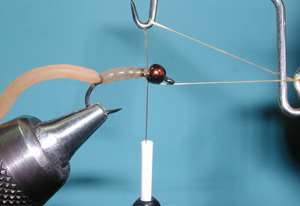
7. Trim the rear body to the length desired.
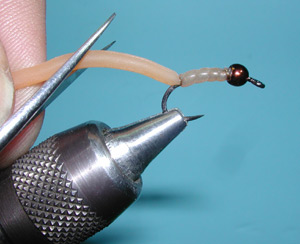
8. Attach the thread to the shank in front of bead.
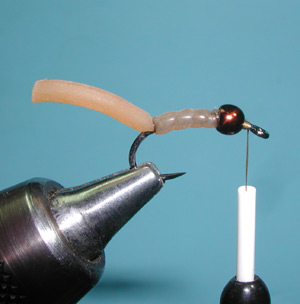
9. Just behind the eye place another strand of Squirmito and secure this strand to the shank with two loose thread wraps.
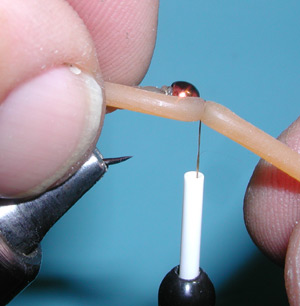
10. Followed by two tight wraps in front of the material.
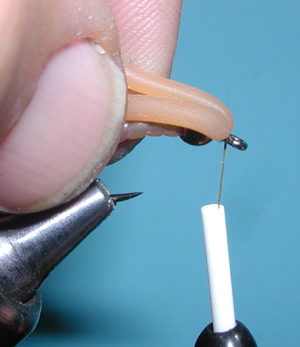
11. And two tight wraps behind the material.
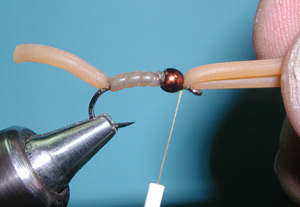
12. Stretch the material and wrap the material back towards the bead. The bead will be pushed over the whip finished thread wraps of the rear section. Secure the material with two loose wraps followed by two tight wraps between the Squirmito material and the bead.
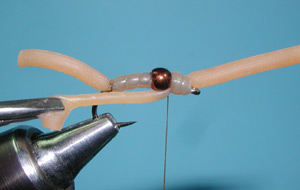
13. Apply a whip finish next to the bead.
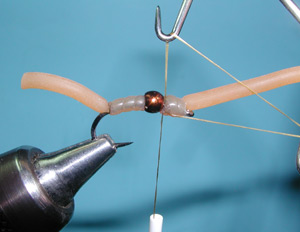
13. The finished Squirmy Wormy.
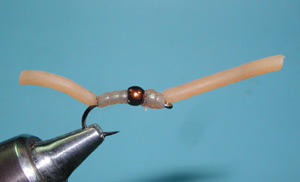
| Materials
to Order Material, click the link |
|
|---|---|
| Hook | Competition 300BL, sizes 12-16 |
| Thread | Danville Flat Waxed, Olive |
| Weight | Dazzle Bead, Metallic Pheasant Tail Brown |
| Body | Squirmito, Worm Tan |
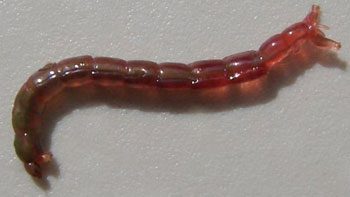

David Hise
Squirmy Wormy
The Squirmy Wormy pattern is a variation of the San Juan Worm by Dave Hise of Hickory, North Carolina. Dave used the silicon tendrils found on certain children’s toys rather than Vernille or Ultra Chenille. The silicon material gave much better action to the pattern and would sinuate through the water column just like a live worm.
World Youth Fly Fishing Championship
The U.S. Youth Fly Fishing team used this pattern during the 2014 World Youth Fly Fishing Championship which they won and repeated their winning performance in Poland during 2015. Some teams, like the Czech team, felt that this pattern was not a “true” fly pattern but should be considered a spinner lure due to the length and action of the tendrils. The Czechs decided to ban this pattern if the tendrils exceeded 1 cm. This restriction made the pattern look more like a…Czech Nymph.
Squirmito
The tendrils are marketed to fly tiers as Squirmito and the material has been reengineered for better durability. However, it remains a material that can be cut quite easily by the thread. Try to select a flat thread such as Danville’s Flat Nylon or or one that is greater than 140 denier. Some tiers prefer to use a dubbed thread or a chenille to secure the silicon tendril to the hook shank. Heat and volatile Glues are also a problem with this material causing melting and breakdown. Dave is the owner of Casters Fly Shop and a fly designer for Orvis since 2008 with over 40 patterns attributed to him.
Tungsten Beads
With the use of jig hooks, tungsten beads are now available in a number of colors. Use of the tungsten beads will really get those squirmy wormies close to the bottom. Using Tungsten beads from 3mm to 4.5 is common. Additional weight can be attained with leadfree wire wraps. For additional durability, apply a drop of UV Loon’s Fly Finish Thick to the collar wraps just behind the bead. I was reading Jason Randle’s book Nymph Masters and even Lefty Kreh indicated that the Squirmy Wormy was one of his favorite patterns. Don’t hesitate to give this pattern a try.
Variations
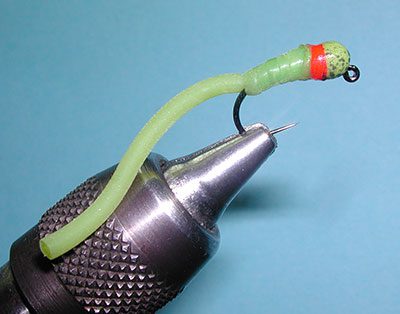
Squirminator Jig, Lt. Olive
| Hook | TMC 403BLJ, sizes 10-14 |
| Thread | Danville Flat Waxed, Light Olive |
| Bead | 5/32 |
| Weight | 0.020 |
| Body | Squirmito, Light Olive |
| Collar | Danville Flat Waxed, Red coated with UV Loon's Fly Finish, Thick |
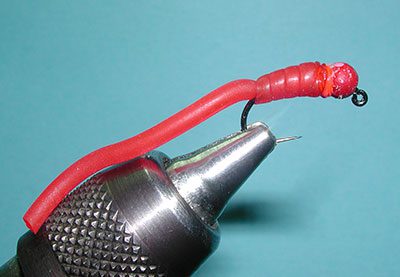
Squirminator Jig, Blood Worm
| Hook | TMC 403BLJ, sizes 10-14 |
| Thread | Danville Flat Waxed, Red |
| Bead | 5/32 |
| Weight | 0.020 |
| Body | Squirmito, Bright Red |
| Collar | Danville Flat Waxed, Red coated with UV Loon's Fly Finish, Thick |
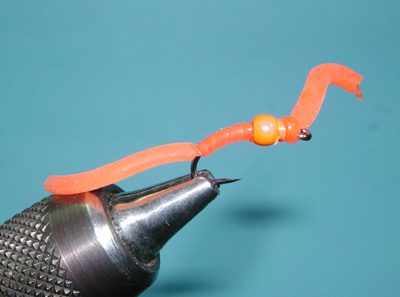
Squirmy Worm, Orange
| Hook | Competition 300BL, sizes 10-14 |
| Thread | Danville Flat Waxed, Fl. Orange |
| Bead | Dazzle Bead, Fl. Orange |
| Body | Squirmito, Fl. Orange |
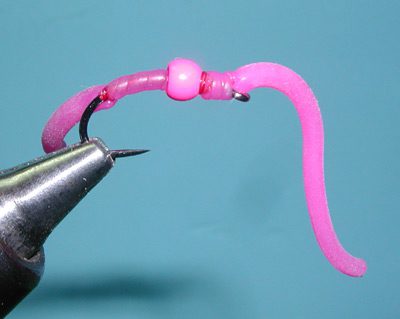
Squirmy Worm, Pink
| Hook | Competition 300BL , sizes 10-14 |
| Thread | Danville Flat Waxed, Red |
| Bead | Dazzle Bead, Pink |
| Body | Squirmito, Pink |
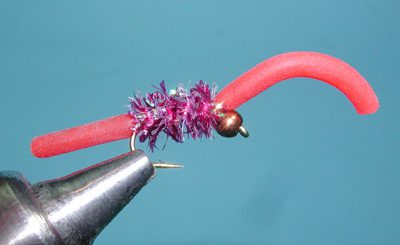
Squirmy Worm, Blood Worm
| Hook | Competition 300BL , sizes 10-14 |
| Thread | Danville Flat Waxed, Red |
| Bead | Tungsten Bead, Metallic Brown |
| Body | Squirmito, Blood Worm and Micro Polar Chenille, Claret |
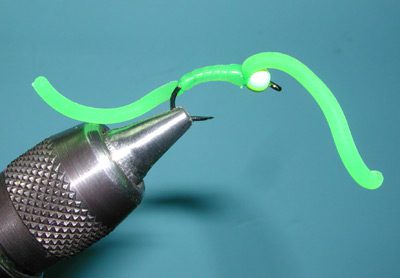
Squirmy Worm, Chartreuse
| Hook | Competition 300BL , sizes 10-14 |
| Thread | Danville Flat Waxed, Fl. Green |
| Bead | Tungsten Bead, Fl Chartreuse |
| Body | Squirmito, Fl. Chartreuse |