
Sub-Total: $0.00
Doc’s Twin Lakes Special – a tribute to a great guy
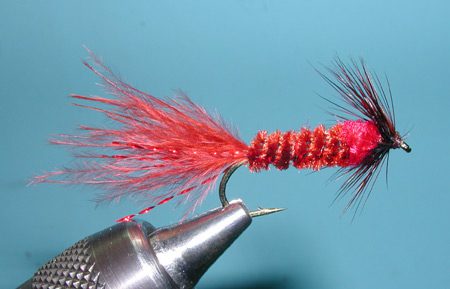
Doc’s Twin Lakes Special
Tying Instructions
1. Secure the hook to vise and attach the thread behind the eye of the hook.
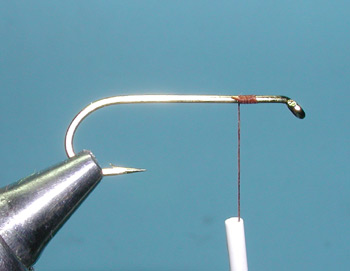
2. Wrap 15-20 wraps of 0.015″ lead-free wire around the shank leaving ample room behind the eye. The thread in remains in front of the wire wraps.
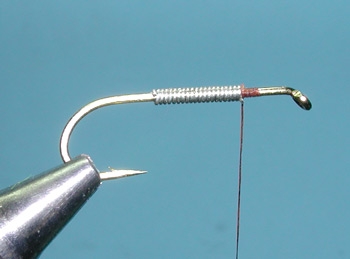
3. Secure the wire with thread wraps and wrap the thread back to the bend of the hook. Apply some head cement to secure the thread wraps.
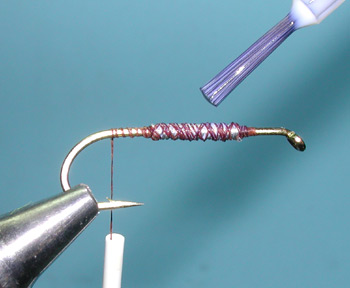
4. Clip a clump of marabou fibers from a quill, keeping the tips somewhat even. Secure this clump at the bend of the hook just above the barb. The tail length should be about the same as the hook shank length.
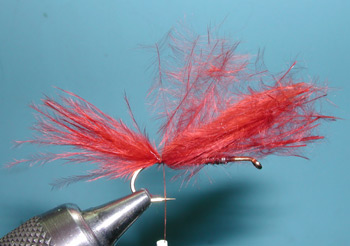
5. Secure the tag ends of the marabou to the hook shank with thread wraps, clipping off the excess where the lead wraps end behind the eye.
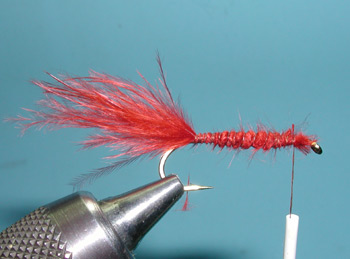
6. Add 2 strands of Krystalflash, the same length as the tail to each side of the tail. Secure the tag ends of the krystalflash to the shank and clip off the excess.
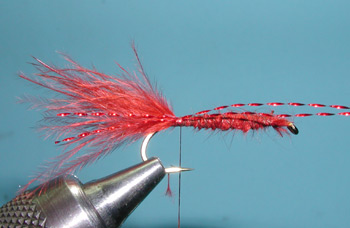
7. Attach the Fine Chenille at the tail tie down point. Do this by removing some of the fuzz of the chennile, exposing the thread core. Use the core of the chenille to fasten the material down to the shank. Attach a single strand of Krystalflash to the base of the tail as well. This strand will be roped around the Chenille to add sparkle.
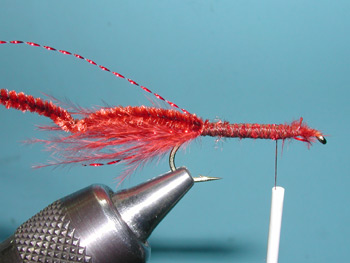
8. In this photo, the Krystalflash is roped around the Chenille and it is ready to wrap around the shank for the body.
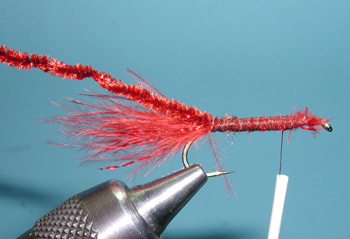
9. Wrap the chenille to about the 3/4 position and anchor with 2-3 thread wraps. Clip off the tag end and secure with additional thread wraps.
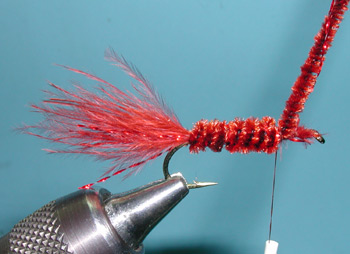
10. Attach a piece of Red Fine Chenille just in front of the body. Do this in the same manner as the body by exposing the thread core and securing the core to the shank.
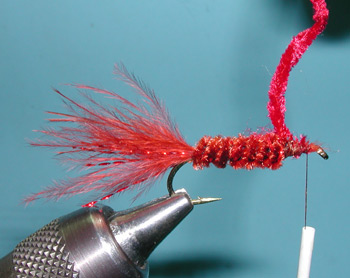
11. Wrap the Red Chenille for a throat. Leave enough room behind the eye to secure the hackle. Trim the tag of the chenille and secure with thread wraps.
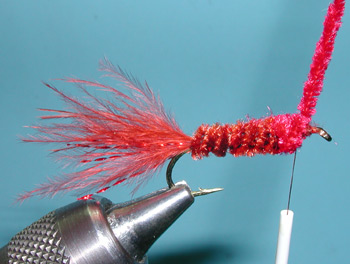
12. Prepare the saddle hackle by folding the fibers along the quill spline so that the fibers are in a plane. The length of the saddle fibers is a personal preference. You can select a hackle in which the fibers reach 1/3 of the body or over half of the body. Attach the saddle hackle by the tip in front of the red chenille. The hackle fibers should be facing the tail.
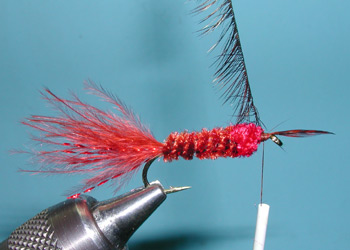
13. Attach your hackle pliers to the bare guill and use the pliers to wrap the hackle around the shank. Each wrap should be groomed back with your fingers to keep the fibers pointing back. Wrap in front of each previous wrap until you reach the base of the eye, then secure with thread wraps. Whip Finish.
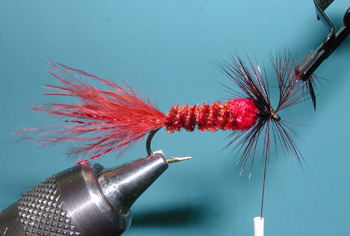
14. Trim off the tag end of the saddle hackle. Secure with a few more thread wraps in front of the hackle and whip finish.
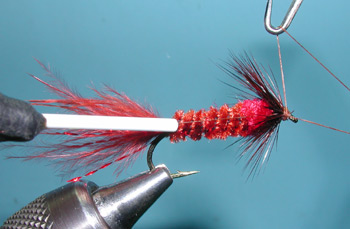
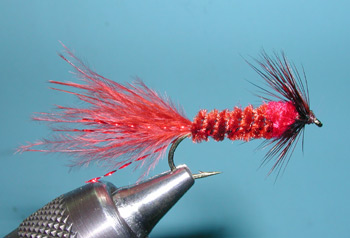
15. Apply some head cement to the finished thread wraps. Here is a traditional Twin Lakes Special. Note how the hackle fibers are supported upright by the chenille. This provides an attractor element to the pattern that produces a vibration when pulled through the water column. The red chenille throat provides an additional attractor element of an alarmed baitfish flaring it’s gills.
| Materials
to Order Material, click the link |
|
|---|---|
| Hook | TMC 5263 #8-12 |
| Thread | Danville Black 6/0 |
| Head | Danville Black 6/0 |
| Weight | 0.020 Leadfree Wire |
| Hackle | 2 wraps of Grizzly Brown Saddle Hackle |
| Body | Fine Brown Chenille |
| Throat | Fine Red Chenille |
| Tail | Brown Marabou with 2 strands of Red Krystalflash |
Doc’s Twin Lakes Special
Doc’s Twin Lake Special is a cross between a Matuka and a Woolly Bugger. It has the Marabou tail and chenille body of a Woolly Bugger with a throat hackle typical of Matukas. There is no palmered hackle through the body. The fly can be tied with many variations of color. One popular variation is an Olive body with a Red Chenille Throat and a Dark Olive Marabou Tail.
Tying in the Round
Bill “Doc” Randol, a retired Veterinarian of Mammoth Lakes, developed this fly in the early 1980’s and it has been a real winner in the local lakes throughout that area. He designed the Twin Lakes Special utilizing Charles Brooks method of “Tying in the Round” so that the pattern attributes would be recognizable from any direction. The fly is marketed throughout the Sierra by Umpqua Feather Merchants. Doc Randol passed away Jan. 3rd, 2009. He will be remembered fondly for his gracious manner and style.
Lanny De Rose presented an interesting variation of Doc’s Twin Lakes Special within a recent fly swap, using Crystal Chenille or J. Fair’s Short shuck for the body. Lanny also utilized a great attraction feature by incorporating Orange marabou into the Olive Marabou tail, which is something that Denny Rickard’s does with his new versions of Seal Buggers.
Variations
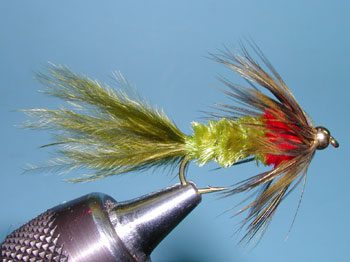
Twin Lake Special, Olive
| Hook | TMC 5263 #8-12 |
| Thread | Danville Black 6/0 |
| Head | Gold Bead |
| Hackle | 2 wraps of Olive Grizzly Hen Saddle |
| Body | Medium Light Olive Chenille |
| Throat | Fine Red Chenille |
| Tail | Olive Marabou with 2 strands of Olive Krystalflash |
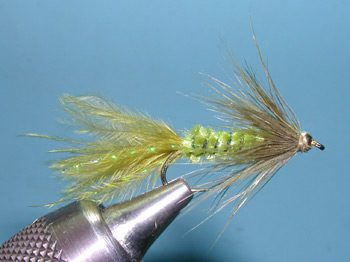
Twin Lake Special, Olive
| Hook | TMC 5263 #8-12 |
| Thread | Danville Olive 6/0 |
| Head | Gold Bead |
| Hackle | 2 wraps of Olive Saddle Hackle |
| Body | Fine Light Olive Chenille |
| Ribbing | 1 strand of Olive Krystalflash roped |
| Tail | Olive Marabou with 2 strands of Olive Krystalflash |
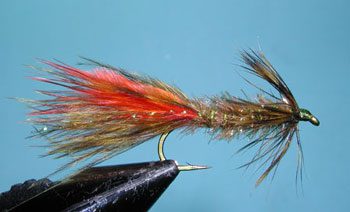
Twin Lake Special, Lanny’s Crystal
| Hook | Daiichi 2220 #8-12 |
| Thread | 8/0 Uni Thread Olive |
| Head | 8/0 Uni Thread Olive |
| Weight | 0.020 Leadfree Wire |
| Hackle | 2 wraps of Olive Grizzly Hen Saddle |
| Body | Olive Krystal Chenille |
| Tail | Olive Marabou under Orange Marabou with 2 strands of Olive Krystalflash |
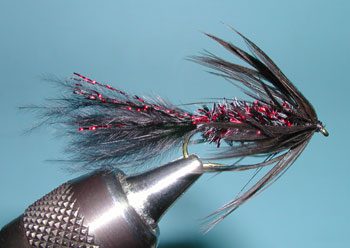
Twin Lake Special, Black
| Hook | TMC 5263 #8-12 |
| Thread | Danville Black 6/0 |
| Head | Danville Black 6/0 |
| Weight | 0.020 Leadfree Wire |
| Hackle | 2 wraps of Black Hen Saddle Hackle |
| Body | Speckled Krystal Chenille Midnight Fire |
| Tail | Black Marabou with 2 strands of Red and Black Krystalflash twisted |