
Sub-Total: $0.00
Mini Sculpin – excellence in a small size
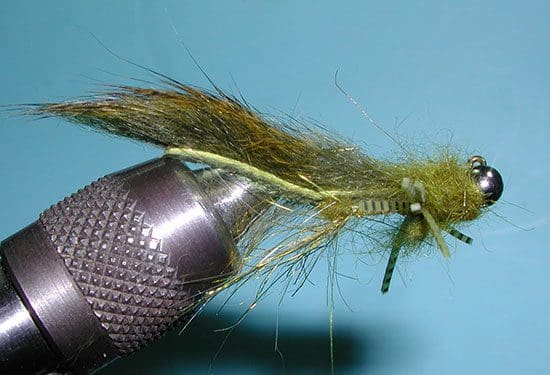
Mini Sculpin
Tying Instructions
Tying Instructions: Mini Sculpin
1. Slip on a slotted tungsten black bead. Using a 5/32 size with a #8 Daiichi 4660 jig hook. Oh! and crimp down the barb.
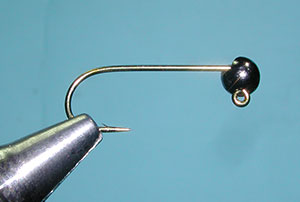
2. Wrap 0.015″ Leadfree wire around the hook shank 4-5 times and shove it into the bead cavity to stabilize the bead.
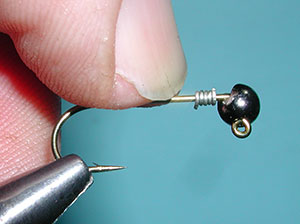
3. Attach the Monofilament thread just behind the bead and secure the wire wraps. Notice the barbs are crimped down.
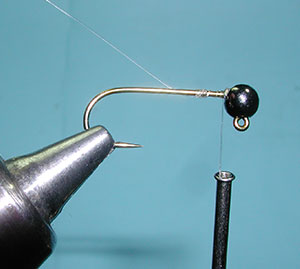
4. Wrap the monofilament thread to the bend of the hook and apply Aussie Dubbing to the thread. I apply one wrap to lock in the material to the shank and can tighten the dubbing around the thread.
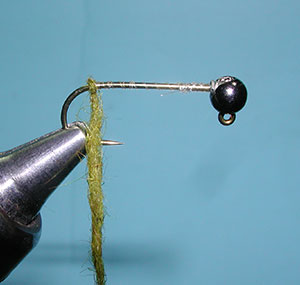
5. Wrap a small ball of dubbing at the bend of the hook. This performs as a stop for the squirrel zonker strip you will apply later. Bring the monofilament thread up to the 1/3 position on the hook shank behind the bead. The is the location you will tie in the legs (or pectoral fins).
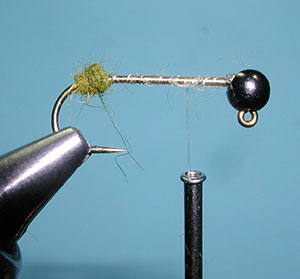
6. Clip off 5 barred legs, 1.5 to 2.0 inches long, and secure the center of the bundle of legs at the tie in position on top of the shank, 1/3 shank length behind the bead. Apply some X wraps.
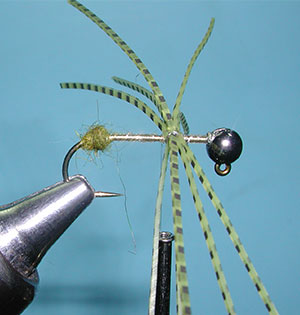
7. Bring the thread to just behind the bead and attach a section of Ice Wing Fiber just behind the bead.
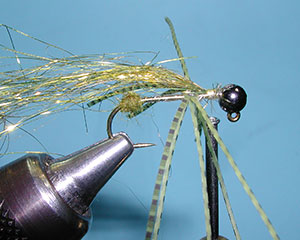
8. Secure the fiber bundle along the top of the shank with thread wraps down to the dubbing ball at the bend of the hook. The monofilament allows the coloration to shine through. This is the reason for using monofilament.
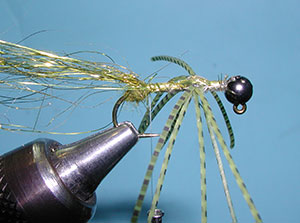
9. Trim the tag end of the fiber bundle about one hook shank from the bend of the hook. Cut the material with some sawing motions of the scissors so that there is some taper.
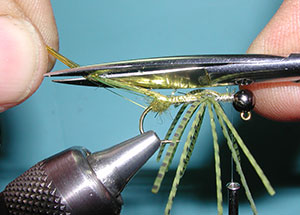
10. Wrap the monofilament thread back up to behind the bead.
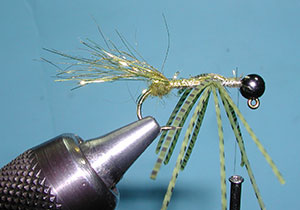
11. Whip Finish and cut off the tag end of the monofilament.
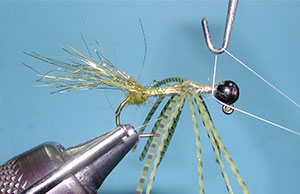
12. Attach the Olive Dun thread to just behind the bead.
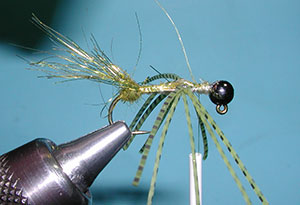
13. Invert the hook and measure a strip of pine squirrel so that the attachment location is about one hook shank long. Marking that spot with your right thumb and index finger, attach the strip to the point of the hook.
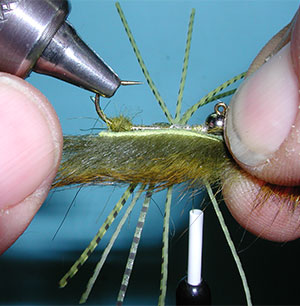
14. Remove the hook from the vise so that you can slip the strip from the hook point, around the bend, and up to the dubbing ball. Reattach the hook in the inverted position and bring the front part of the strip up to the bead.
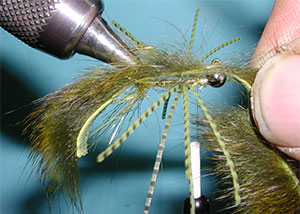
15. Secure the strip with thread wraps just behind the bead. Cut off the tag end and secure with additional thread wraps.
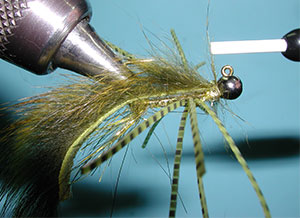
16. Attach a small wad of dubbing to both the top and bottom of the hook shank behind the bead. This material helps to hide the thread wraps that secure the strip but also provides additonal material to construct the sculpin head.
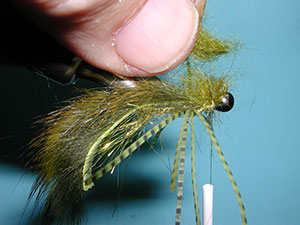
17. This photo shows how the material is clumped on both sides of the hook shank.
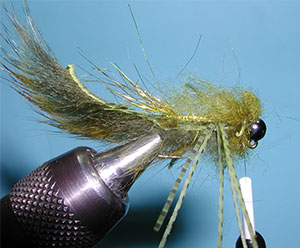
18. Create a dubbing loop and apply Aussie Dubbing to the loop.
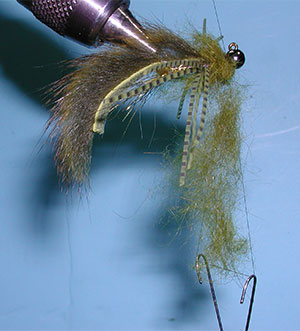
19. Twist the loop to create a dense chenille of dubbing.
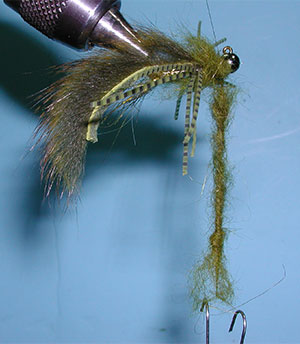
20. Wrap the dubbing around the shank just behind the bead. This should be fairly dense. Secure with thread wraps and trim off the tag end.
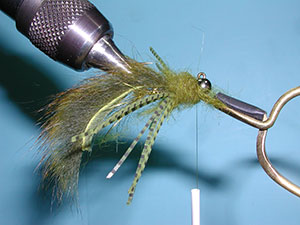
21. Whip Finish and trim off the tag end of the thread.
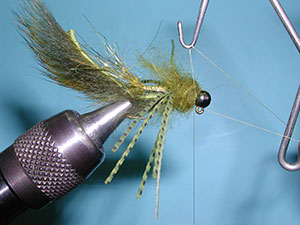
22. The head dubbing that is on the “belly” side of the pattern should be trimmed so that more of the shiny belly material shows itself.
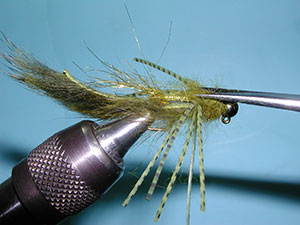
23. Brush out the head to get a nice flow of material going rearwards.
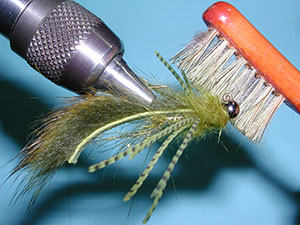
24. Grab the end of the silicon legs and trim so that they are about the length of the hook shank. These legs should extend perpendicular from the shank and not be pushed rearwards by the head dubbing.
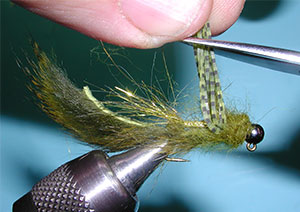
25. The finished Mini Sculpin. Designed to bounce off the bottom with the hook point being upright to reduce snags. The entire fly is only about 1.5 inches long, very close to many natural sculpins found in Sierran waters.
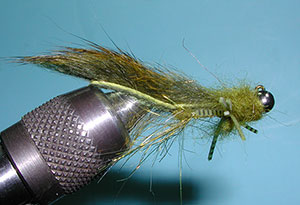
| Materials
to Order Material, click the link |
|
|---|---|
| Hook | Daiichi 4660 #8-12 |
| Thread | Danville Monofilament and Uni 8/0 Olive Dun |
| Head | Black Nickel Slotted Tungsten Bead, 5/32 |
| Weight | 0.015 Leadfree Wire |
| Fins | Grizzly Flutter Legs, Black Barred Olive |
| Body | Aussie Possum, Olive |
| Ribbing | Flat Silver Tinsel |
| Tail | Pine Squirrel Strip, Olive |
| Collar | Aussie Possum, Olive |
| Flash | Light Olive Ice Wing |
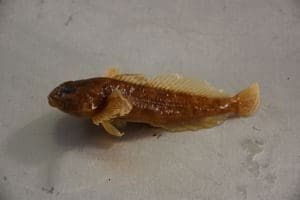
Sculpin
Mini Sculpin
Many Sculpin patterns are tied with Rabbit strips, utilizing a straight strip for a tail and a crosscut strip for the body. However, most of your natural sculpins are less than 1.5 inches and the rabbit strips are just too long and bulky to tie at this size. Welcome to Pine Squirrel! This material can be used with size #6-12 streamer or nymph hooks. The material still has the movement and natural mottled coloration of rabbit and can be used with a lighter rod such as a 4 weight. The patterns usually call for some type of heavy beadhead such as tungsten beads or formed Sculpin Heads marketed by Fish Skulls. Fish Skulls have a mini-size, perfect for these 1.5 to 1.75 inches patterns.
Jig Style Hooks
Many of these patterns are tied onto jig style hooks so that the pattern rides with the point upwards, reducing snagging. The body of the sculpin tapers from fat near the head to skinny near the tail. The Pine Squirrel strip produces this tapered effect and has an undulating effect within the current. Some sculpin patterns use spun deer hair for a head but this material tends to provide flotation to the pattern. Other patterns will utilize spun wool for the head which can be quite heavy and bulky when wet. These tungsten beads or Mini Sculpin heads are a good choice for getting the patterns to the bottom quickly and not create a tsunami wave upon casting.
Sculpins
Sculpins live near the bottom of the stream. They do not have stabilizing air bladders like trout so that they tend to tip up when drifting with the current and tip downwards when swimming. These weighted jig hooks will often produce the same effect.
Up and across casts are very effective with twitches to the line giving the pattern some movement in slack currents. Keep the line in the water with some tension to the pattern, you want to keep slack line to a minimum. Sculpins tend to live within the gentler currents usually within the lower sections of a run or pool. They dart among the rocks as they are not good swimmers. Occasionally, they get washed downstream and trout will be looking for them in drop-offs below riffle sections or transition areas along a gravel bar where fast water transitions to stillwater.
Variations
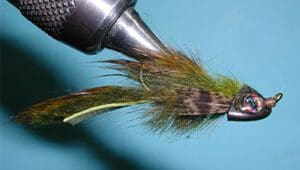
Fishskull Helmet Mini Sculpin, Olive
Fishskull Helmet Mini Sculpin, Olive
| Hook | TMC 5263 #6-10 |
| Thread | Danville 6/0 Dark Brown |
| Head | Mini Sculpin Helmet |
| Fins | Dyed Partridge, Olive |
| Body | Pine Squirrel Zonker Strip, Sculpin Olive |
| Tail | Pine Squirrel Zonker Strip, Sculpin Olive |
| Collar | Ozzie Possum, Olive |
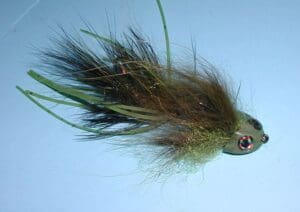
Fishskull Mini Headbanger
Mini Headbanger
| Hook | Gamakatsu B10S, #8 |
| Thread | Veevus 10/0 Black |
| Head | Olive Sculpin Helmet, Small |
| Legs | Crazy Legs, Olive/Black Flake |
| Body | Pearl Olive Estaz Chenille palmered with Black Schlappen Hackle |
| Tail | Black and Olive Marabou |
| Collar | Light Olive Mottled Nymph Blend |
| Overwing | Arctic Fox Body Fur, Olive |