
Sub-Total: $0.00
The Fly Patterns of Roderick Haig-Brown

Roderick Haig-Brown was an avid fly-fisher, pioneering conservationist, acclaimed author and magistrate.
His writing has influenced fisheries biologists, ecologists and countless others interested in the evolving relationship between people and nature.
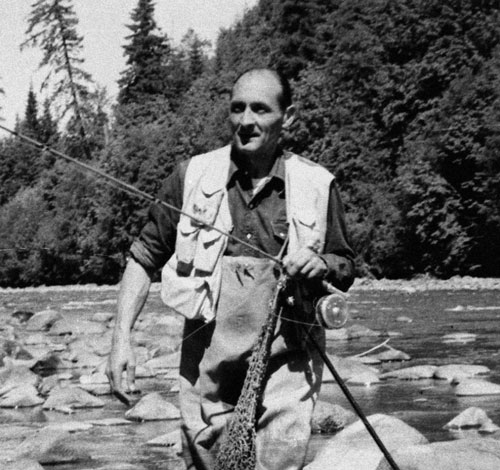
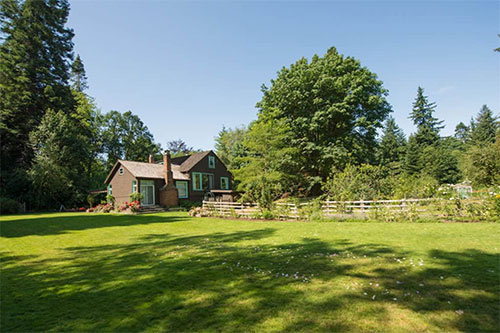
He moved to Campbell River in 1936, renting a house on the river which at the time belonged to one of Campbell River’s founding settlers, Reg Pidcock. When the neighboring house belonging to Reg’s brother Herb came up for sale, they purchased it and Haig-Brown embarked upon his writing career while working on expanding the house. The house was known as “Above Tide”. Today, it has been renamed the Haig-Brown Heritage House and is available as a B&B rental.
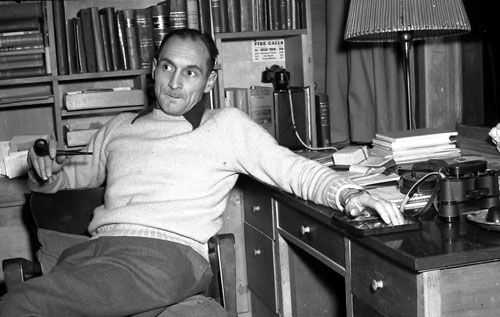
Within his study, Haig-Brown wrote over 25 books and more than 200 articles. Although he never attended a University, he served as a magistrate and as chancellor at the University of Victoria. Today, Roderick Haig-Brown is a figure with international stature. Literary awards grace his name, provincial parks are named after him, and his library is the object of personal pilgrimages by writers, anglers and conservationists.
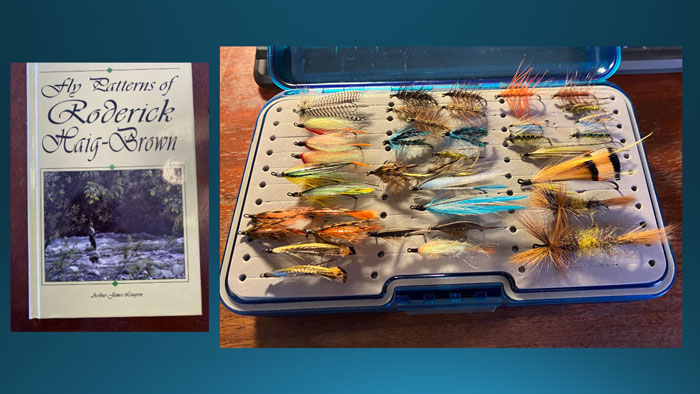
After Haig-Brown’s death in 1976 at the age of 68, Art Lingren (1993) put together a book of 20 fly patterns that were described by Haig-Brown. Many of these patterns are noted in his book, The Western Angler (1939). A few others were shown in The Fisherman’s Spring (1951) and The Fisherman’s Fall (1964). All of his patterns were based on imitating a food source of the trout. The patterns have evolved over time with different materials since some of the original materials are either illegal or very difficult to obtain. For example, dyed seal fur is substituted with John Rohmer’s Simi Seal and dyed Polar Bear fur can be substituted with the synthetic Polar Hair. The Indian Crow is replaced by orange Hen Neck tips. And the Blue Chatterer on the Silver Lady is substituted by the Kingfisher or blue strung Saddle hackle.
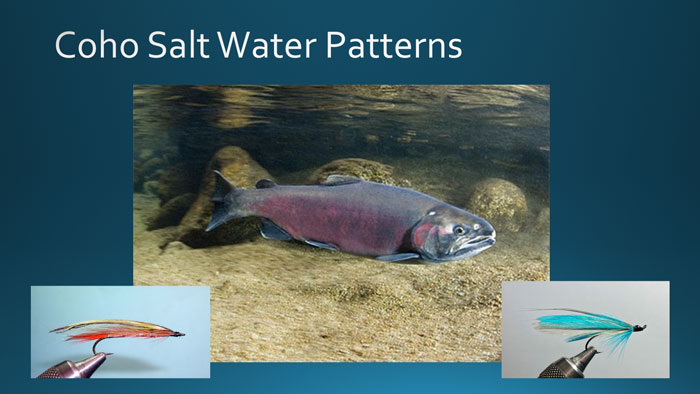
It was long assumed that the Pacific Salmon would not take a fly. Within the Pacific Northwest, this attitude was so prevalent that in the 1840’s, Captain John Gordon, suggested to his brother-in-law, England’s Foreign Secretary, Lord Aberdeen, that Oregon and Washington were not worth fighting over with the United States since the Pacific Salmon could not be hooked once they entered fresh water. Roderick Haig-Brown wanted to hook Pacific Salmon and some were able to do so within the salt water, starting in the early 1900’s. These early fly fishermen used baitfish imitation that worked within the estuaries and bays as the Salmon chased smelt, anchovies, and candlefish. The prevailing attitude of the time was that the Salmon would only pursue baitfish in a saltwater environment and would stop eating once they entered freshwater. The patterns that Haig-Brown designed for fishing Coho Salmon in the salt water include the Coho Golden and the Coho Blue were in the 1930’s.
Coho Golden
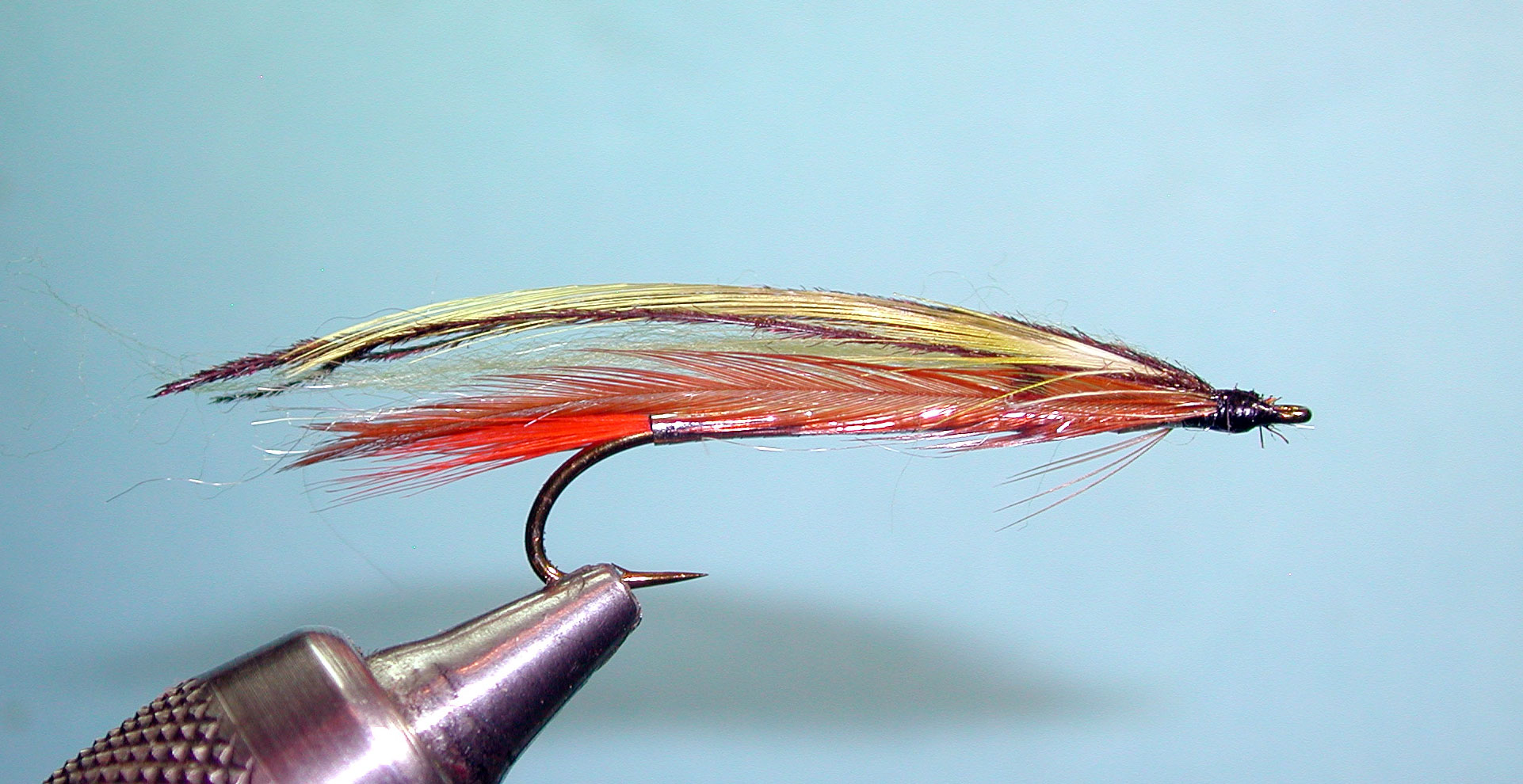
Coho Golden.
The Coho Golden was originally tied on a 2 1/2 inch Long Dee hook. (The Western Angler, 1939)
Hook: Daiichi 2370 #6
Tail: Orange Polar Bear
Body: Flat Silver
Wings: White Bear Fur, Olive Bear Fur
Sides: Red Jungle Cock hackles, flat along the wings, full length, bronze peacock herl laid along these
Topping over all
Polar Bear fur is restricted from purchase by the Marine Mammal Act of 1972. However, you can purchase polar bear fur that is documented as pre-1972. The colors needed can be dyed in a strong dye solution (Rit Dyemore or Prochem). Polar Hair is often used as a synthetic substitute.
Red Jungle Cock hackles can be difficult (and expensive) to find, however, Red Pheasant tail tips are easily available.
Coho Blue
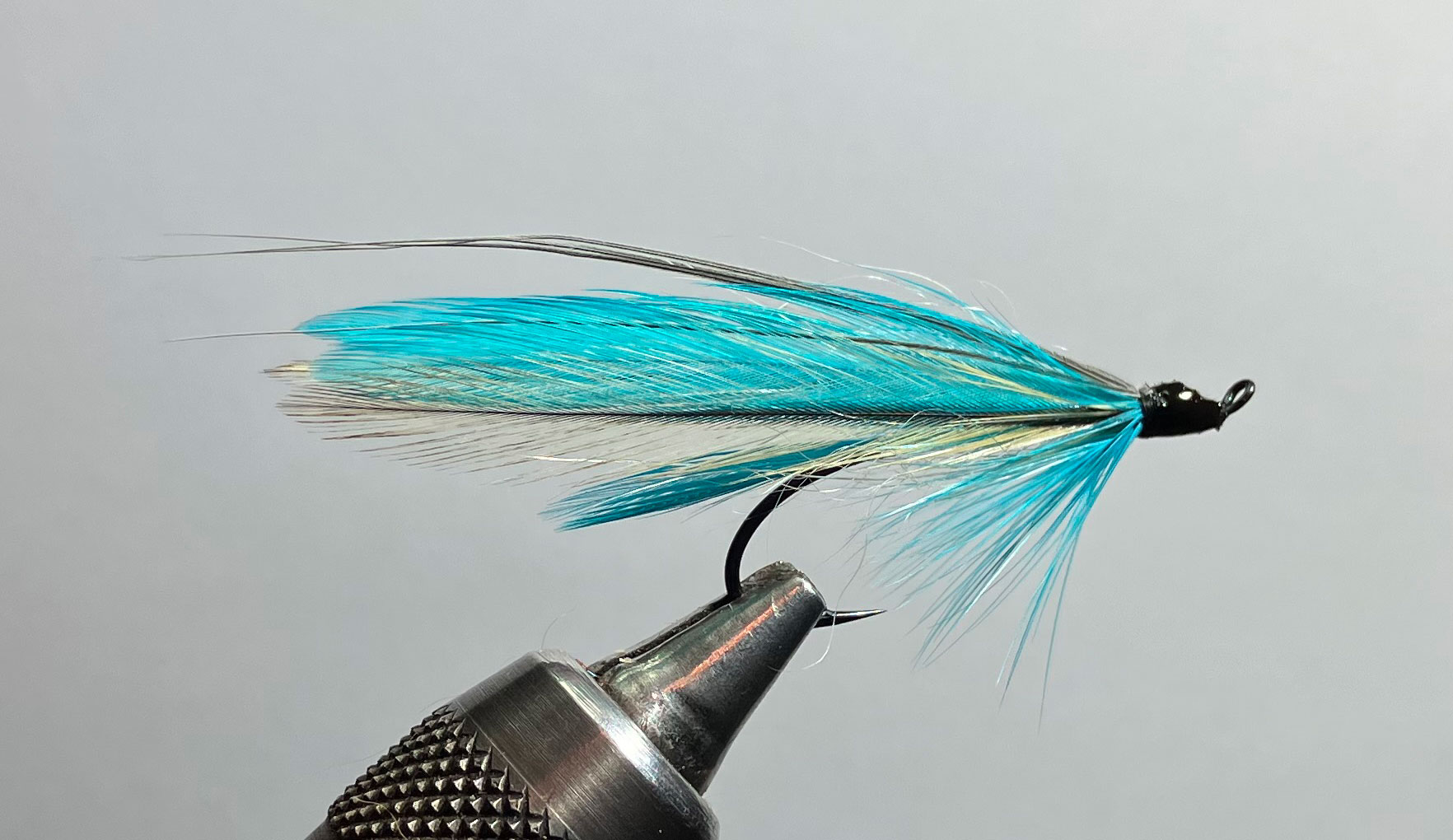
Coho Blue.
Coho Blue was originally tied on a 2 1/2 inch Long Dee hook. (The Western Angler, 1939)
Hook: Daiichi 2421 #6
Tail: Tip of large blue hackle
Body: Flat Silver
Wings: White Bear fur, Blue Bear fur
Sides: Blue Hackles and Badger Hackles, flat along wings, full length
Heron Hackles over all.
The Migratory Bird Treaty Act makes it illegal to possess, buy, or sell native heron feathers. The Grey Heron is a non-native bird and is often available. Other substitutes include Whitings Spey Rooster Necks/Saddles or Ringneck Pheasant Rump feathers. Nature’s Spirit has dyed Goose Flank Spey hackles that work well.
Polar Bear fur is restricted from purchase by the Marine Mammal Act of 1972. However, you can purchase polar bear fur that is documented as pre-1972. The colors needed can be dyed in a strong dye solution (Rit Dyemore or Prochem). Polar Hair is often used as a synthetic substitute.
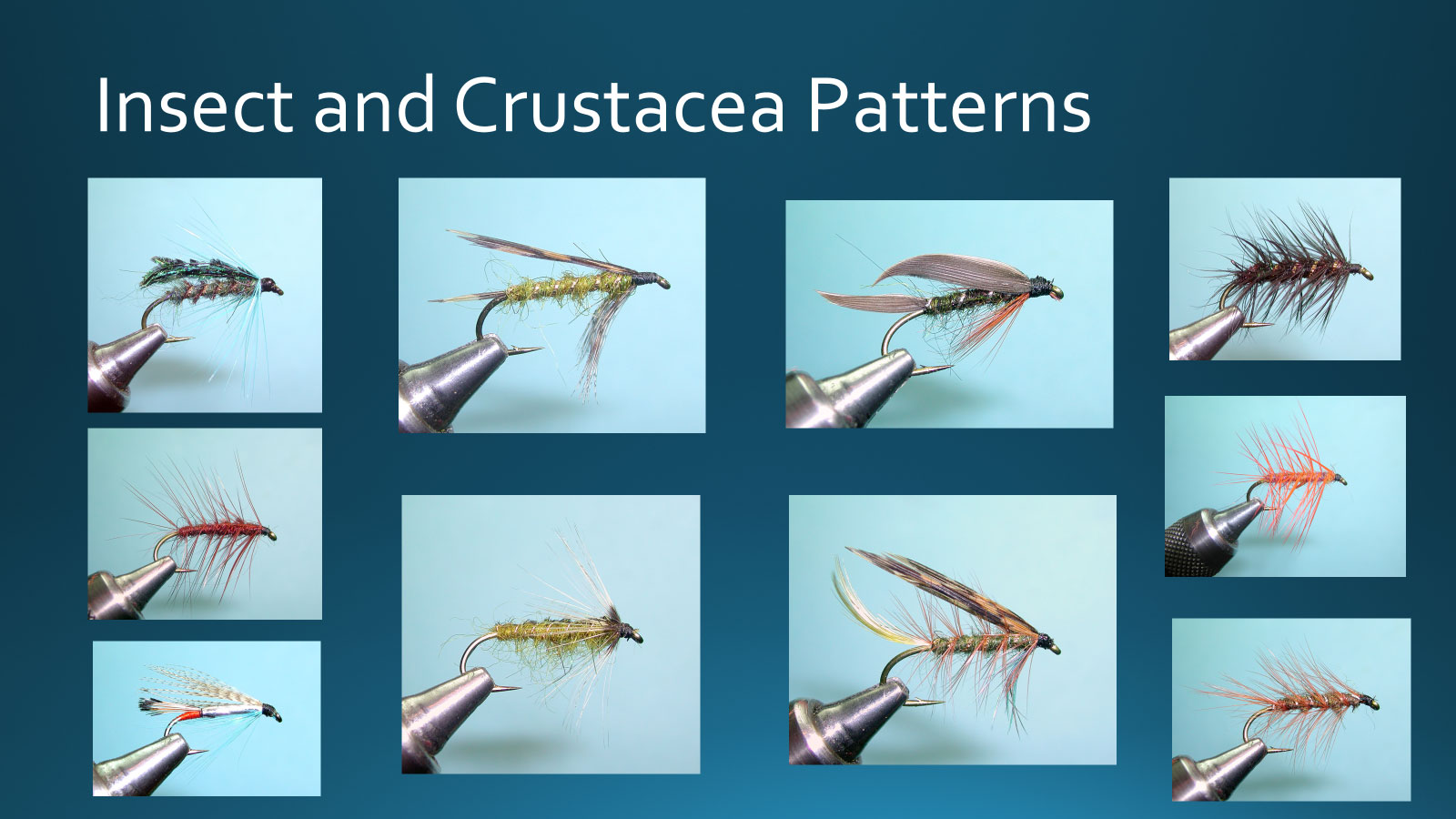
Haig-Brown’s Insect and Crustacea patterns imitated more of the terrestrial forms rather than the aquatic ones. The insect patterns included Caddis, Stoneflies, a terrestrial Beetle, and various caterpillars. He also created three crustacean patterns, the Gammarus, Mysid, and Asellus.
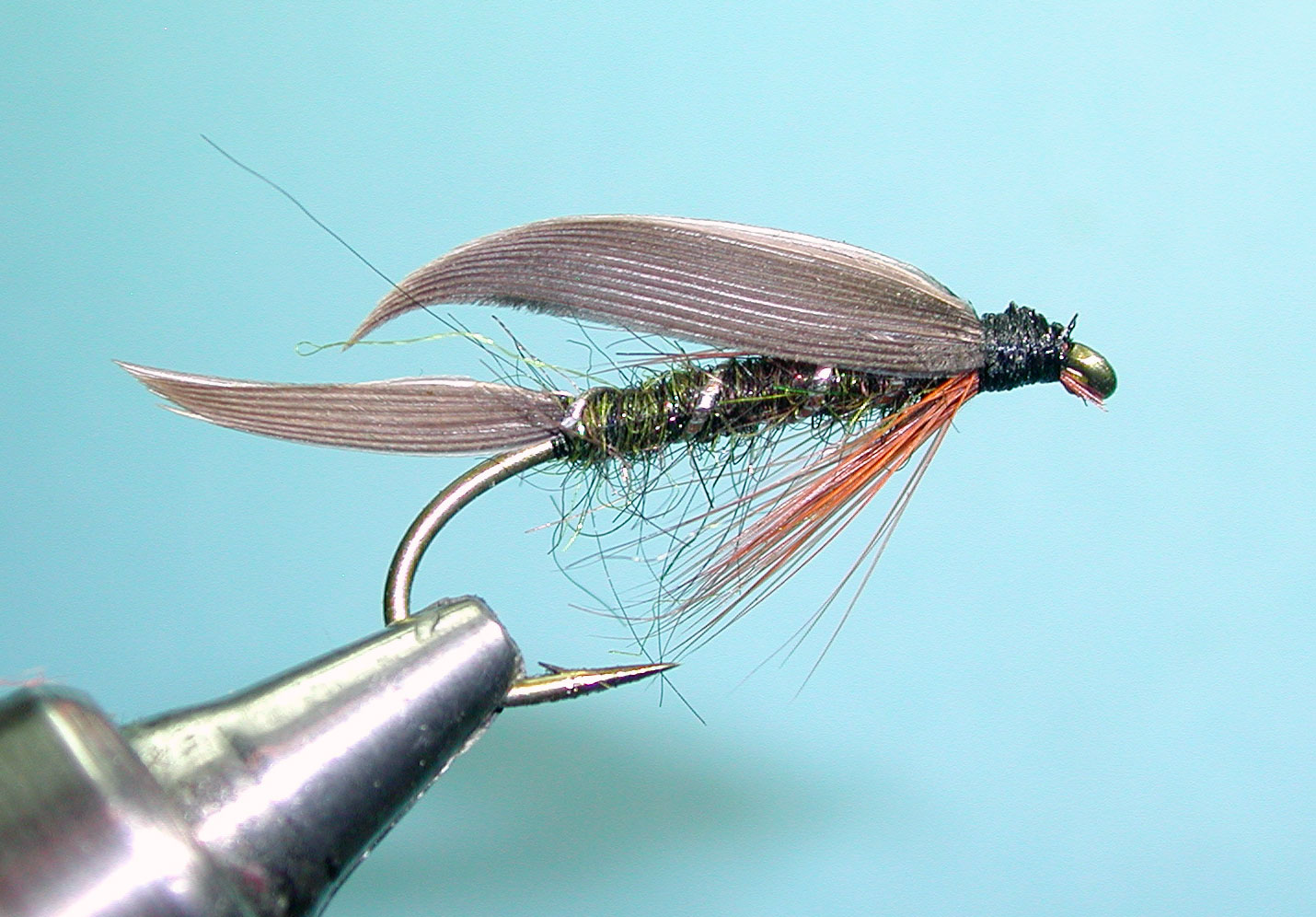
Dark Caddis
This is the only caddis pattern that is attributed to Haig-Brown. He wrote about this pattern in his book, The Western Angler (1939). He indicates that the pattern is closely related to Greenwell’s Glory and that it is “a good summer fly in many cutthroat streams.”
Tied on a Daiichi 1530 #6 hook
Tail: Dark mallard
Body: Very dark green seal’s fur
Ribbing: Oval gold
Hackle: Furnace or dark olive
Wings: Blae* or Dark Mallard
*Blae is the Scottish term for bluish-gray or leaden color
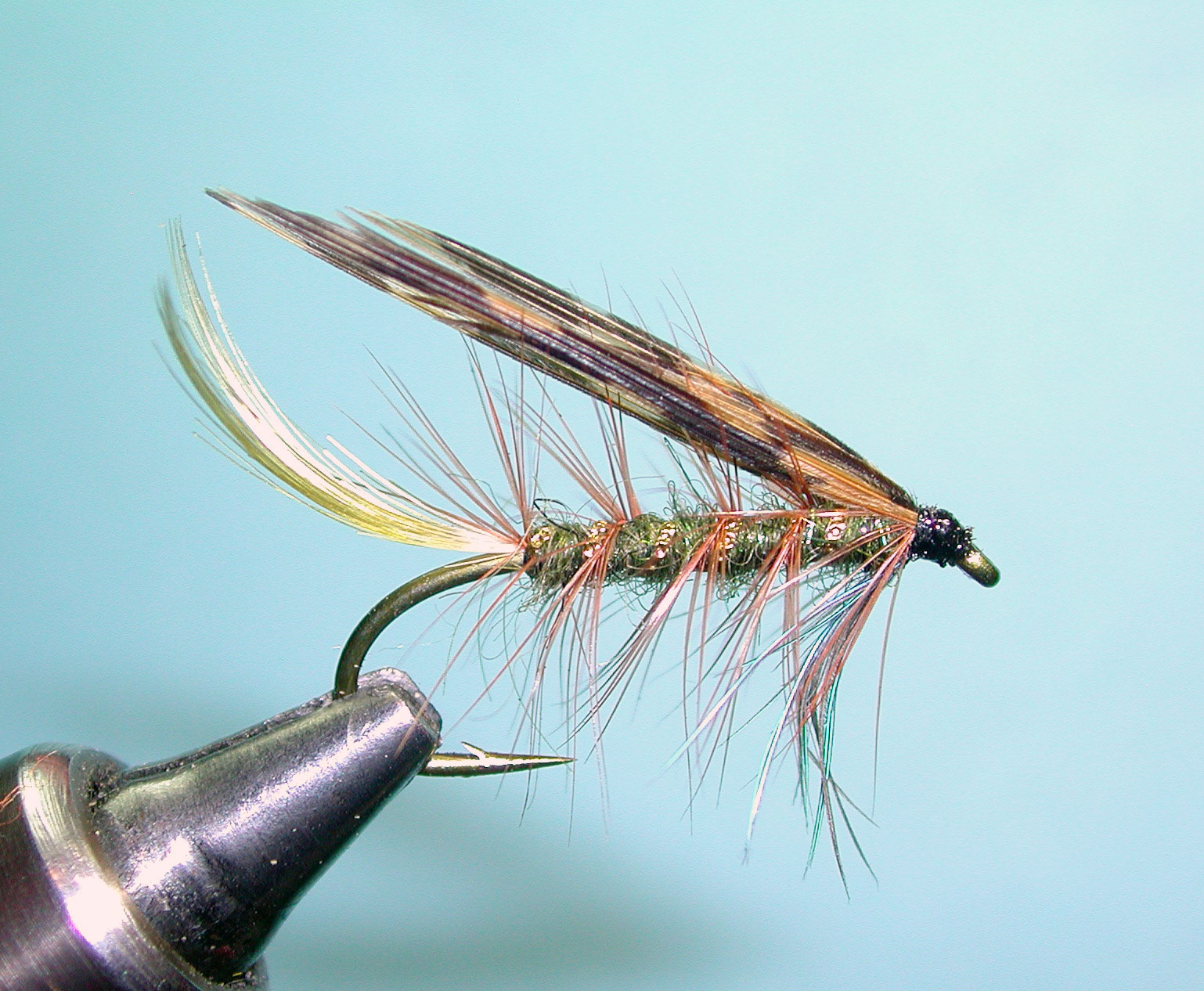
Gammarus
Haig-Brown recognized the importance of freshwater shrimp, also known as a “scud” in the diet of trout and salmon. He considered his pattern to be a simplification of the Golden Olive Salmon Fly tied in sizes 6-10. The English trout fly, Invicta, is also very similar. Haig-Brown used this pattern with great success in the Kamloop region on Paul Lake. The native shrimp, Gammarus limnaeus , flourishes in low temperature and ample oxygen water with some degree of alkalinity.
Tied on a Daiichi 1530 #6 hook
Tail: Small Golden Pheasant Crest Topping
Body: Olive Seal’s Fur, veiled by brown hackle wound over
Ribs: Oval Gold Tinsel
Throat: Blue Jay
Wings: Hen Pheasant Center Tail Strips
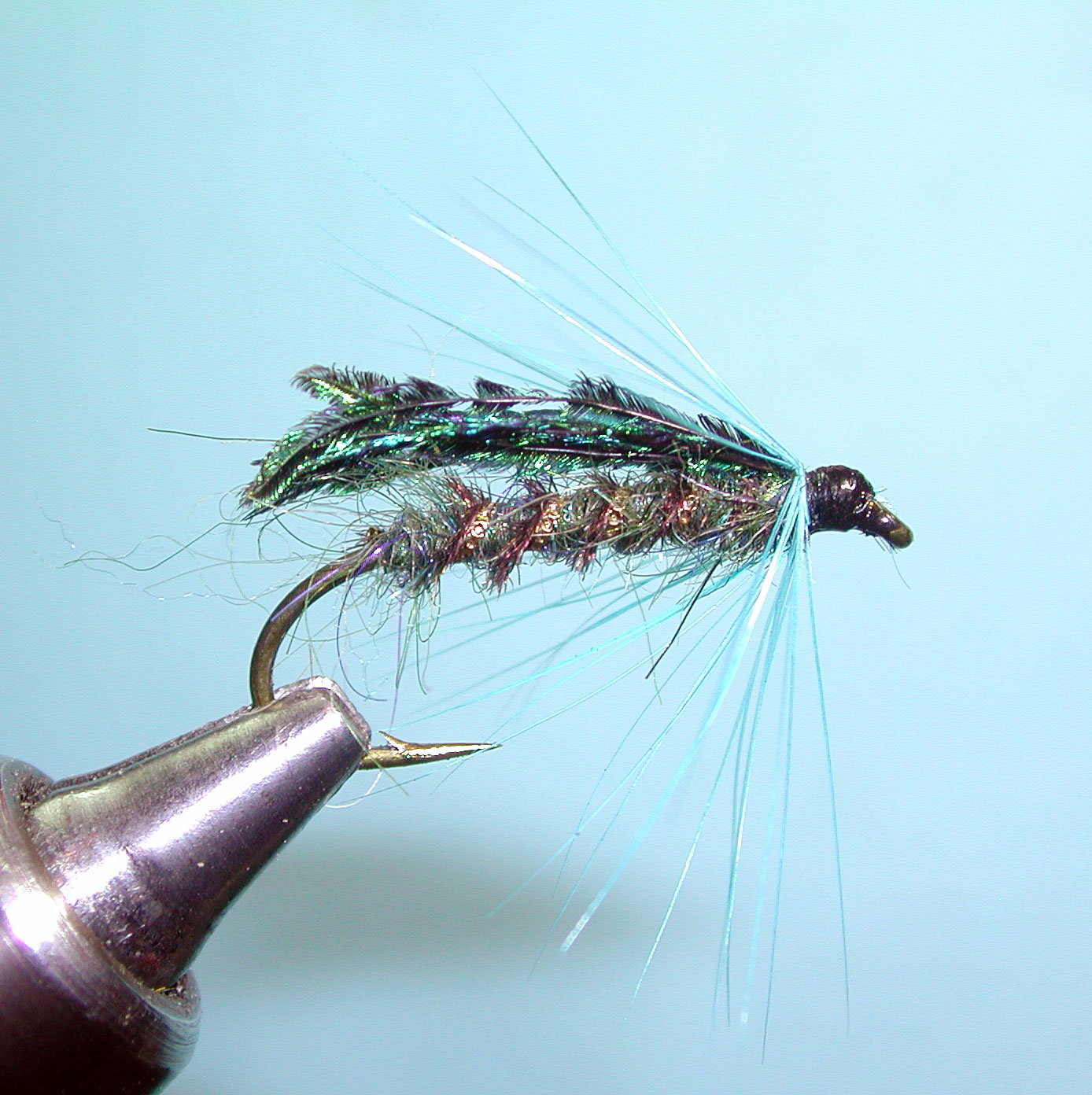
Cedar Borer
According to Haig-Brown, “This is a freak-looking fly, but trout in coast streams seem to take the brilliant blue-green borer beetles whenever they find their way into the water and it is rather comforting to have even the roughest imitation.” Usually tied on size 6-8.
Tied on a Daiichi 1530 #6 hook
Body: Mixed Emerald Green and Blue Seal’s fur. I’m using Arizona Simi Seal Peacock.
Ribs: Bronze Peacock Herl, Gold Thread. I’m using Art Lingren’s choice of Bronze Peacock Herl and a fine oval tinsel in Gold.
Wings: Green Peacock Sword
Hackle: Light Blue tied ahead of the wing.
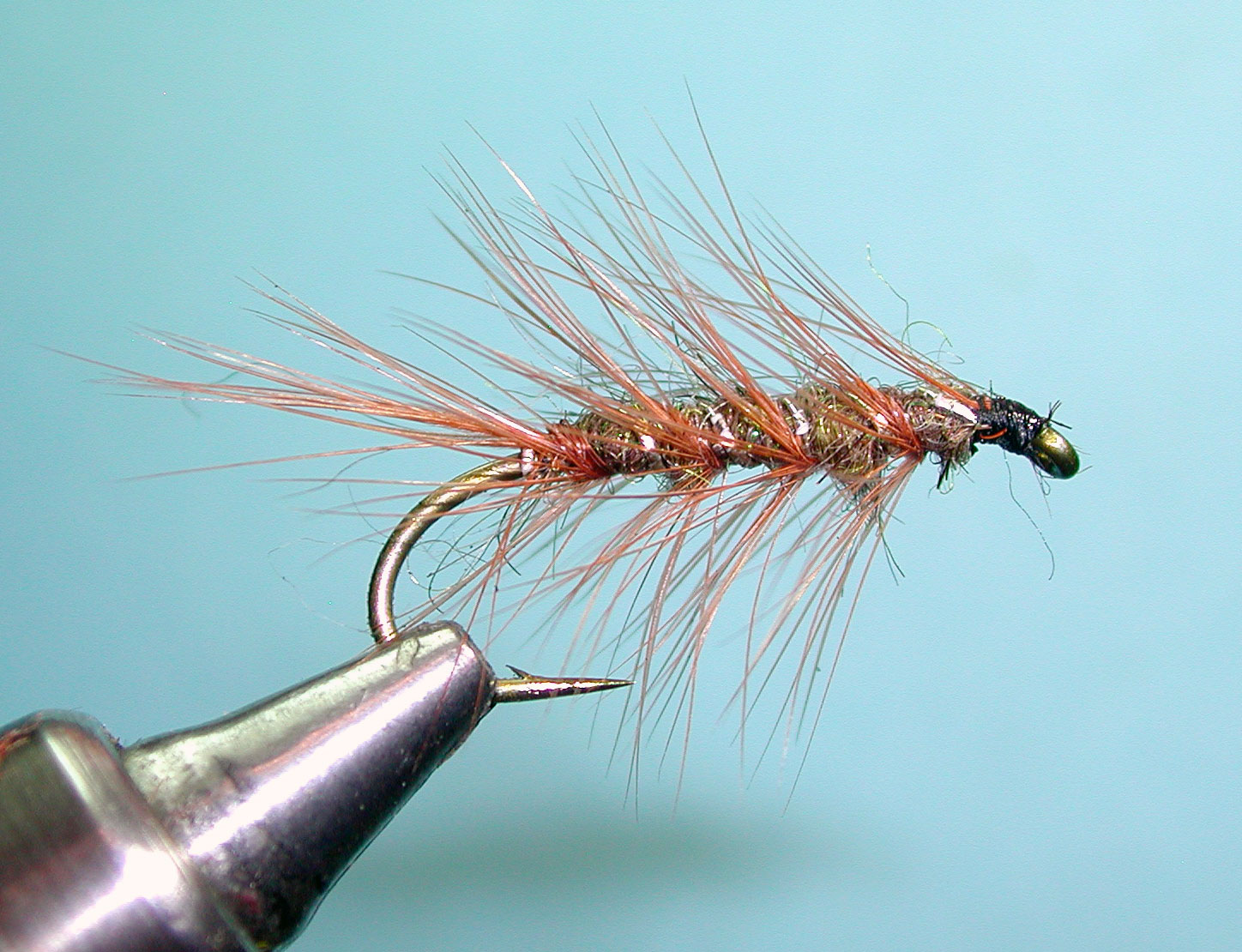
Brown Caterpillar
Caterpillar fly patterns go way back to the 1600’s when Isaac Walton in The Compleat Angler described the pattern as a rough body of either Black Spaniel’s fur or an ostrich feather and a red hackle over all. They referred to the pattern type as ‘Palmers”. During the Crusades, pilgrims would travel to the Holy Land carrying palm branches. They were called “palmers”. The observation extended to British caterpillars since they also travelled a great distance prior to creating their cocoons and they began to be called “Palmers” in England. Since the hackle wrapped around the dubbed body is reminiscent of the caterpillar it is this technique that became known a “palmering”.
Tied on a Daiichi 1530 #4-6 hook
Body: Olive Seal’s Fur. I’m using Simi Seal, Olive
Ribs: Oval Silver Tinsel
Hackle: Long soft dark red wound palmerwise. I’m using a Furnace Hen Neck Hackle.
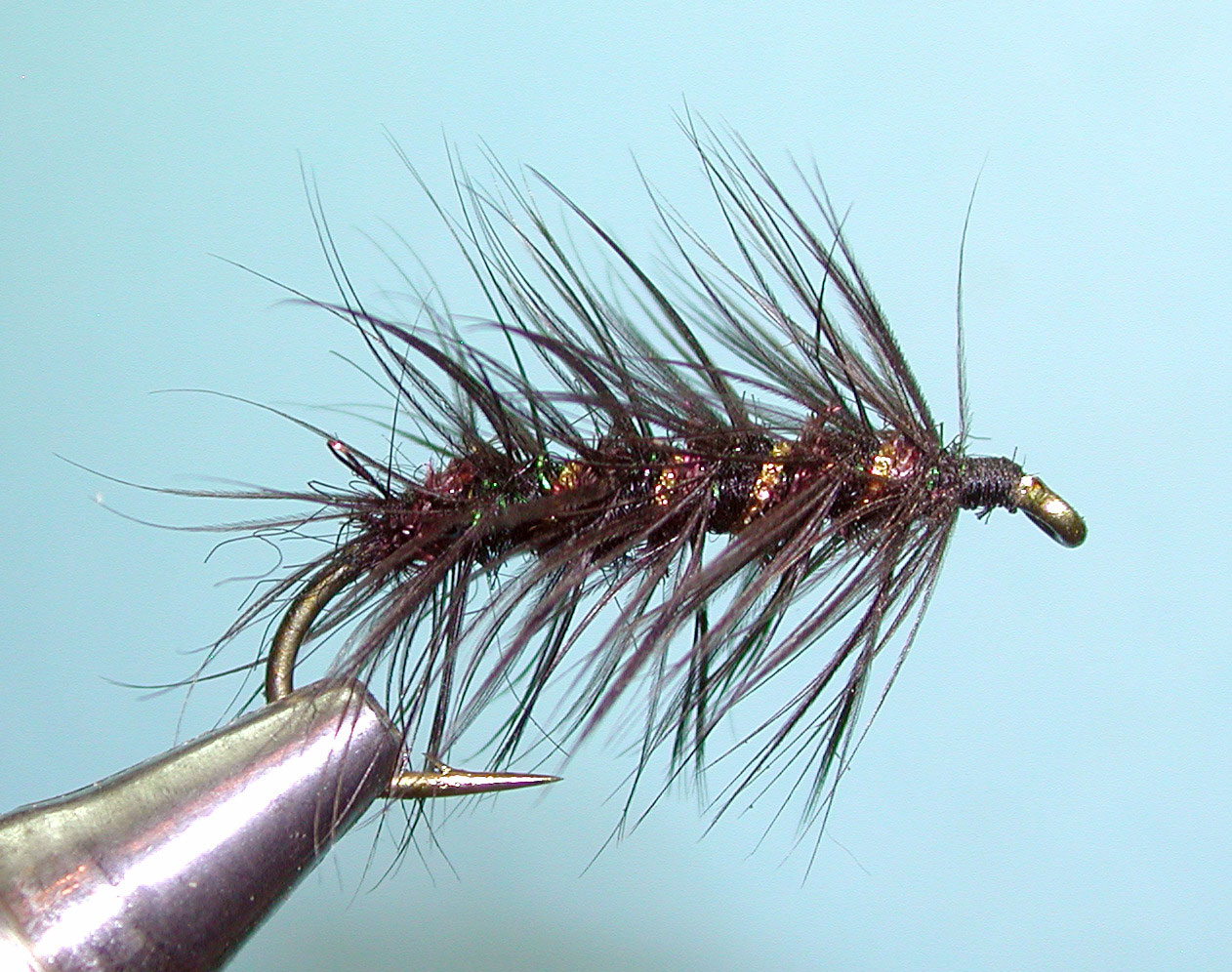
Black Caterpillar
Haig-Brown wrote in The Western Angler (1939), “This is the best flying-ant imitation I have ever used. Other caterpillars, tied in the same way with seal’s fur of different colors and matching hackles are also good. Orange and Fiery Brown particularly valuable.” He also wrote, “On the Campbell River, the main hatch is over in a single day, but there are a few ants on the water for several days after that, and the fish still take the bedraggled black fly better than anything else.”
Tied on a Daiichi 1530 #6-8 hook
Body: Black Seal’s fur. I’m using Black Peacock Simi Seal.
Ribs: Bronze Peacock Herl, Oval Gold tinsel
Hackle: Black wound palmerwise, or one side of any bronze feather wound palmerwise. Effect should not be too tidy. I’m using a Whiting Hen Cape, Black
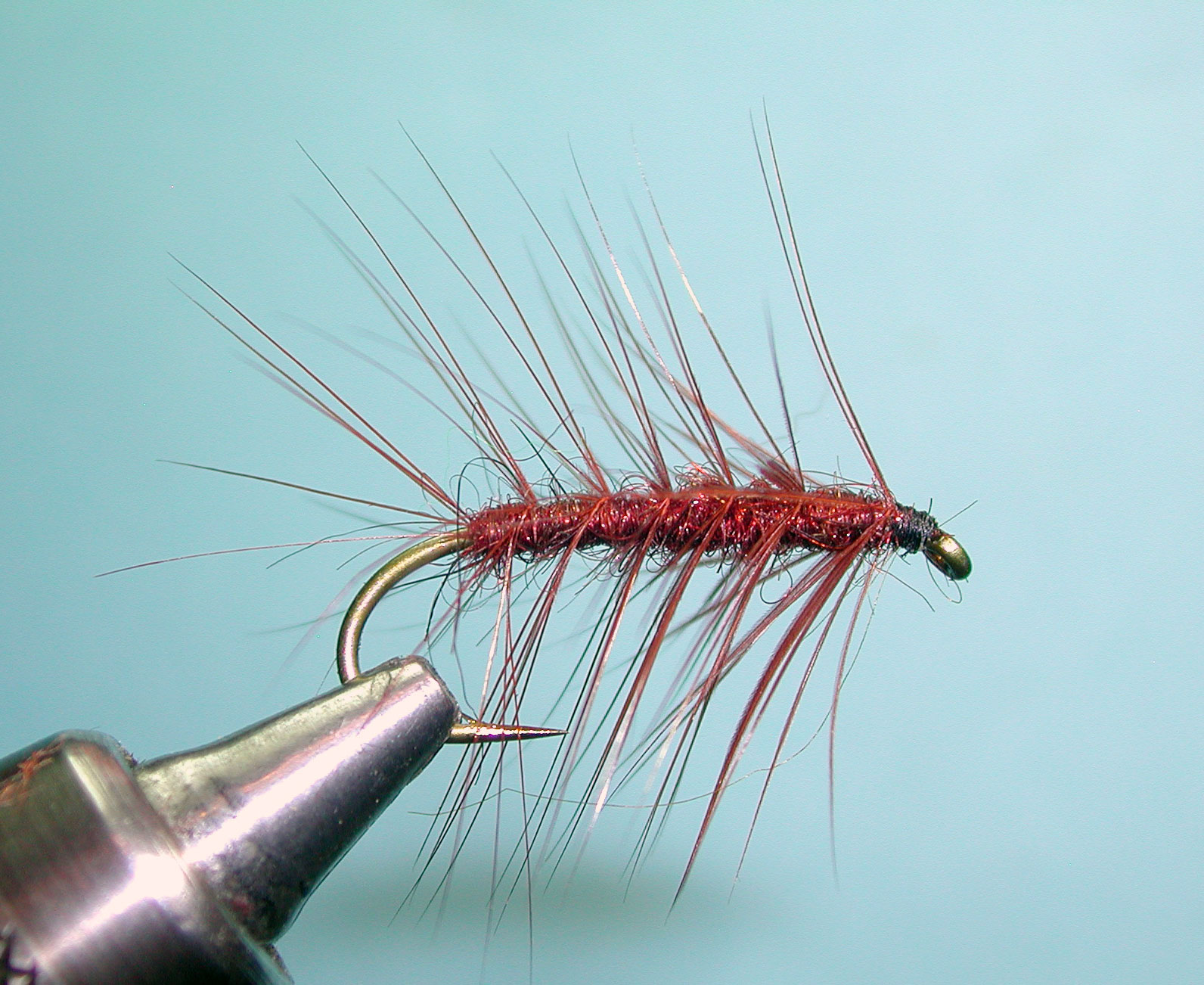
Fiery Brown Caterpillar
Tied on a Daiichi 1530 #6-8 hook
Body: Fiery Brown Seal Fur. I’m using Reddish Brown Simi Seal
Hackle: Fiery Brown, wound palmerwise. I’m using Coachman Brown Whiting American Saddle Hackle.
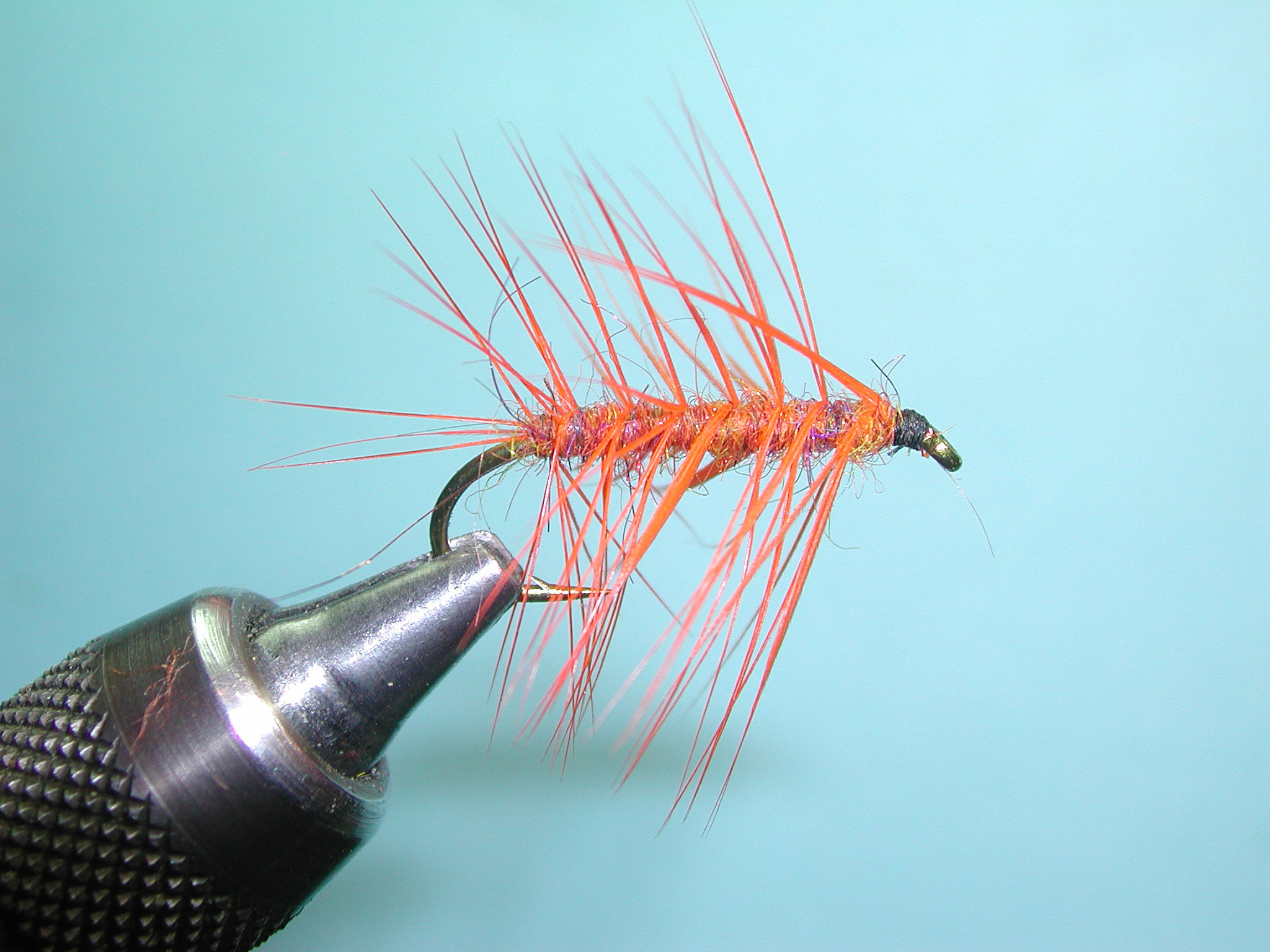
Orange Caterpillar
Tied on a Daiichi 1530 #6-8 hook
Body: Orange Seal Fur. I’m using Jorgensen’s SLF Sunset Orange dubbing.
Hackle: Orange, wound palmerwise. I’m using Orange Whiting American Saddle Hackle
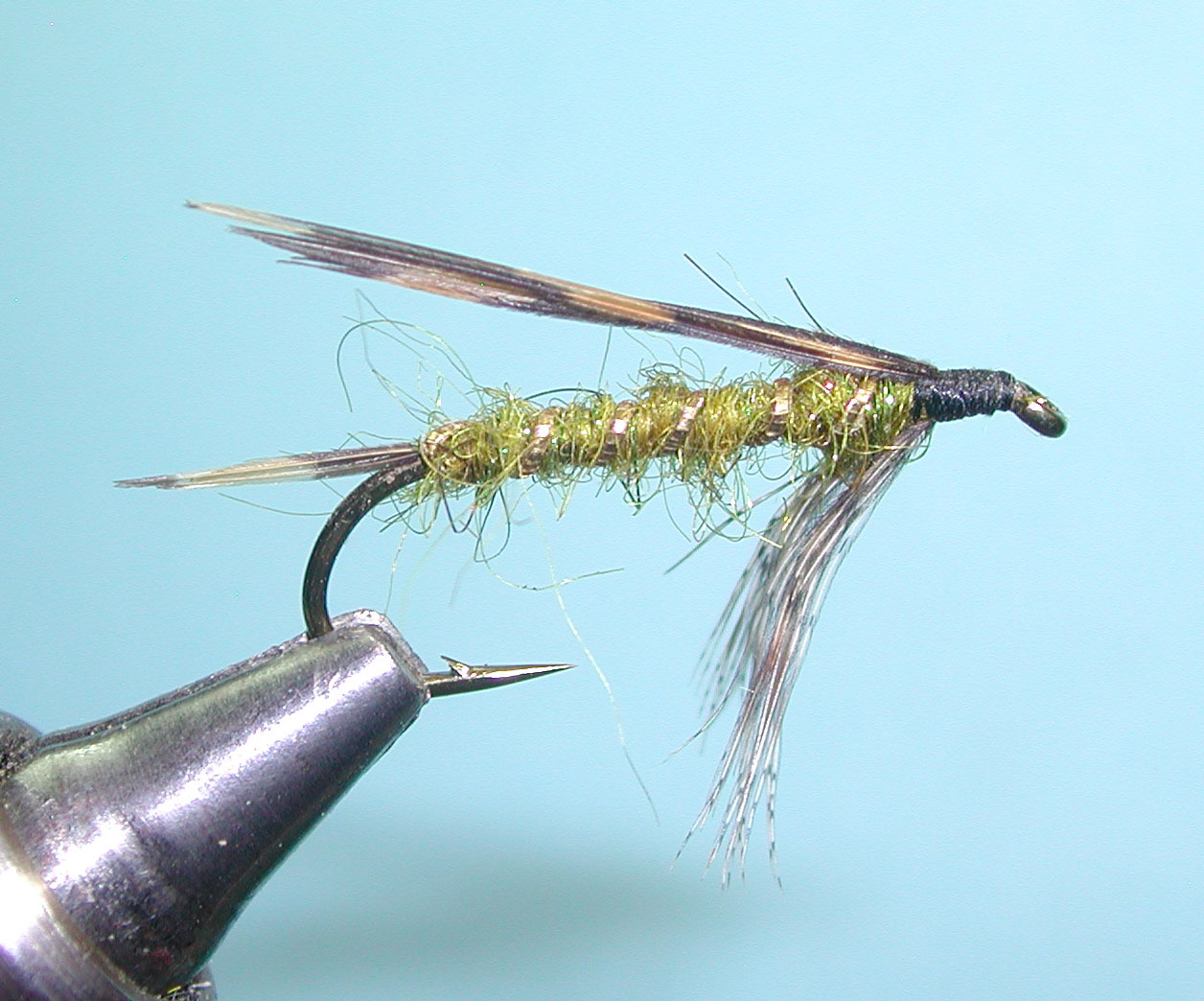
Perla
This is Roderick Haig-Brown’s pattern for stonefly nymphs. He wrote in Fisherman’s Spring (1951), “Perla is a fine big nymph, usually with a mottled, dark brown back and a vividly contrasting pale olive-green belly; the body flattened a little to work in the powerful currents of the rapids, and two long tails sweep back to tapered points.” Haig-Brown’s interpretation of the nymph focused on the back to be composed of Golden Pheasant Tail Feather slips set to lie flat over the body and recognition of the paleness of the underbody. He writes, “A thick body would be better, olive seal’s fur or primrose yellow or even bleached green, perhaps with ribs of gold to give it life.”
Tied on a Daiichi 1530 #8 hook
Tail: Golden Pheasant Tail feather
Body: Olive, Primrose Yellow, or bleached green seal fur to match local conditions
Ribs: Oval, Gold tinsel
Throat: Badger Hackle or Brown Partridge
Wings: Golden Pheasant Tail feather, set to lie flat over the body.
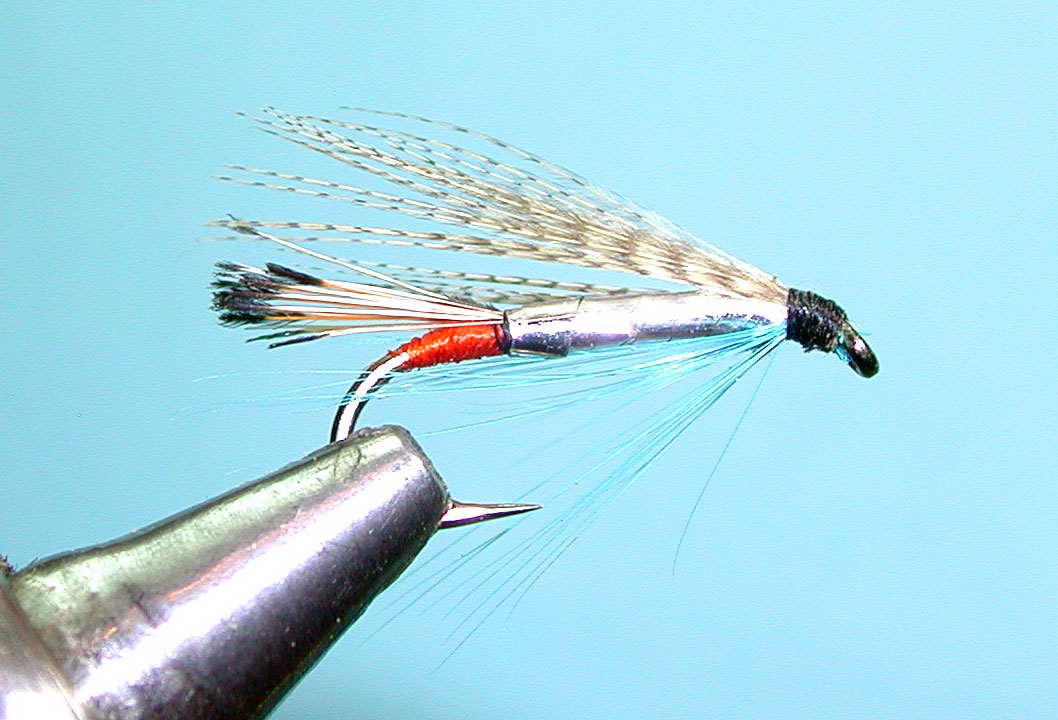
Mysid
Mysids are small transparent shrimp found within estuaries during the summer months. Haig-Brown developed this pattern as his first attempt and was pleased with the results. “The body was rather short for the hook size, and I hoped that its silver, with the lightly barred wing feathers, might give some illusion of transparency. On its first trial this fly securely hooked three of the small fish in quick succession, and I felt that the problem was solved; within an hour it had also taken a sixteen-inch Coho Jack and a cutthroat of the same size and I was inclined to believe I had solved all estuary problems for all time.” “I named the fly the Mysid and tied some more like it…”
Hook: Daiichi 1550 size 10-14
Tag: Orange Tying Silk
Tail: 5 strands of tippet
Body: Flat Silver Tinsel
Throat: Sparse natural blue, soft hackle
Wings: 2 slender strips of barred summer duck.
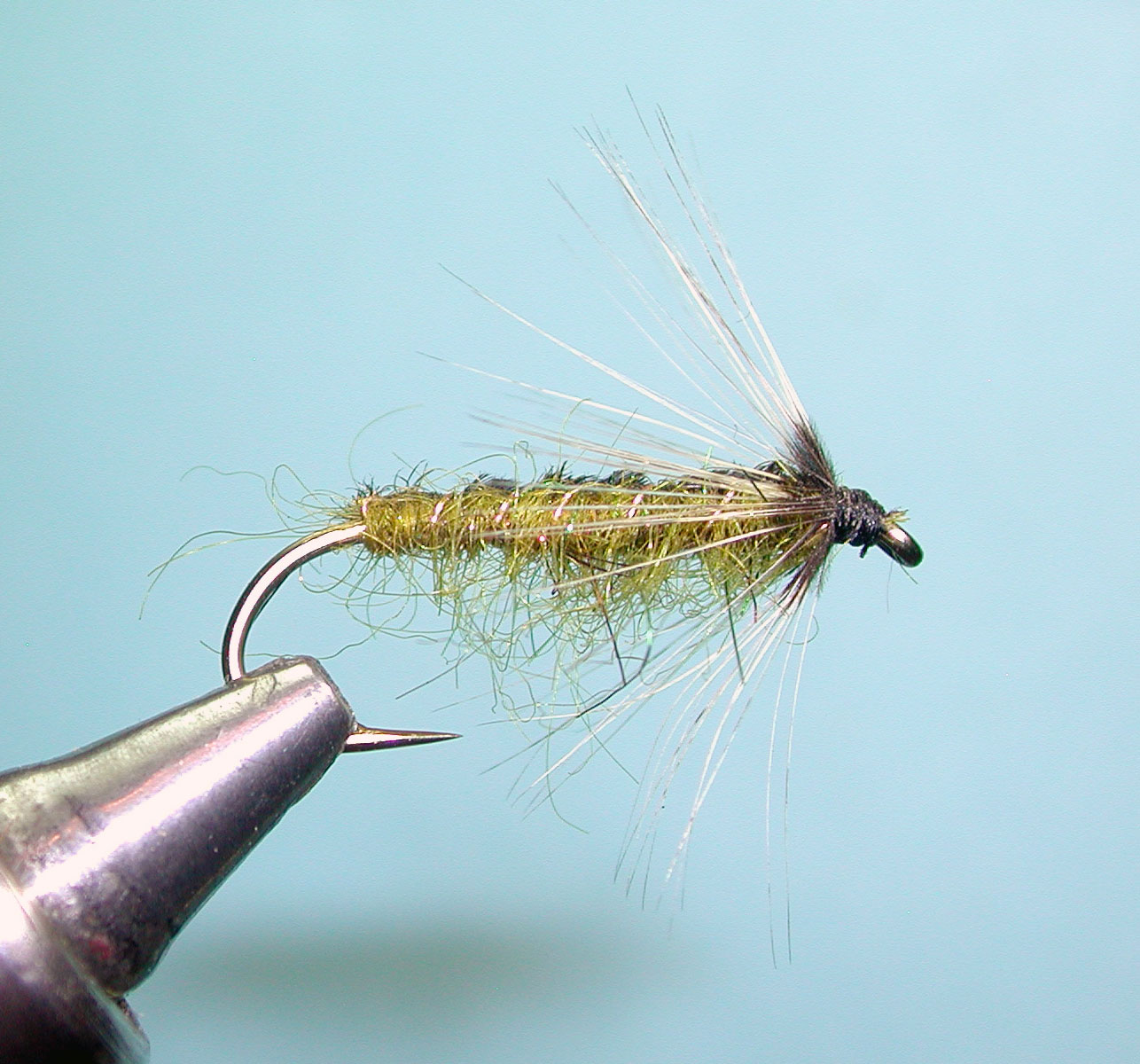
Asellus
The Asellus is a close aquatic relative of the terrestrial sowbug. It clings to wood and bark but swims swiftly on its back. Haig-Brown moved to this pattern after his Mysid attraction started to wane with the cutthroats. The Asellus pattern “was an immediate success and again this early success tapered off from the dramatic to the normal. Like the Mysid, the Asellus is a good, solid, effective pattern that I still tie and use often. Both flies take estuary cutthroats quite well at times and both have also taken cohos and pink salmon in estuaries; but it is equally true that both have taken fish well in fresh water, miles away from any natural mysids or asellus and I find myself wondering whether the estuary cutthroats take them because they look a lit bit like the creatures they are supposed to represent, or simply because they are there in front of them and look like something that might be good to eat.”
Hook: Daiichi 1550 size 8
Body: Olive Seal Fur, Thick
Ribs: Fine Gold Wire, wound over the back and body after the back is secured at the head.
Back: Peacock Sword, tied in at the hook bend and at the eye.
Throat: Badger Hackle
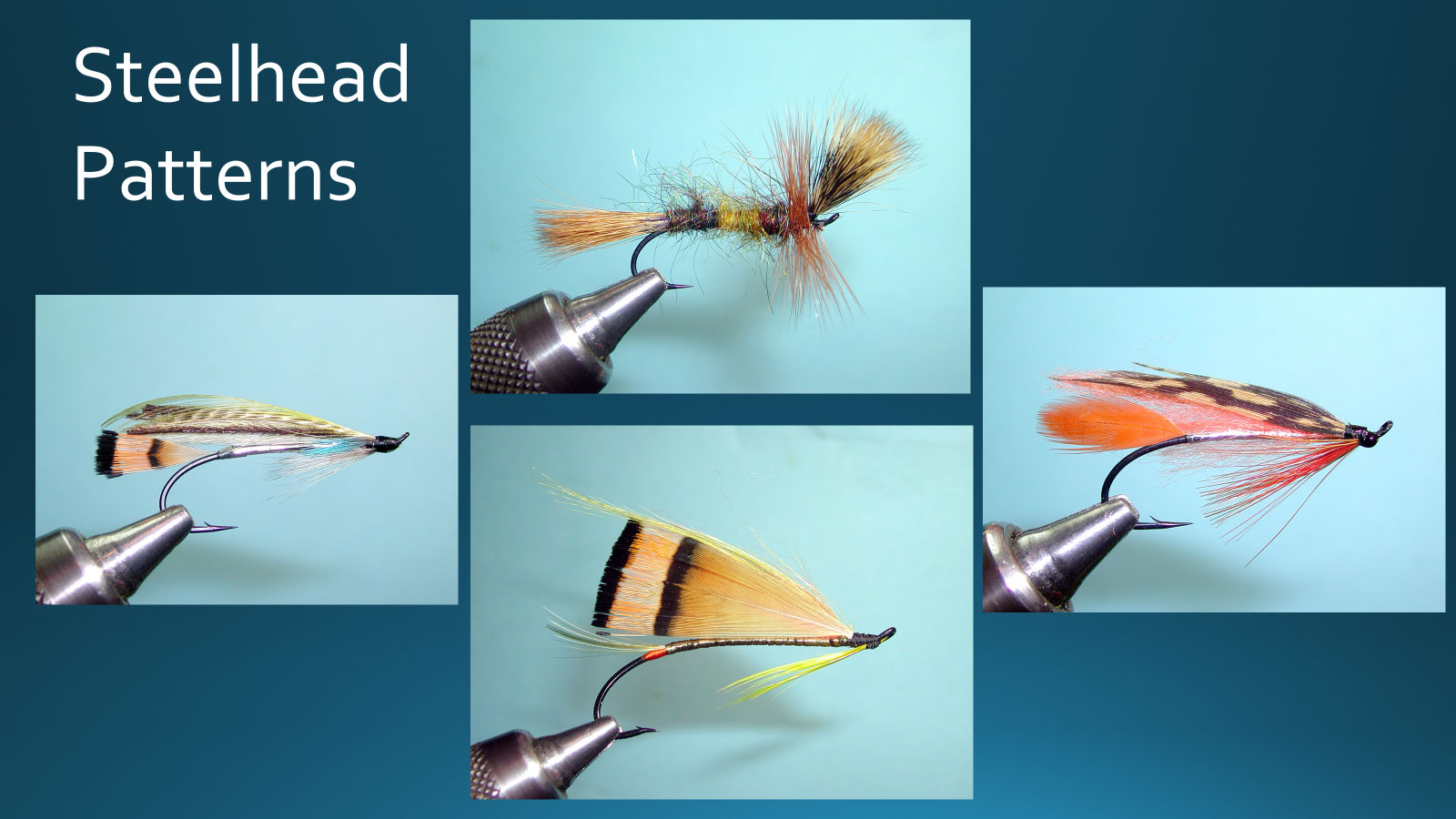
Steelhead fishing was Haig-Brown’s favorite time, particularly on the Campbell River. He developed some beautiful patterns in the 1930’s with the Silver Lady and Silver Brown. Both of these flies being salmon fry imitations. After World War II, Haig-Brown desired to create steelhead flies using the foundations of the Atlantic Salmon patterns and came up with The Golden Girl, his only attractor pattern. Later, in the 1950’s, Haig-Brown created one of the first steelhead dry flies with his Steelhead Bee. This may have been his most popular fly pattern.
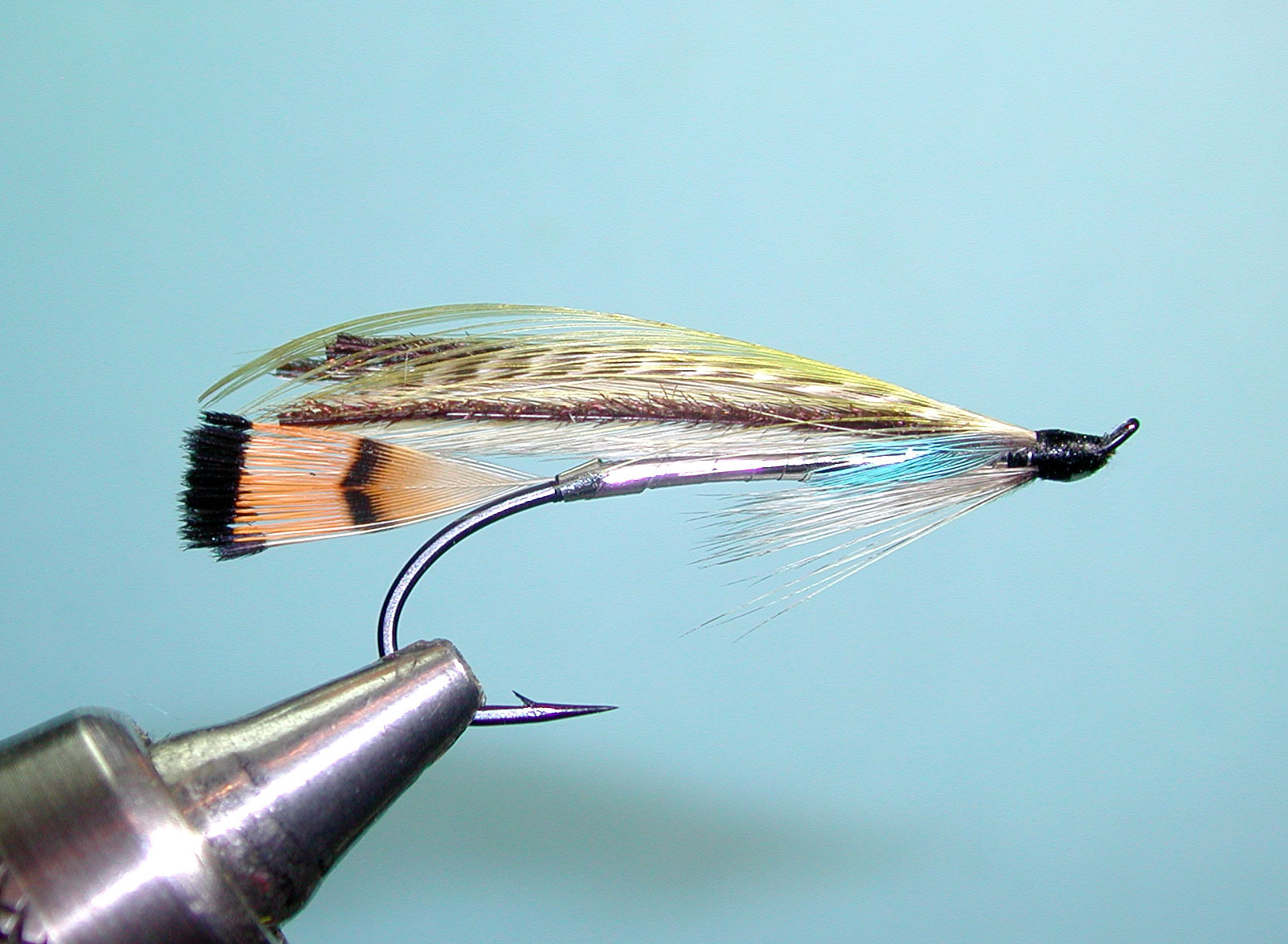
Silver Lady
This is an early Haig-Brown pattern from the 1930’s. In The Western Angler (1939) Haig-Brown cites that the Silver Lady is “excellent for summer steelhead either as an ordinary wet fly or a greased line fly. Also takes cutthroat trout very well.” Haig-Brown also cites in his book, Fisherman’s Spring (1951) that the two patterns that persist over time for a minnow pattern has been the Silver Lady and Silver Brown. The Silver Lady “is an early season fly, effective for feeding trout when spring or dog salmon are abundant. So far as I can judge its essentials are the silver body and the wing that combines pale blue with some light barred feather such as teal, wood duck, or light mallard. I usually add a badger hackle and a whole feather tail of pale pink or orange.
Hook: A low-water hook number 6 or larger, I used a Daiichi 2421 #6
Tail: Tippet (small whole feather)
Body: Flat Silver
Hackle: Badger
Wings: 4 strands bronze peacock herl, teal strips, badger hackles laid along these, topping over all
Alternative Wing: 2 Blue Hackles, good sides out, paired strips, golden pheasant center tail, barred summer duck. Topping over.
Cheeks: Pale Blue Chatterer. I used Kingfisher.
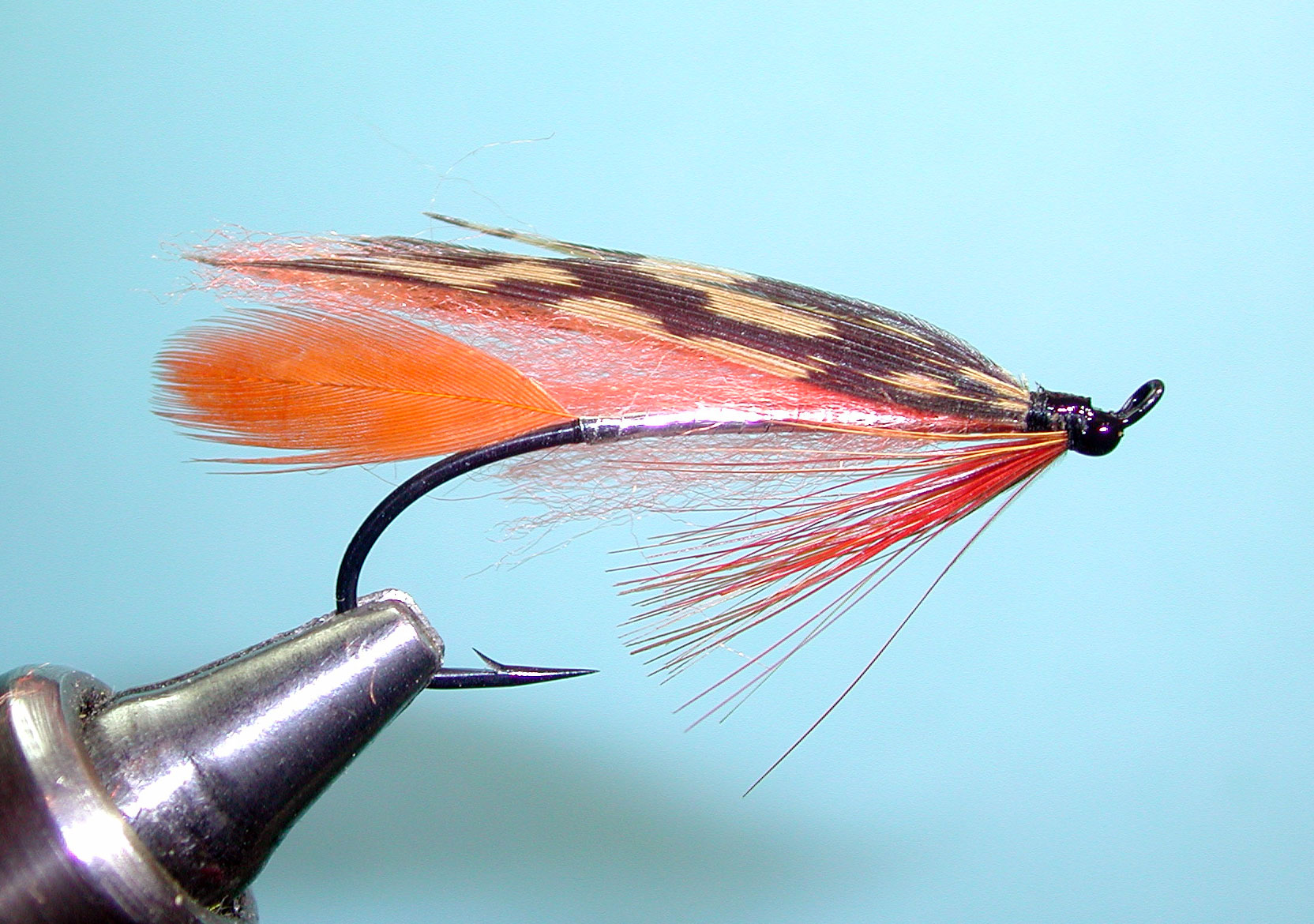
Silver Brown
Haig-Brown cites the Silver Brown and Silver Lady as two patterns that have persisted over time as an excellent minnow pattern. The Silver Brown was designed in the 1930’s as an imitation of coho and cutthroat trout fry. From The Western Angler (1939) “The dressing which I have given in many other writings is very simple: Indian Crow Tail, Silver Body, natural red hackle, wings of golden pheasant center tail enclosing orange bear fur.” “It fishes best in low summer water, when most fry except the cutthroats and cohos have left the river, and at that time should be worked very slowly, just under the surface. It is just as likely to move a ten- or twelve-pound steelhead at such times as a two- or three-pound cutthroat, is steelhead are in the stream.”
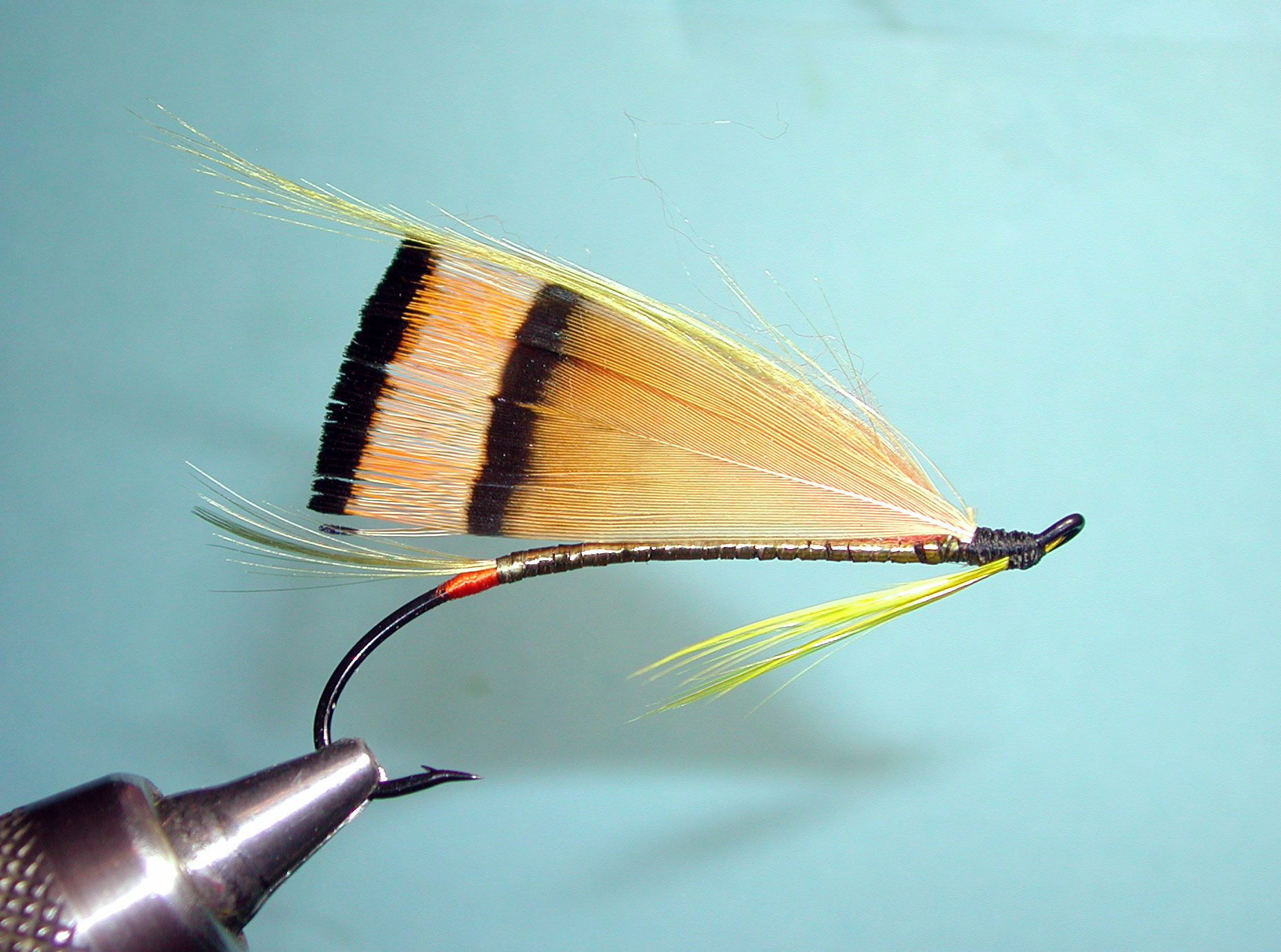
Golden Girl
During World War II, Haig-Brown enlisted into the Canadian Army in 1941 and was stationed in British Columbia. His focus was within the military but his thoughts were about the ideal winter steelhead pattern. He wanted to take the aspects of the fully dressed Atlantic Salmon fly and apply those features to a Winter Steelhead pattern. The colors of Orange and Red were considered to be a preference for the steelhead and Haig-Brown came up with the Golden Girl using a full tippet feather for the wing.
Hook: Number 2 to 2/0 Salmon hook
Tag: Orange Tying Silk
Tail: Two small golden pheasant crest feathers
Body: Flat or Oval Gold Tinsel
Throat: Yellow Hackle
Wing: Two large black barred orange golden pheasant tippet feathers enclosing orange polar bear fur with a golden pheasant crest feather over all.
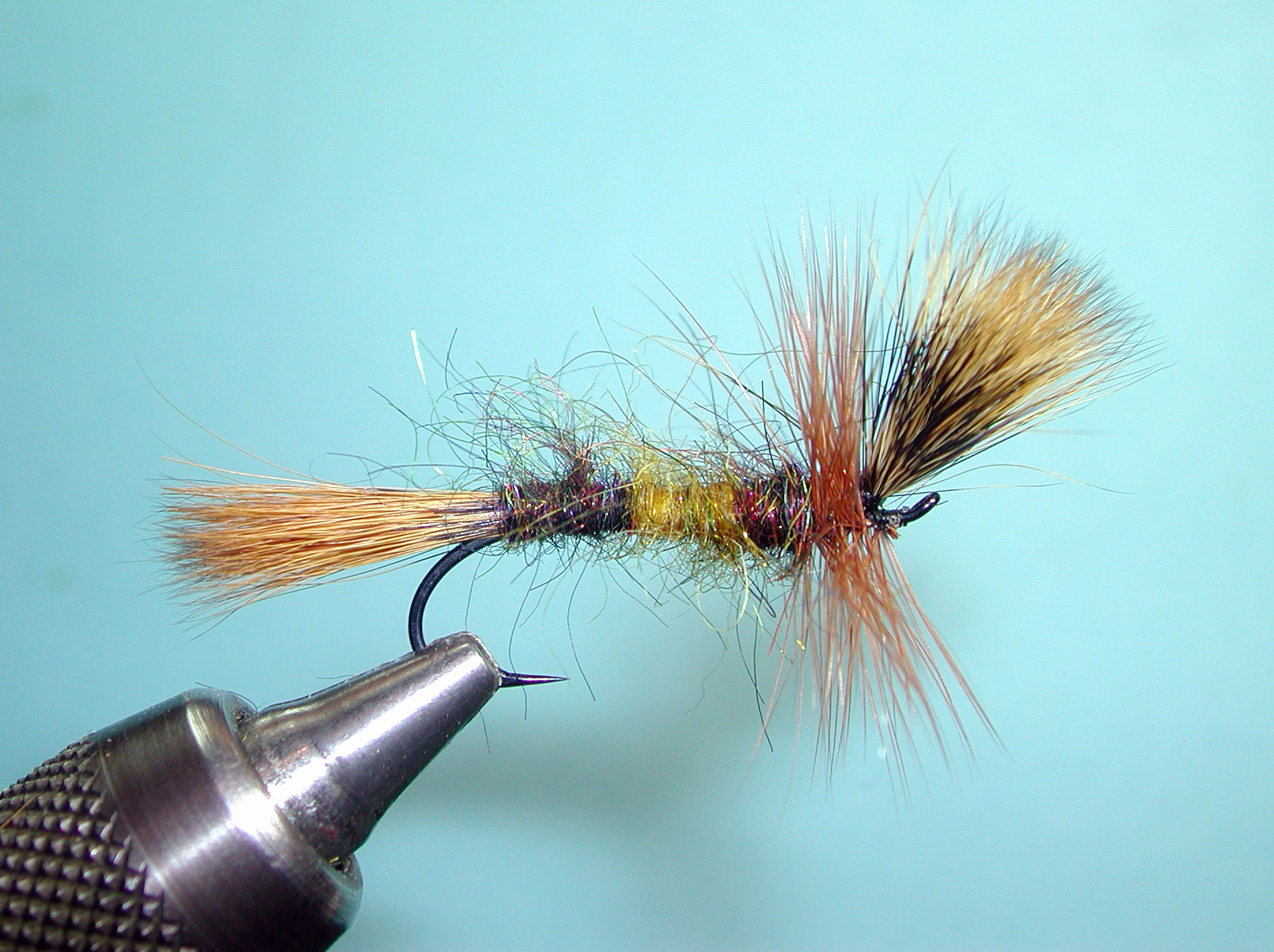
Steelhead Bee
This is a later pattern of Haig-Brown designed in the Autumn of 1951. Haig-Brown wrote of this pattern in Fisherman’s Summer (1959) “I started in at the lower end of the bar in the Main Island Pool with 2x gut and a new fly pattern – a variation of the MacKenzie River Brown and Yellow Bug, tied Wulff fashion with fox squirrel wings and tail on a No. 6 hook.” Haig-Brown did not name the pattern until he wrote Fisherman’s Fall (1964) “Most of my fish have been taken on a No.8 hook with a dressing I now call the Steelhead Bee….There is nothing sacred or mystic about this dressing, except perhaps its general shape and coloration. Other brown hairs than fox squirrel may be used and I have often used them. The body may be made of fur dubbing instead of silk and the hackle could equally well be ginger or honey.”
Roderick Haig-Browns writings of the Steelhead Bee, reintroduced and popularized a dry fly presentation to the summer steelhead during the 1960’s.
Hook: No 2 to 10
Tail: Fox Squirrel, quite bushy
Body: Equal sections of dark brown, yellow and dark brown – silk, wool, or seal fur.
Hackle: Natural Brown, Ginger, or Honey, Sparse
Wings: Fox Squirrel , quite bushy, set slightly forward and well divided.
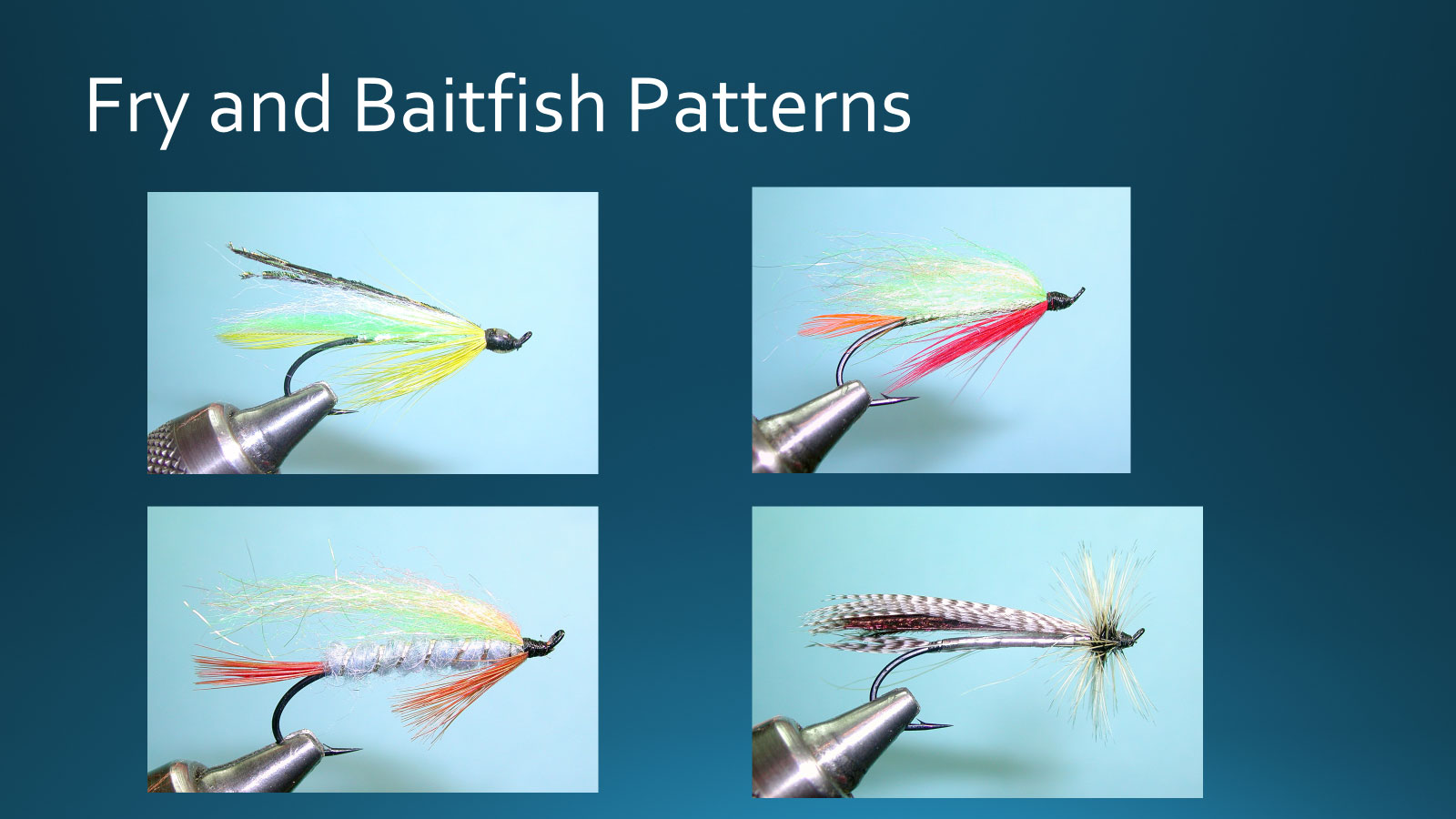
After World War II, in the later 1940’s Haig-Brown designed two fry patterns for Steelhead and Salmon, the Humpback Fry and the General Fry. During this time period, Haig-Brown also designed the Stickleback as a baitfish pattern. Another baitfish pattern, the Bullhead, goes back to his earlier days of the 1930’s and some consider this pattern to be one of the first sculpin patterns tied in British Columbia.
Humpback Fry
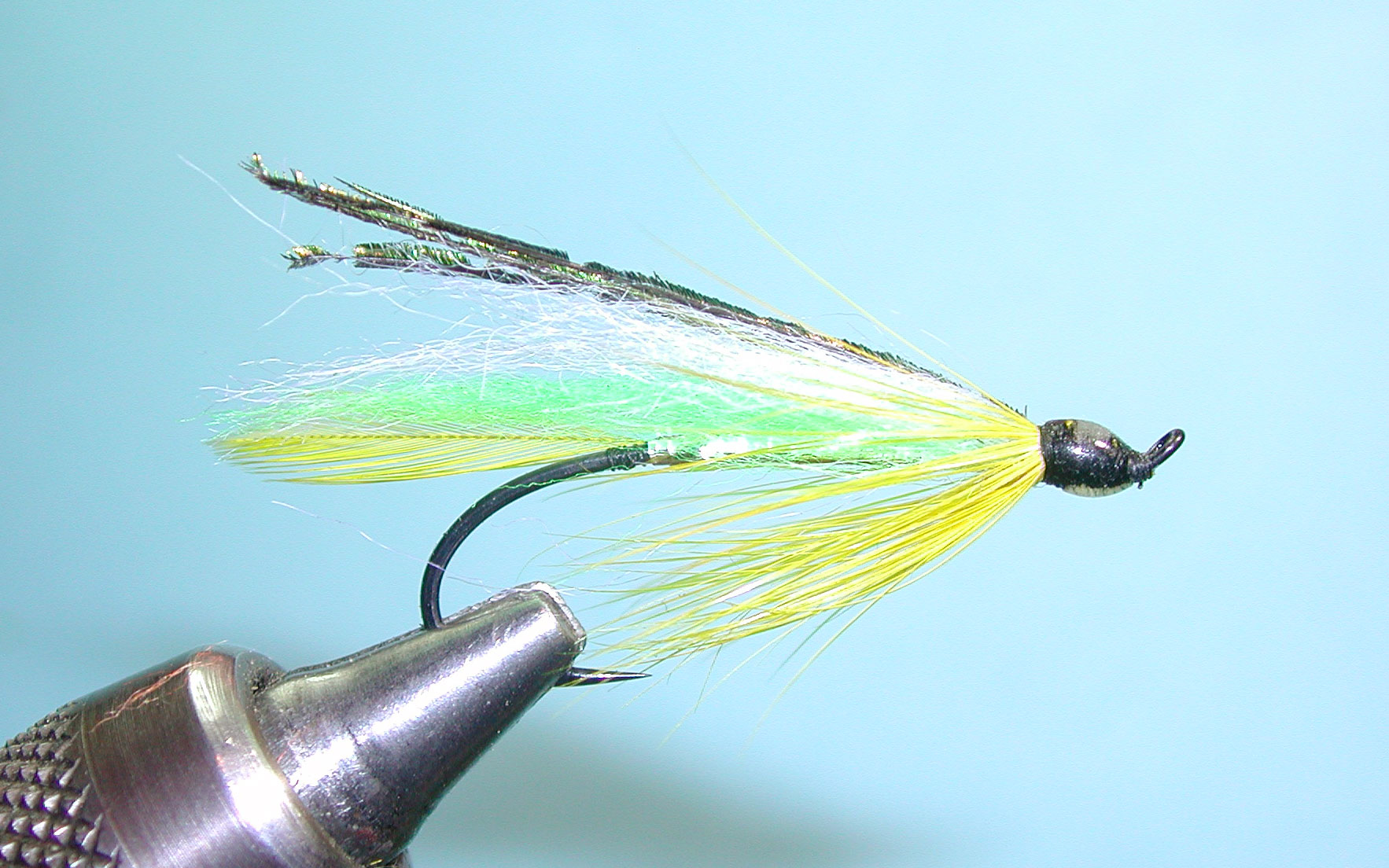
The pattern was described in Haig-Browns book The Fisherman’s Spring (1951). It is a continuation of creating a fry pattern that is a food source for steelhead based upon the Pink or “Humpback” salmon that spawn and their fry that emerge in the Spring. He writes, “This is an effective fly when the humpback fry are going down in good numbers, and it has also caught fish, including steelhead and coho salmon, for me much later in the season. I should like to find a wing still more brilliantly blue and silver, but I think this fly will always take trout that are feeding on fry or minnows without heavy markings or strong colors.
Hook: Low-water, #8. I use a Daiichi 2441 #8
Tail: Yellow Hackle fibers
Body: Flat, silver tinsel
Throat: Yellow Hackle
Wing: Mixed, dyed blue and green polar bear fur with a few strands of peacock sword over top
General Fry
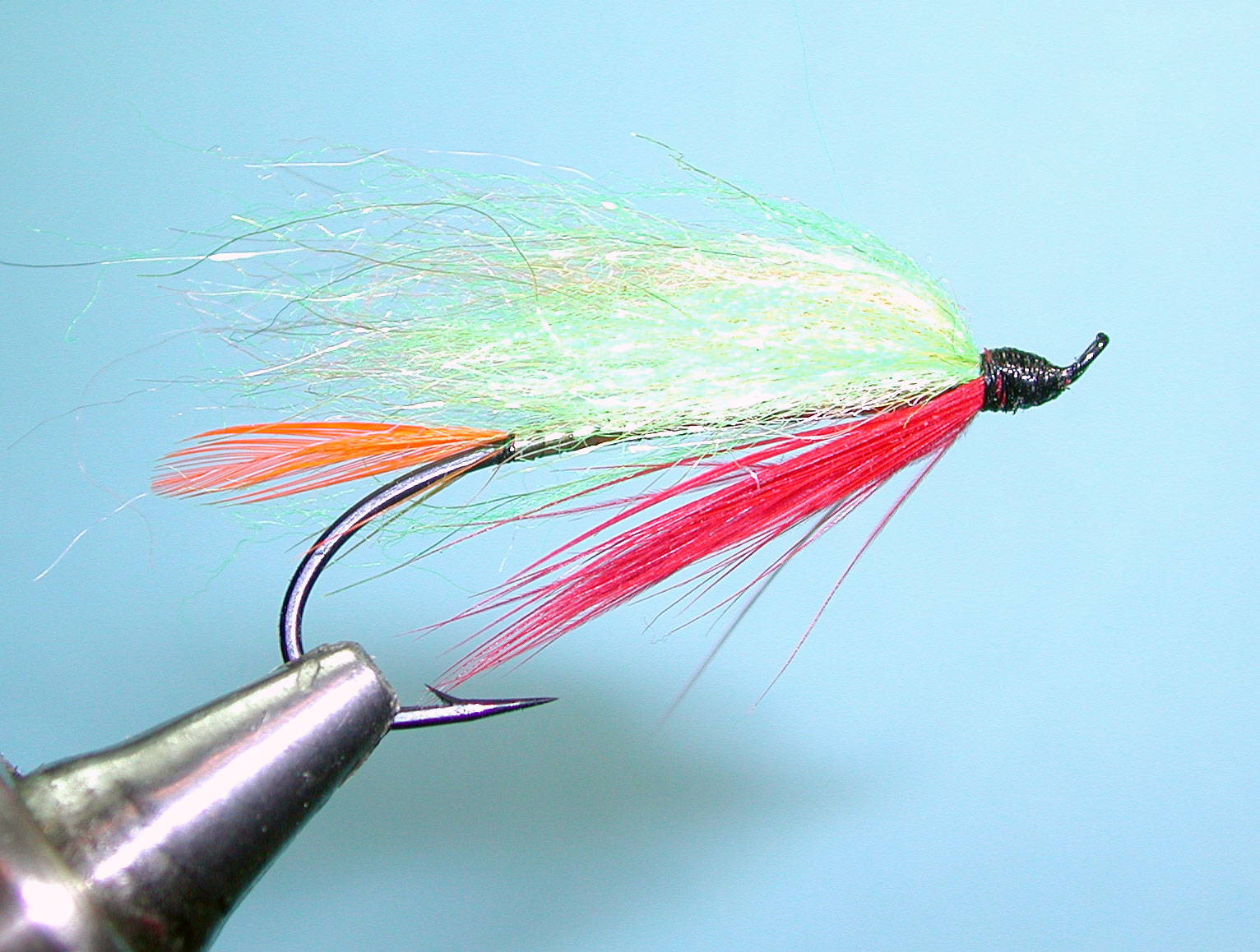
Haig-Brown tried to develop a general-purpose fry imitation. With the General Fry, the adaptation to different natural fry would be the hook size and the quantity of material placed for the wing.
Hook: Low-water, size 4-6. I’m using the Daiichi 2441 size 6
Tail: Small, pale, red, or orange feather
Body: Flat, Silver Tinsel
Throat: Small, Scarlet hackle
Wing: Mixed, not layered strands of dyed orange, yellow, blue, green and some white polar bear fur.
Stickleback
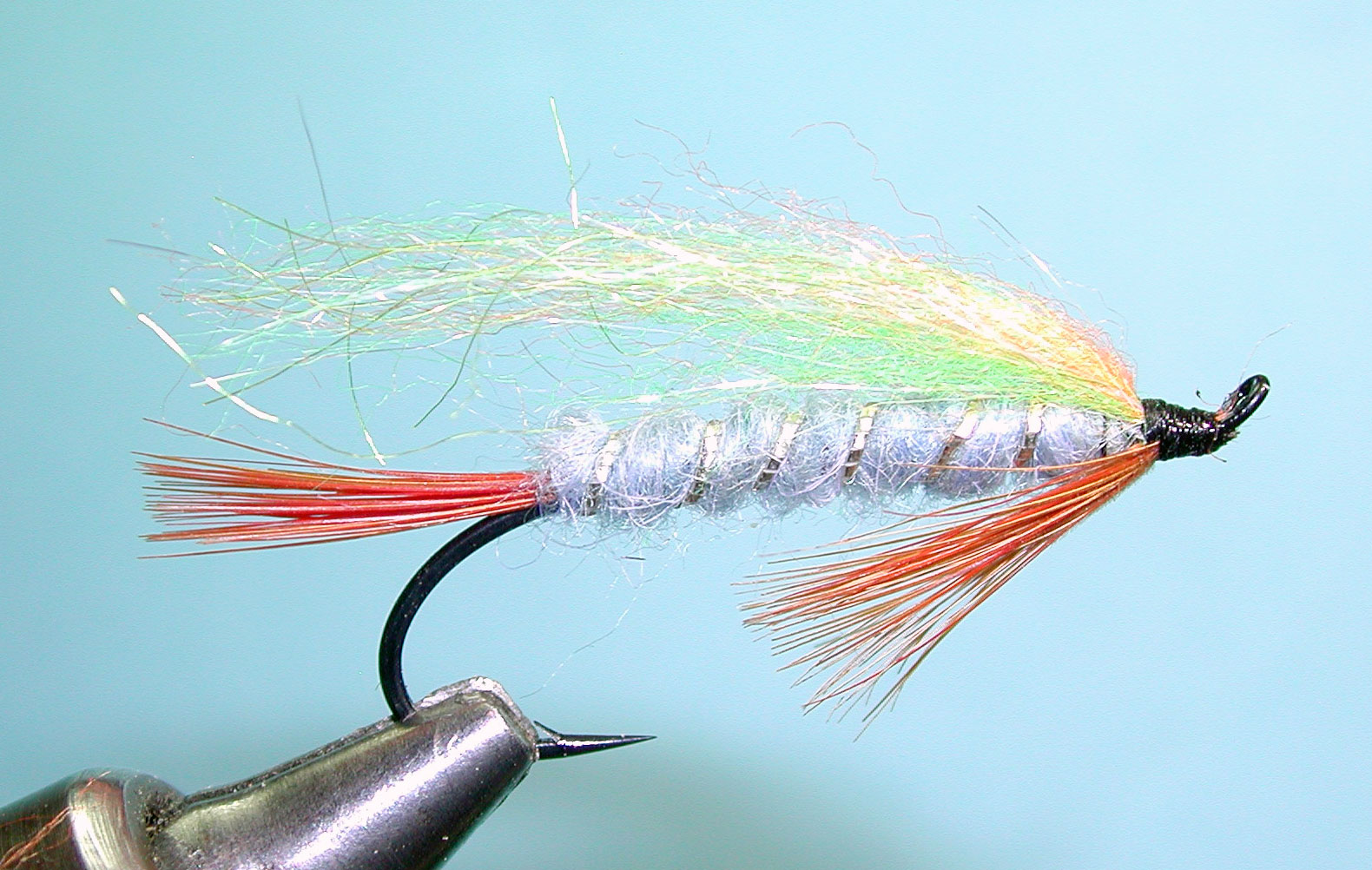
The Stickleback is another pattern described in his book Fisherman’s Spring (1951). The Stickleback will “interest big trout in the early part of the season in a way that nothing else does. This pattern “catches fish convincingly and consistently”.
Hook: Low-water, size 4-6
Tail: Claret Hackle fibers
Body: Silk or Wool. Very light green or a good blue.
Ribs: Oval, Silver Tinsel
Throat: Claret hackle
Wing: Sparse Polar Bear fur – mixed orange, blue, green, yellow or olive.
Bullhead
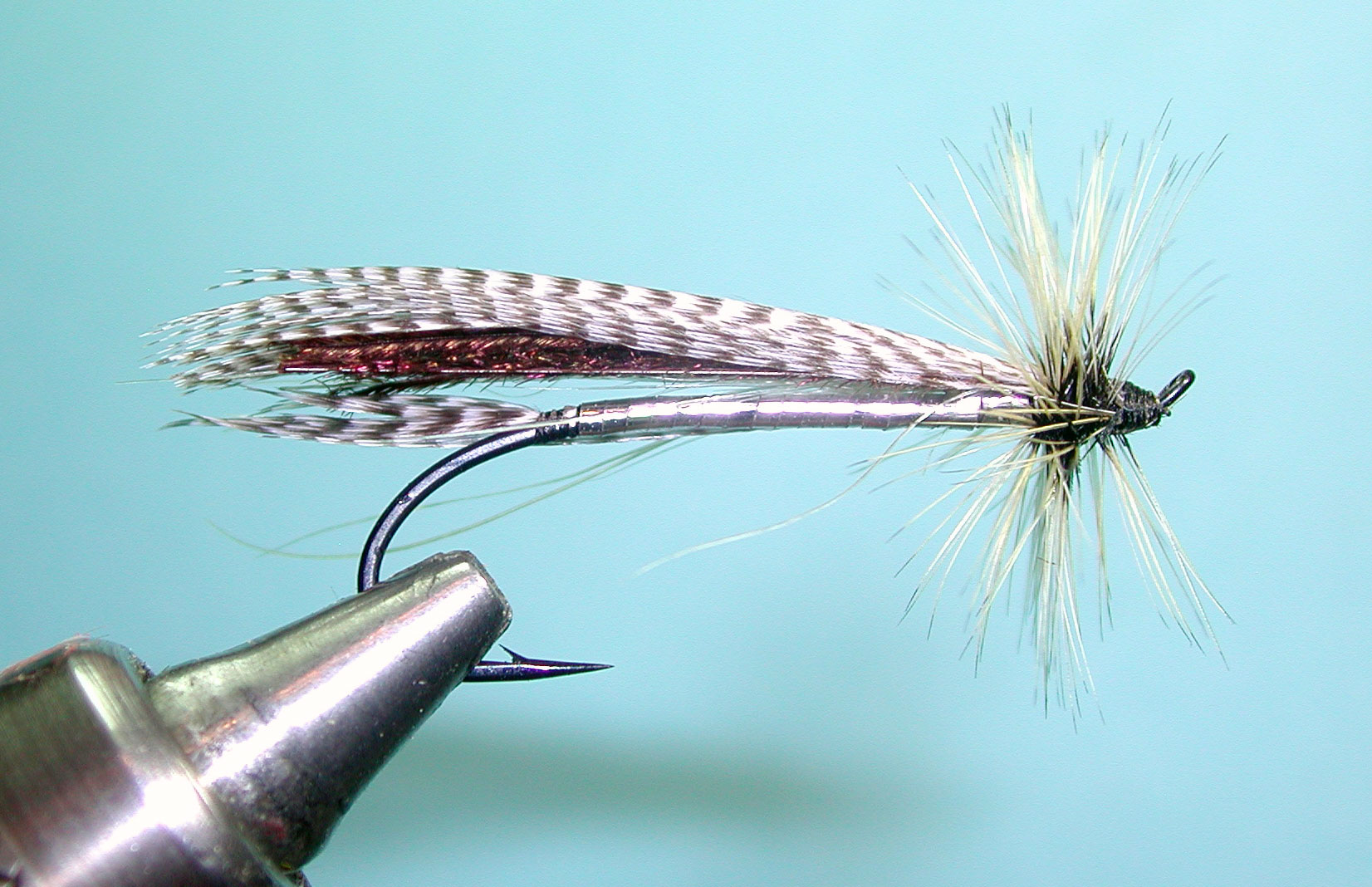
The Bullhead is a sculpin that is found throughout British Columbia lakes and streams. Haig-Brown was one of the first fly tiers to imitate this baitfish as listed within his book, The Western Angler (1939).
Hook: Low-water, size 4-6. I’m using a Daiichi 2441 #6
Tail: Light Mallard
Body: Flat Silver Tinsel
Wings: Light Mallard, thick, enclosing 4 strands bronze herl. Sometimes also a few polar bear hairs
Hackle: Badger, heavy, set ahead of wings and standing stiffly out from the shank of the hook. May be varied with dark red, claret or blue hackle
Conclusion
My appreciation goes out to Art Lingren who wrote Fly Patterns of Roderick Haig-Brown in 1993 with Frank Amato Publications. I bought my copy about twenty years ago and always had on my bucket list to tie each of his patterns. The book is fairly rare these days but some can be found on the internet. Art followed up in 2008 with another book, Fly Patterns of British Columbia: The Roderick Haig-Brown Centenary Edition, which covers all of these Haig-Browns patterns but also the flies of his friends that influenced him, Tommy Brayshaw, General Noel Money, and Bill Nation.
Happen to find your your site while looking for Haig-Brown patterns. Have you seen the yellow fly he tied for a contest for the steelhead society in 1994.I have the article in flyfishing vol17 no. 1. March April 1994
Ernest, Thank you for sending me the contest announcement from the “FlyFishing Magazine” of Amato publications. The fly was donated by an unnamed angler in “memory of Jack Eschenmann, angler, fly fisherman, and gentleman”. Bob Ververka had a letter of authenticity to accompany the fly. The fly appears to be a fully hackled wet fly using yellow dyed Hen Saddle over a red thread body. Haig-Brown was known to tie simple, yet effective, patterns. Thanks for sharing the photo with me.
Steve